
Gwangju Biennale’s Taiwan Pavilion Puts AI, Digital Memory and Geopolitics in the Spotlight

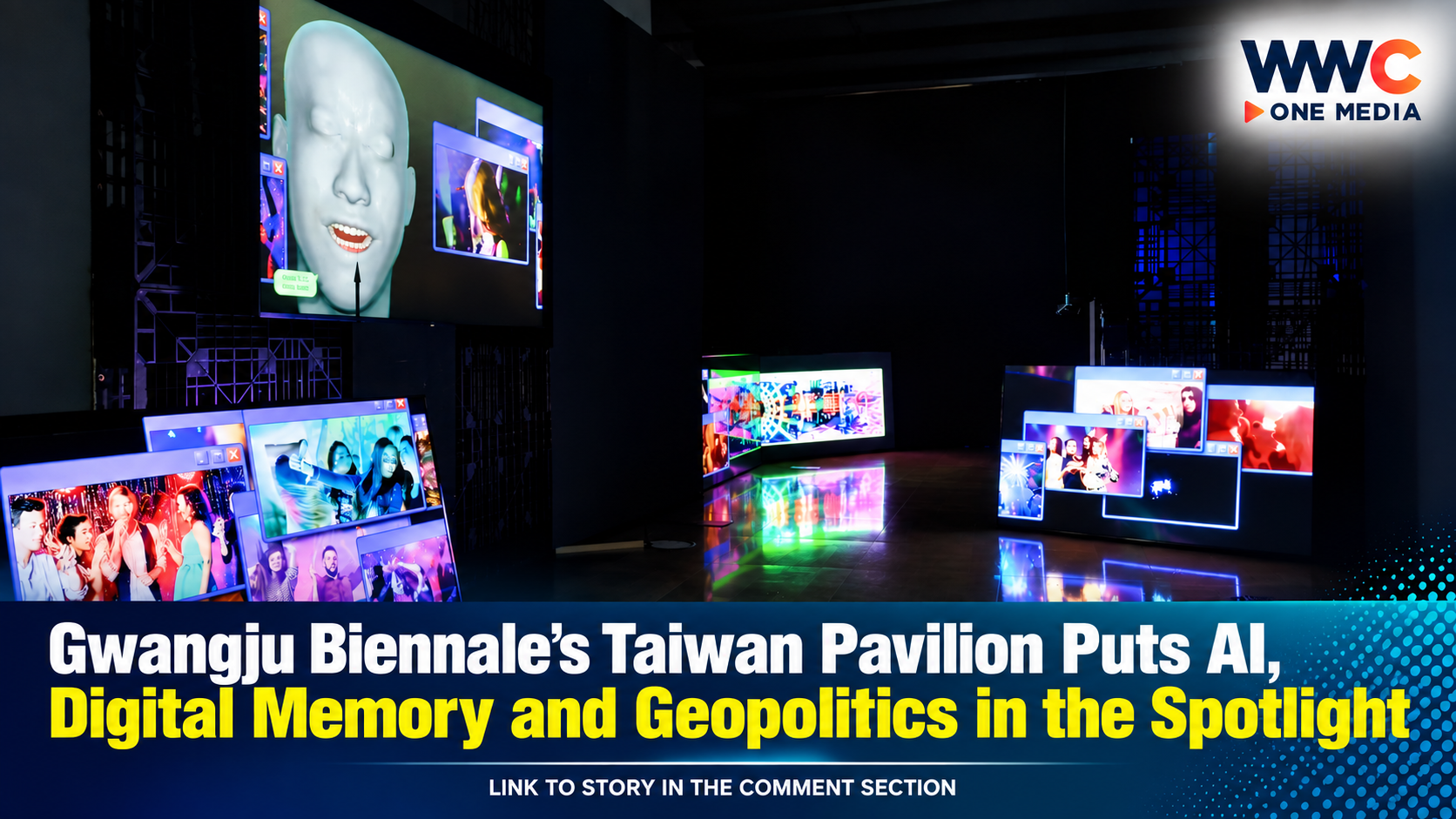
GWANGJU, South Korea — Taiwan’s rapidly evolving digital-art scene is taking center stage at the 16th Gwangju Biennale, where the Taiwan Pavilion, titled Instance Dungeons: Gray Zone, brings together artists exploring artificial intelligence, algorithms, surveillance, virtual spaces, war, memory and the increasingly blurred boundary between reality and digital information.
The pavilion opened on Sept. 5 alongside the biennale’s main exhibition and will run through Nov. 15. The project is organized by the National Taiwan Museum of Fine Arts (NTMoFA) and curated by Chen Hsiang-wen and Lin Hsiao-yu. Eight Taiwanese artists and artist groups are participating.
Rather than treating new media as simply a technological novelty, the exhibition asks a more unsettling question: What happens when technology begins influencing how people remember history, understand conflict and decide what is real?
AI, surveillance and the politics of information
The Taiwan Pavilion focuses heavily on new media practices, using digital technologies as a way to examine contemporary power structures.
Artist Li Yi-fan, whose work was also presented at the 2026 Venice Biennale, draws on online conspiracy theories to explore how fabricated information can nevertheless generate genuine fear, desire and emotional responses.
Other works turn the visitor into part of the artwork.
Cheng Hsien-yu, for example, uses beams of light that follow visitors, transforming ordinary movement into an examination of attention, observation and surveillance. Juan Po-yuan uses artificial intelligence to reconstruct military ruins and historical archives, raising questions about how algorithms interpret—and potentially distort—the past.
The pavilion also addresses the psychological distance between people and images of conflict.
Cheng Ting-Ting examines how mediated representations of war can separate audiences from the realities of violence, while Chang Wen-hsuan connects wartime memories in Taiwan and South Korea with the effects of information overload.
Meanwhile, Hsu Che-yu and Chen Wan-yin revisit memories surrounding Taiwan's former nuclear weapons program, bringing suppressed or complicated histories into a contemporary digital-art context. Su Hui-yu combines cinema and artificial intelligence to investigate collectivism, patriarchy and national narratives.
Together, the works make the pavilion less about technology for technology's sake and more about how technology changes memory, perception and political reality.
A pavilion caught in a political storm
The artistic program, however, arrived in Gwangju after a major dispute over something seemingly simple: its name.
The Gwangju Biennale Foundation initially listed the exhibition as the “NTMoFA Pavilion,” rather than the “Taiwan Pavilion.” Taiwan's Ministry of Culture objected, saying the exhibition had been proposed and communicated as the Taiwan Pavilion. Artists and curators also accused the organizers of changing the designation without their consent.
The dispute escalated in August, with the Taiwan side arguing that removing “Taiwan” from the pavilion's name went beyond a technical labeling issue and raised concerns about artistic expression and representation.
The Gwangju Biennale Foundation offered a different account, saying the project had been classified as an institutional pavilion associated with the National Taiwan Museum of Fine Arts and that the naming had been connected to the terms of its agreement.
After negotiations, the foundation ultimately approved the use of “Taiwan Pavilion.” The exhibition therefore opened under that name on Sept. 5.
China withdraws from the biennale
The naming controversy did not end there.
China's participation became entangled in the dispute, with Chinese artists and the curatorial team announcing their withdrawal from the festival. Beijing criticized the use of “Taiwan Pavilion,” arguing that the designation conflicted with China's position on Taiwan.
The Associated Press reported that the Chinese artists' withdrawal involved the China Pavilion, one of the separate national and institutional exhibitions operating under the Gwangju Biennale's Pavilion Project.
Gwangju Biennale Foundation chief executive Youn Bum-mo subsequently expressed regret over China's withdrawal and said the organization would seek to reform the pavilion system to prevent similar controversies in the future.
The episode has placed an unusual spotlight on the relationship between contemporary art, cultural diplomacy and geopolitics.
Why the Taiwan Pavilion matters
The controversy surrounding its name may have generated headlines, but the exhibition itself is ultimately centered on a broader question: how technology is changing the way societies construct reality.
That question fits within the wider theme of the 16th Gwangju Biennale, You Must Change Your Life. The main exhibition features 43 artists and groups and examines change as an ongoing process rather than a single moment of transformation.
The pavilion project expands that conversation across Gwangju, with the 2026 edition involving 27 participating countries, cities and cultural institutions and a total of 28 pavilion presentations.
For Taiwan's artists, the Gwangju presentation offers an international platform to confront questions that increasingly define life in the digital age: Who controls information? Can algorithms be trusted with history? How does surveillance affect human behavior? And what happens when artificial intelligence begins reconstructing memories that people themselves cannot—or do not want to—remember?
Those questions give the Taiwan Pavilion significance beyond the political dispute that preceded its opening.
Its most provocative message may be that in an era of AI, digital archives and algorithm-driven information, the battle over reality is no longer taking place only in politics—it is also taking place inside the artwork itself.