
Houthis Hit Saudi Oil Cities, Wounding 73 as U.S. Strikes Iran — But the Most Dangerous Front May Be Opening Next

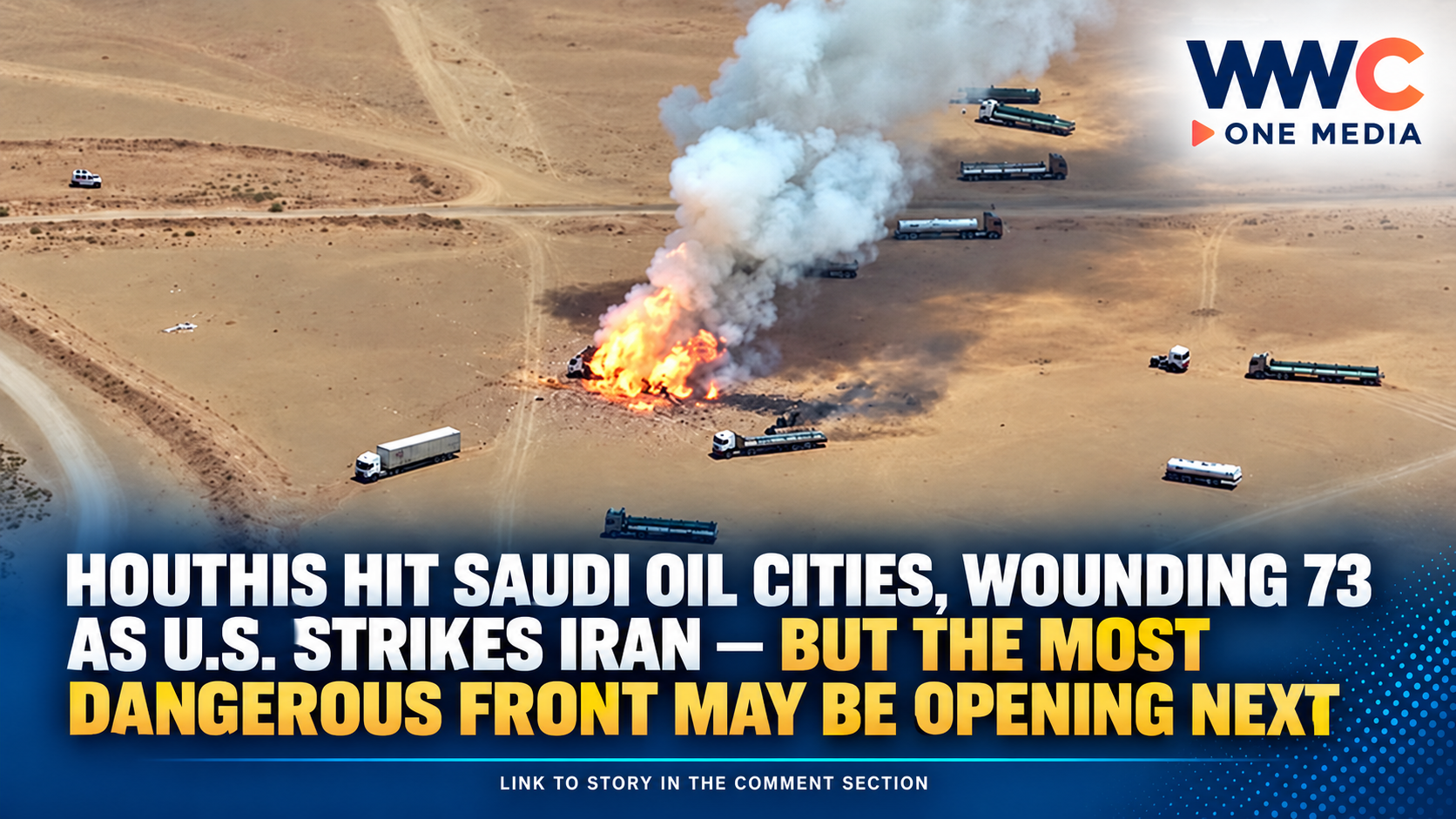
The widening confrontation between the United States and Iran has spilled more dramatically into Saudi Arabia, raising fears that a war already disrupting one of the world’s most important energy corridors could become an even broader regional conflict.
Yemen’s Iran-aligned Houthi movement launched missiles and drones toward four cities in southern Saudi Arabia on Tuesday, September 8, striking energy and other installations as Saudi authorities reported 73 civilians wounded, including women and children.
The attacks hit or targeted Abha, Khamis Mushait, Jazan and Najran, according to Saudi officials. The Houthis said their operation included Saudi energy facilities and a military airbase.
Saudi-led coalition spokesman Maj. Gen. Turki al-Maliki described the attacks as a dangerous escalation and said Riyadh would take measures to confront and neutralize the threat. Saudi state reporting separately confirmed that several energy-sector facilities in the kingdom’s southern region had been targeted.
The development is significant not simply because Saudi territory has again come under direct attack, but because it opens another potential pressure point on global energy infrastructure at a time when shipping through the Strait of Hormuz is already severely disrupted.
Smoke Over Jazan Raises New Oil-Supply Fears
The Houthis said their operation targeted Saudi state oil company assets, including installations in Jazan.
Satellite imagery reviewed by Reuters showed black smoke over the Jazan refinery and another plume over an oil distribution facility in Abha. CNA, carrying the Reuters report, noted that independently verified ground images of the affected Saudi locations were initially unavailable.
Jazan is especially important because its refinery has capacity of about 400,000 barrels per day and has become increasingly strategically important as Gulf producers look for ways to move energy while traffic through Hormuz remains constrained.
The Financial Times reported that the Jazan complex had already been attacked earlier and that product exports from the facility had fallen sharply as renewed Houthi operations placed greater pressure on Saudi Arabia’s Red Sea-facing energy infrastructure.
That changes the strategic calculation.
For months, much of the world’s attention has been centered on the Strait of Hormuz. Renewed Houthi attacks mean the risk could increasingly extend toward Saudi Arabia’s western export infrastructure and the Bab al-Mandeb, the narrow maritime gateway connecting the Red Sea with the Gulf of Aden.
U.S. Strikes Iranian Oil Tankers as Gulf Retaliation Intensifies
Almost simultaneously, the United States carried out new attacks on Iranian oil tankers after what Washington said were attempted Iranian strikes against an American Navy warship.
Reuters reported that U.S. forces struck multiple tankers linked by Washington to Iran’s Islamic Revolutionary Guard Corps. Associated Press separately reported that five Iranian oil tankers were destroyed in the latest U.S. operation.
Iranian media reported strikes near Kharg Island, Tehran’s main oil-export hub, as well as near Jask on the Gulf of Oman.
The escalation prompted another warning from Iran.
The Revolutionary Guard threatened retaliation involving oil tankers in Kuwaiti and Bahraini ports and urged crews to evacuate, according to Iranian state media. Such threats have added to fears that commercial shipping, energy infrastructure and ports belonging to countries not formally fighting Iran could increasingly be caught in the confrontation.
Iran Threatens a New “Maritime Exclusion Zone”
Tehran is also preparing another move that could have consequences far beyond the battlefield.
Iranian officials say the country plans to establish a new restricted or “maritime exclusion zone” extending into waters around the Strait of Hormuz.
Iran has argued that normal passage through the strait cannot be guaranteed while the United States continues attacking Iranian assets. Washington, meanwhile, has attempted to protect and guide commercial shipping while restricting Iranian oil exports.
The confrontation has effectively turned Hormuz into an economic weapon for both sides: Washington wants Iranian oil revenues squeezed while international energy traffic continues, while Tehran wants to demonstrate that its own exports cannot be targeted without costs for its opponents and the broader global economy.
Before the conflict, roughly a fifth of global oil and liquefied natural gas shipments moved through the Strait of Hormuz. Reuters reported that commodity-vessel traffic through the waterway recently fell to its lowest level since May.
Yemen’s War Is Roaring Back to Life
Behind the strikes on Saudi Arabia is another conflict that had never truly been resolved.
Saudi Arabia intervened in Yemen in 2015 after the Houthis seized Sanaa and drove out the internationally recognized government.
A UN-mediated truce beginning in 2022 sharply reduced large-scale hostilities, even after the formal agreement expired. But that relative calm is now breaking apart.
Saudi-backed Yemeni government forces have launched counteroffensives in areas including Taiz, al-Bayda and al-Jawf, while saying they ultimately intend to regain territory controlled by the Houthis, including Sanaa.
The Houthis, meanwhile, have fought government-aligned forces and increased pressure around Yemen’s western coast.
Al Jazeera reported some of the heaviest fighting in years as both camps launched renewed operations, bringing the country closer to a return to full-scale warfare.
The latest Saudi-Houthi escalation also followed allegations from the Houthis that a Saudi strike hit a prison in Yemen’s al-Jawf province, killing seven people. Saudi Arabia had not publicly confirmed responsibility for that specific strike at the time of AP's reporting.
That distinction matters: both sides are making claims during an active war, and individual battlefield allegations may remain difficult to independently verify.
Oil Moves Back Toward the $100 Mark
The economic consequences are already spreading.
Benchmark oil prices jumped to their highest levels in roughly six weeks as traders absorbed the combination of attacks on Saudi facilities, renewed U.S.-Iran fighting and continuing uncertainty around Hormuz.
Reuters reported Brent crude settling at $97.92 a barrel, while U.S. West Texas Intermediate finished at $93.03 after Tuesday’s trading.
But the most important issue may not be whether crude crosses $100 on a particular trading day.
It is whether the conflict simultaneously threatens three vital components of Middle Eastern energy trade:
the Strait of Hormuz, Saudi energy infrastructure and the Red Sea-Bab al-Mandeb route.
If pressure intensifies across all three, oil exporters would have fewer practical ways to reroute supplies around the fighting.
For now, alternative export routes, growing production outside OPEC and weaker demand in some major economies have helped keep crude below the extreme levels some analysts feared. Reuters reported that additional supply from producers such as the United States, Canada and Guyana has also softened some of the shock.
That buffer, however, is not unlimited.
Why the Saudi Attacks Change the War
The biggest shift is geographical.
The U.S.-Iran confrontation is no longer only about Iranian territory, American military assets or ships passing through Hormuz.
Saudi energy sites are again being hit. Yemen’s civil war is escalating. Shipping routes on both sides of the Arabian Peninsula face threats. Iran and the United States are attacking assets connected to each other’s economic lifelines.
And every additional country, port, refinery or commercial shipping lane pulled into the confrontation makes diplomatic containment more difficult.
The Trump administration has combined military operations with sanctions and an economic campaign designed to increase pressure on Tehran, while Iran has continued using missiles, drones and maritime disruption to demonstrate that it retains the ability to impose costs despite months of attacks. AP reported that neither pressure nor military action has yet forced the Iranian leadership to accept Washington’s demands.
What Happens Next Could Matter Far Beyond Saudi Arabia
Saudi Arabia has promised a response to the Houthi strikes.
The Houthis have promised to continue responding to what they describe as Saudi aggression.
Iran is threatening tighter restrictions around Hormuz.
And Washington is again attacking Iranian oil assets.
The danger is therefore no longer one isolated confrontation spinning out of control.
It is several conflicts — Iran versus the United States, the Saudi-Houthi confrontation and Yemen’s civil war — becoming increasingly interconnected.
That leaves the global economy facing one crucial question:
Can the fighting be contained before another major refinery, tanker route or Gulf state becomes the next front?
WWC ONE MEDIA M.J.E