
IBP Lawyers Reach 16,148 Filipino Detainees in Massive Jail Drive — But Legal Advice Is Only the First Step

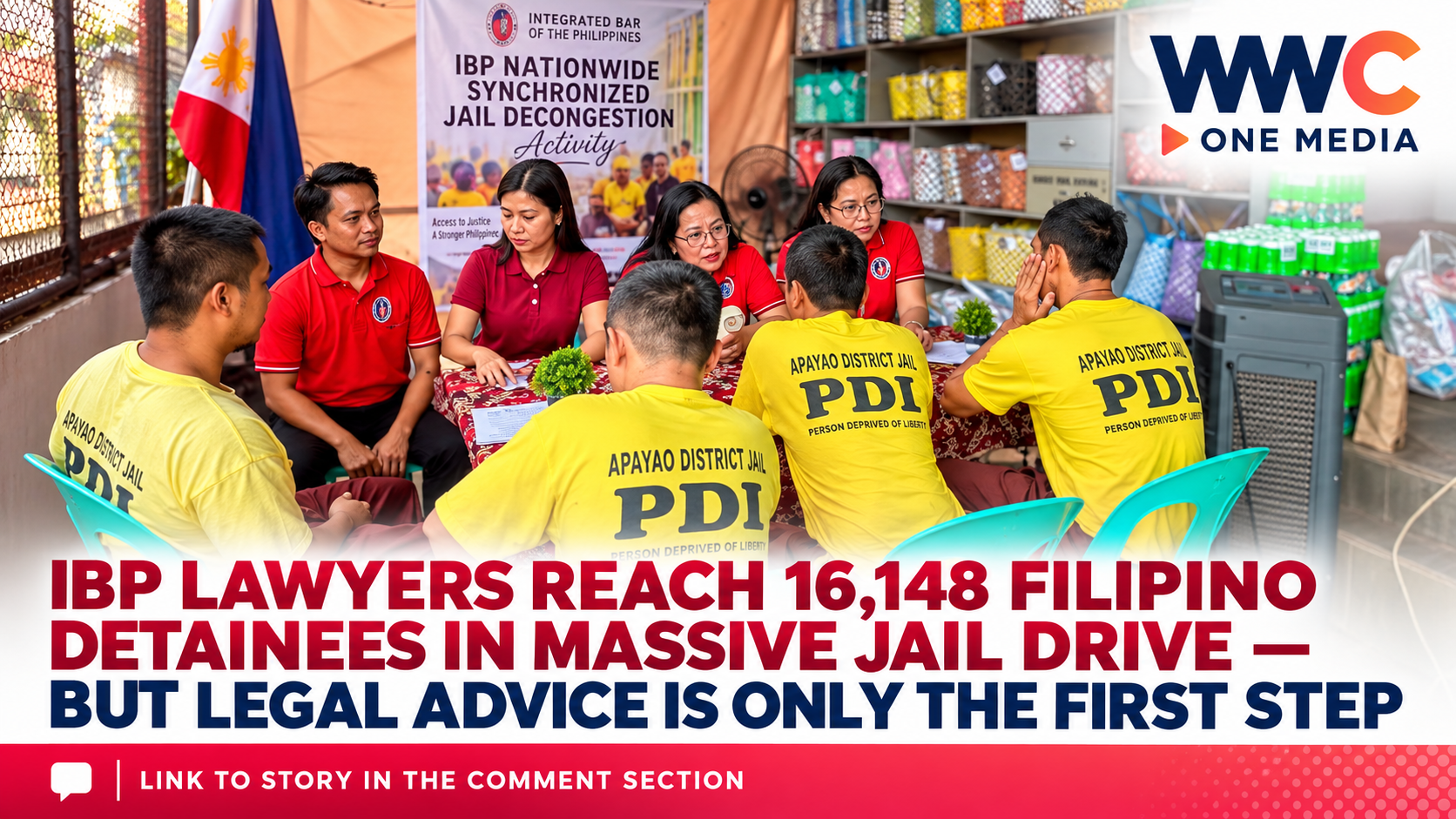
MANILA, Philippines — Thousands of persons deprived of liberty across the Philippines have received legal assistance under a nationwide campaign led by the Integrated Bar of the Philippines, as the country continues to confront severe overcrowding inside its detention facilities.
The Integrated Bar of the Philippines reported that lawyers participating in its nationwide synchronized jail-decongestion campaign assisted 16,148 persons deprived of liberty, or PDLs, according to the tally cited by Manila Standard.
The August 27 initiative mobilized IBP chapters around the country to bring lawyers directly into detention and correctional facilities, where PDLs were offered consultations and assistance in reviewing possible legal remedies.
Independent reports confirm that the campaign was conducted nationwide.
The Philippine Daily Inquirer reported that more than 85 IBP chapters were participating in the synchronized effort. In Oriental Mindoro, for example, lawyers visited the Calapan City District Jail, which housed 155 PDLs, and combined free legal assistance with medical services and the distribution of basic supplies.
At the New Bilibid Prison in Muntinlupa, the Bureau of Corrections confirmed that the IBP's National Center for Legal Aid, together with its Pasay-Parañaque-Las Piñas-Muntinlupa and Makati chapters, conducted a legal-aid mission at the minimum- and medium-security camps on August 27.
BuCor described the operation as part of the IBP's Nationwide Synchronized Jail Decongestion Activity, aimed at widening access to lawyers while supporting efforts to reduce congestion inside detention and correctional institutions.
Why lawyers could make a difference to jail congestion
The significance of the campaign goes beyond giving detainees legal advice.
Some PDLs may potentially qualify for remedies involving bail, probation, parole, Good Conduct Time Allowance, credit for preventive imprisonment, dismissal or resolution of pending cases, executive clemency or other forms of lawful release or sentence relief, depending on their individual circumstances.
In April, BuCor and the IBP formalized a partnership designed to institutionalize legal services for qualified PDLs.
GMA News reported that the agreement covers legal representation and advice involving appeals and post-conviction remedies, along with assistance in applications for commutation, pardon, parole and executive clemency. It also covers matters involving Good Conduct Time Allowance and other sentence credits.
That distinction matters: a legal-aid visit does not automatically mean a detainee will be released.
Lawyers must first determine what remedy, if any, is legally available. Courts, prosecutors, jail authorities or other agencies may then have to act depending on the nature and status of the case.
DOJ encountered the same problem: some release-eligible PDLs had no lawyer
The Department of Justice has separately identified lack of legal representation as an obstacle for some detainees.
On July 7, the DOJ Action Center conducted a Legal Aid Desk specifically for PDLs who had previously been assessed and verified as potentially eligible for release but still needed lawyers to pursue the necessary proceedings in court.
The initiative involved the DOJ, an IBP chapter, volunteer lawyers and law students tasked with reviewing case records and identifying possible remedies.
The episode illustrates one of the less visible causes of prolonged detention: a legal remedy may technically exist, but a detainee without adequate representation can still struggle to invoke it.
From Iligan to General Santos, lawyers went inside the jails
Regional operations show how the nationwide program worked on the ground.
In Iligan City, 23 volunteer lawyers from the IBP-Lanao del Norte chapter joined the August 27 jail-decongestion operation. PDLs received consultations, while jail officials also discussed sentence-reduction mechanisms including Good Conduct Time Allowance and Time Allowance for Studying, Teaching and Mentoring.
In General Santos City, the IBP South Cotabato-General Santos chapter worked with the Mindanao State University-General Santos Clinical Legal Education Program to provide legal consultations, notarization and assistance with concerns involving pending cases at both male and female jail dormitories.
North Cotabato's IBP chapter, meanwhile, said its operation brought together private lawyers, the Public Attorney's Office, prosecutors and the courts in an effort to improve access to justice for detainees.
Philippine jails are still dramatically overcrowded
The legal-aid push is taking place against a much larger structural problem.
BJMP Chief Jail Director Efren Nemeño said in August that the country's national jail congestion rate had fallen from 292% to 281%.
The improvement is significant, but the number also makes clear that overcrowding remains far from resolved.
Earlier government data showed that 351 of 488 BJMP facilities — nearly 72% — remained overcrowded, with an average congestion rate around 279% at that point.
The Davao Region offers evidence that legal remedies can help reduce those numbers. BJMP-XI reported in September that its average congestion rate fell to 162% for January through August 2026 from 208% during the comparable period in 2025.
Officials attributed part of the decline to PDLs gaining access to remedies including probation, bail, sentence completion with applicable time allowances, acquittal, provisional dismissal and transfers to other institutions.
A new legal-aid system could expand the impact
The IBP campaign also coincides with a major change in the legal profession.
Under the Supreme Court's Unified Legal Aid Service rules, covered Philippine lawyers are generally required to provide at least 60 hours of pro bono legal assistance during every three-year compliance period.
The rules took effect on February 3, 2025 and allow qualifying services to include court representation, legal counseling, document preparation, legal outreach activities and certain notarization work.
That could create a much larger pool of legal manpower for indigent Filipinos — including detainees unable to afford private counsel.
The real test comes after the jail visit
Reaching 16,148 PDLs in a coordinated legal-aid effort is a major undertaking.
But the more consequential number will be how many cases actually move afterward.
A consultation can uncover an overlooked remedy. A lawyer can file a motion, correct paperwork or bring a long-pending case back before the proper authority. But genuine jail decongestion ultimately depends on courts, prosecutors, public defenders, corrections officials and other justice agencies being able to process those cases efficiently.
The August campaign therefore represents something bigger than a one-day legal mission.
It tests whether the Philippines can convert thousands of individual legal consultations into faster case resolutions, lawful releases for qualified detainees and a sustained reduction in one of the country's most persistent justice-system problems.
WWC ONE MEDIA M.J.E