
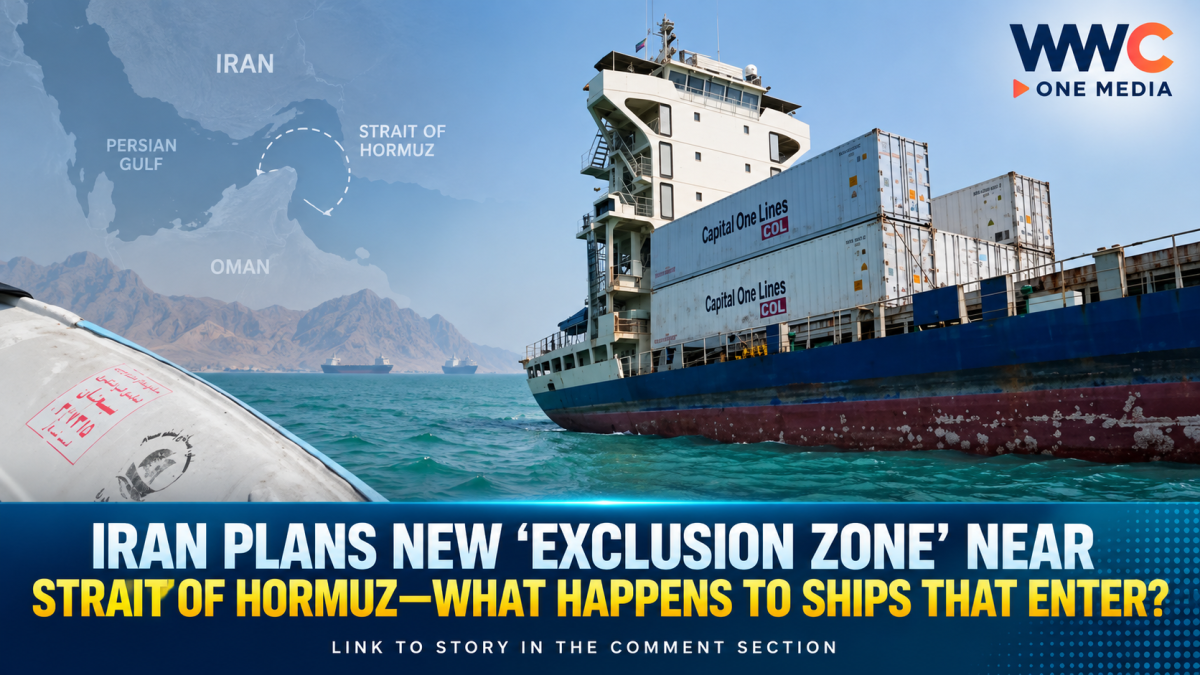
TEHRAN — Iran is preparing to announce a new “exclusion zone” outside the strategic Strait of Hormuz, raising fresh concerns over commercial shipping, global oil supplies and the possibility of a wider escalation between Tehran and Washington.
Mohsen Rezaei, secretary of Iran’s Supreme National Security Council, said Sunday that the new zone would be announced in the coming days. According to Iranian state media, the proposed area would begin around the line of the U.S. naval blockade, extend toward the Strait of Hormuz and reach into parts of the Persian Gulf.
Rezaei warned that vessels entering the designated area with the intention of transiting the Strait could be placed on an Iranian sanctions list.
The announcement comes after a sharp escalation in maritime hostilities. The United States said it struck three Iranian oil tankers on Saturday after Iran launched ballistic missiles toward U.S. Navy vessels. Iran, meanwhile, claimed it had attacked vessels it considered to be using unauthorized routes through the Strait.
New restrictions could further complicate shipping
The exact boundaries of Iran’s proposed exclusion zone have not yet been publicly detailed, leaving uncertainty for commercial shipping companies and international maritime operators.
The U.S. military has said more than 20 warships are involved in operations supporting its blockade of Iranian oil exports. The Associated Press reported that U.S. forces had redirected 92 commercial vessels and disabled three vessels as of Sunday.
Iran’s proposed zone would add another layer of restrictions around one of the world’s most strategically important waterways.
The Strait of Hormuz connects the Persian Gulf with the Gulf of Oman and the Arabian Sea. Before the current conflict, roughly one-fifth of global oil supplies moved through the waterway, making any sustained disruption a major concern for energy markets.
Oil markets already feeling the pressure
The latest confrontation is already affecting global energy markets.
Reuters reported Monday that Brent crude climbed to about $96.80 a barrel, while U.S. West Texas Intermediate reached around $92.14, as traders reacted to renewed attacks involving tankers and military vessels around the Strait of Hormuz. Reuters also reported that the number of commodity vessels transiting the waterway had fallen to an average of about 10 per day over the previous 10 days, the lowest level since May.
U.S. Energy Secretary Chris Wright said about 9 million barrels of oil per day were still moving through the Strait, although he acknowledged that continued flows depended heavily on U.S. naval protection and escorts.
That means the proposed Iranian exclusion zone could become significant not only militarily but also economically if shipping companies begin avoiding the area or if additional vessels are prevented from passing.
Iran says the Strait remains under its control
Iran has maintained that the Strait of Hormuz is under the control of its armed forces.
Rezaei also said Iran was working with Oman on a new corridor through the waterway, with Iranian authorities controlling its entry and exit points, according to the Philippine News Agency. Iranian officials have claimed that only a limited number of vessels carrying essential goods are currently being allowed through.
However, statements from Tehran regarding individual attacks and the status of shipping have been disputed by Washington.
Iranian officials claimed Sunday that an unmanned U.S. vessel attempting to enter the Strait had been struck. U.S. Central Command rejected the claim, describing it as false.
Washington and Tehran issue new warnings
The latest maritime confrontation has also been accompanied by increasingly aggressive rhetoric from both sides.
Iranian Parliament Speaker Mohammad Baqer Qalibaf warned that future attacks against Iranian interests would receive a faster and more forceful response.
At the same time, U.S. officials have defended military operations intended to protect shipping and restrict Iranian oil exports.
The confrontation follows the breakdown of diplomatic efforts between Washington and Tehran. Iran and the United States had previously reached a preliminary memorandum of understanding mediated by countries including Pakistan and Qatar, but both sides have accused the other of failing to honor commitments.
What happens next?
The biggest question now is how the proposed exclusion zone will be defined—and whether Iran will attempt to enforce it against commercial vessels.
For shipping companies, the uncertainty could mean longer routes, higher insurance costs and greater security risks. For global energy markets, any significant reduction in traffic through Hormuz could put additional upward pressure on oil prices.
For now, Iran has announced its intention to establish the zone, but the precise boundaries, enforcement mechanisms and implementation date remain unclear.
What happens when Tehran formally announces the restrictions—and whether commercial ships challenge them—could determine the next major escalation in the already tense confrontation around the Strait of Hormuz.
WWC ONE MEDIA J.M.S




Leave a Reply