
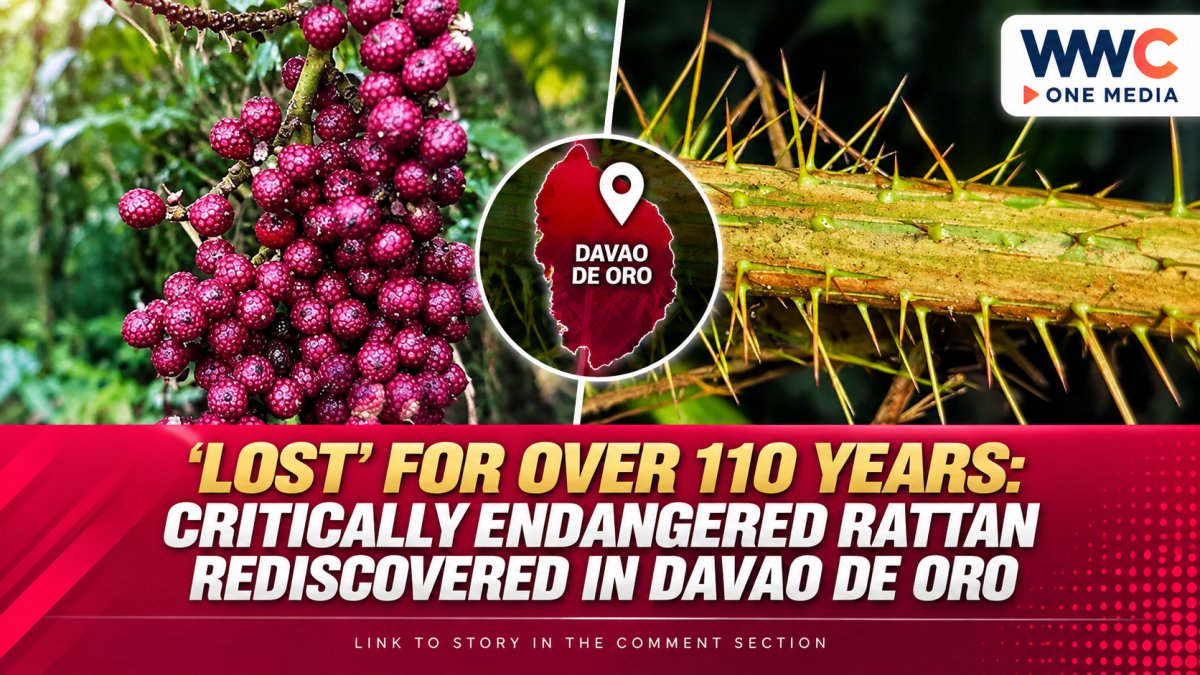
DAVAO DE ORO, Philippines — A critically endangered Philippine plant believed to have vanished from scientific records for more than a century has been found alive in the forests of Mindanao.
Researchers have rediscovered Calamus vinosus, a rare native rattan species that had not been documented in the wild for more than 110 years, during a biodiversity expedition in the Mt. Candalaga Range in Maragusan, Davao de Oro.
The discovery is being described as a major moment for Philippine biodiversity research — and a powerful reminder that some of the country’s most important natural treasures may still be hiding in forests that scientists have barely explored.
The Philippine Eagle Foundation (PEF) announced the rediscovery on Sept. 3, saying the rare palm was encountered during plant documentation work in one of Mindanao’s most biologically important mountain landscapes.
For botanists, the discovery was extraordinary.
The species had last been scientifically collected in 1912 on Mt. Urdaneta in Agusan del Norte. Since then, there had been no documented sightings in the wild.
Until now.
A “Lost” Species Found Again
Calamus vinosus is a Philippine-native rattan belonging to the palm family and is recognized by its distinctive wine-colored fruits.
But despite its striking appearance, the species had effectively disappeared from modern scientific observation.
For more than a century, there was no confirmed documentation showing that the plant was still surviving in its natural habitat.
Its rediscovery in Mt. Candalaga changes that.
PEF said the find came during a plant photography expedition conducted from Nov. 26 to Dec. 4, 2024, involving researchers and conservation workers documenting the extraordinary plant diversity of the mountain range.
The expedition included Dr. Julie F. Barcelona and Dr. Pieter B. Pelser of the University of Canterbury and the Philippine Eagle Foundation, along with PEF researcher Guiller S. Opiso.
The broader effort forms part of continuing research aimed at better understanding the forest habitats that support the critically endangered Philippine eagle and other rare wildlife.
The identification of the rediscovered rattan was later verified with assistance from palm expert Jiro Adorador of the University of the Philippines Los Baños.
According to the Philippine Eagle Foundation, Adorador described the encounter as extraordinary and said he never expected to see the species alive in its natural habitat.
Thousands of Photos, Hundreds of Plant Species
The rediscovery was not the only significant outcome of the expedition.
Researchers collected an impressive 2,271 photographs documenting 236 plant species across the Mt. Candalaga Range.
Several of the documented species had reportedly never before been recorded in Davao de Oro, expanding scientific knowledge about the province’s flora.
The photographs were uploaded to Co’s Digital Flora of the Philippines, an open-access biodiversity database named in honor of the late Filipino botanist and plant taxonomist Leonardo L. Co.
The extensive documentation highlights an important reality about Philippine forests: scientists are still discovering, rediscovering and documenting species in areas that remain insufficiently studied.
And if one critically endangered rattan could remain unseen for more than a century, researchers say it raises an even bigger question:
What else is still waiting to be discovered?
Why Mt. Candalaga Matters
The rediscovery has also renewed attention on the importance of protecting the forests of the Mt. Candalaga Range.
The mountain landscape is more than just the new confirmed refuge of Calamus vinosus.
It is also home to other threatened and remarkable species, including the critically endangered Philippine eagle and Rafflesia mira, one of the Philippines’ giant parasitic flowers.
Conservationists have long emphasized that protecting forests cannot focus on a single iconic species.
A forest that shelters an endangered eagle may also contain rare plants, insects, mammals, amphibians and organisms that have yet to be fully documented.
That interconnected biodiversity makes discoveries like Calamus vinosus especially important.
Saving one habitat can mean protecting an entire hidden network of life.
PEF said the rediscovery reinforces the urgent need to conserve the remaining forests of Mt. Candalaga and surrounding mountain ecosystems.
A Growing List of Philippine Rediscoveries
The remarkable find in Davao de Oro comes during a period of renewed biodiversity discoveries and rediscoveries in the Philippines.
Earlier in 2026, researchers also documented Ophiorrhiza biflora, a rare flowering plant that had not been recorded on Mt. Apo for 122 years.
The plant was spotted during routine wildlife monitoring inside the Mount Apo Natural Park, demonstrating once again that Philippine forests continue to reveal species thought to have disappeared from scientific observation.
In Samar, conservation researchers also recently documented the endangered Rafflesia manillana after roughly 15 years without updated records.
These discoveries carry the same underlying message: absence from scientific records does not always mean extinction.
Sometimes, a species simply survives beyond the reach of regular observation.
But rediscovery is not the same as safety.
A species found again can still disappear forever if its habitat is destroyed.
Rediscovered — But Still Critically Endangered
The rediscovery of Calamus vinosus is undoubtedly a scientific victory.
But conservationists caution against interpreting rediscovery as a guarantee of survival.
The species remains classified as Critically Endangered, meaning its population and habitat require serious protection.
For more than 110 years, no scientist had documented it alive in the wild.
Now that researchers know it still exists, the next challenge begins.
Can it be protected?
The answer may depend heavily on the survival of the forests where it was found.
Deforestation, habitat fragmentation and environmental degradation continue to threaten biodiversity throughout the Philippines, particularly in ecologically rich mountain regions.
The rediscovery of Calamus vinosus therefore represents two things at once.
It is a celebration.
And it is a warning.
What Else Is Hiding in Mindanao’s Forests?
Perhaps the most exciting part of this story is not only that a plant missing from scientific records since 1912 has returned.
It is what the discovery suggests about the forests around it.
Mt. Candalaga still holds secrets.
The expedition documented hundreds of plant species, including several not previously recorded in Davao de Oro.
That means even in 2026, scientists are still building the most basic inventory of life inside some Philippine forests.
Somewhere beneath the canopy may be another plant not seen for generations.
Another insect never formally described.
Another animal whose population has never been counted.
Or another species that science has quietly assumed was gone.
For Calamus vinosus, survival remained a mystery for more than a century.
Then, deep in the forests of Davao de Oro, a camera found proof.
It was never truly gone.
It was waiting to be found.
And now, the responsibility has changed.
For more than 110 years, the question was whether this rare Philippine rattan still existed.
Today, scientists finally have their answer.
The bigger question is whether the Philippines can protect it long enough so it will never disappear again.
WWC ONE MEDIA J.M.D




Leave a Reply