
Marcos Tours Aboitiz’s 1,100-Hectare LIMA Estate — But Its Next 500 Hectares Could Change Batangas Even More

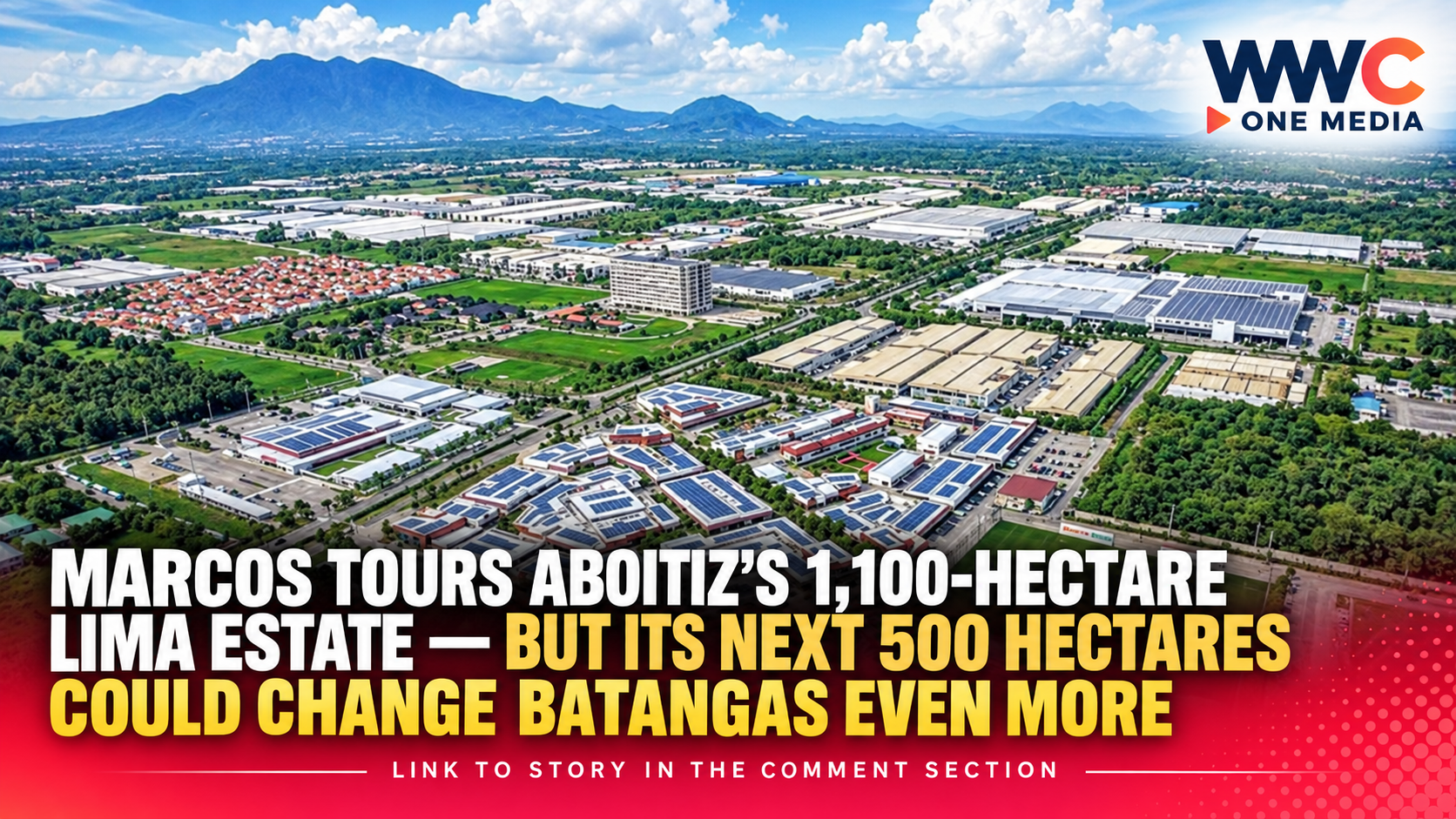
BATANGAS, Philippines — President Ferdinand Marcos Jr.’s visit to Aboitiz Group’s sprawling LIMA Estate has put one of Southern Luzon’s biggest industrial hubs back in the spotlight, but the more consequential story may be what comes next: another 500 hectares, dozens of incoming factories and an ambitious projection that the estate could eventually support far more jobs than it does today.
Marcos visited the Lipa-Malvar Industrial, or LIMA, Estate in Batangas on September 7, touring facilities tied to manufacturing, technical education and energy-sector training as the government pushes closer alignment between schools and the industries expected to generate future employment.
LIMA currently spans about 1,100 hectares, hosts more than 200 local and foreign companies, and supports roughly 75,000 jobs, according to Aboitiz and reports on the estate. The conglomerate says cumulative investment at LIMA has reached more than ₱128.9 billion.
Those numbers are already substantial.
But Aboitiz is preparing to make the estate considerably larger.
LIMA Could Grow From 1,100 to 1,600 Hectares
The Philippine Star reported in late August that Aboitiz Economic Estates plans to add another 500 hectares to LIMA over the coming years, eventually taking the development to around 1,600 hectares.
That is nearly a 45% increase from its present 1,100-hectare footprint.
Aboitiz Economic Estates president and CEO Rafael Fernandez de Mesa said demand remains strong, with about 20 companies already constructing facilities and another 20 in the planning stage.
The company has even floated a much larger employment figure.
De Mesa said Aboitiz projects that LIMA could potentially support around 250,000 manufacturing jobs in total, including the roughly 75,000 currently associated with the estate.
That number is potentially transformational for Batangas.
But it needs to be presented accurately.
250,000 is a forward-looking company projection, not a current employment count and not a government guarantee.
Whether the estate reaches that level will depend on how much of the additional land is actually developed, which companies locate there, investment conditions, infrastructure, power costs and global manufacturing demand.
What Marcos Actually Saw
The presidential visit was not simply a factory tour.
Marcos also visited LIMA Tower One, the Batangas State University LIMA Campus and the JERA-AboitizPower Global Technical Center of Excellence, highlighting the broader ecosystem Aboitiz is attempting to create around its industrial estate.
The idea is straightforward: factories need more than industrial land.
They need reliable electricity.
They need roads, water, wastewater treatment and digital connectivity.
And increasingly, companies looking at higher-value manufacturing need workers with specialized engineering and technical skills.
Aboitiz is betting that putting those pieces in one location makes LIMA more competitive against industrial parks elsewhere in Southeast Asia.
Batangas State University Is Now Inside the Industrial Estate
One of the more unusual pieces of the strategy is education.
The Batangas State University-LIMA Campus is designed to bring engineering students physically closer to companies operating within the industrial zone.
Aboitiz Economic Estates said the campus was set to welcome 800 freshman engineering students beginning in August 2026 as part of what it describes as an industry-based learning model.
PTV reports that the campus offers 10 undergraduate engineering programs and eight graduate programs, alongside micro-credential programs intended to provide additional technical training.
That gives Marcos' visit a broader economic significance.
The administration has repeatedly argued that education and technical training should be tied more directly to available jobs rather than operating separately from industry needs.
During the Batangas visit, Marcos pointed to the government's progress in expanding competency-based training, including more than 700 registered micro-credential programs between July 2022 and May 2026 and assessments involving nearly five million TVET graduates.
The question is whether that training translates into actual hiring.
At LIMA, Aboitiz is attempting to build that connection into the estate itself.
A Japanese Partnership Adds Another Layer
Marcos also visited the Global Technical Center of Excellence, established through a partnership involving AboitizPower and Japanese energy company JERA.
The center opened in September 2025 and has provided training or capability-development opportunities to around 2,000 participants from the two companies, according to Aboitiz. Its Basic Operations & Maintenance Program has produced 79 graduates.
The visit came as the Philippines and Japan mark 70 years of diplomatic relations in 2026, giving the event an additional bilateral dimension.
Japanese companies already form part of LIMA's manufacturing base, including Epson and Yamaha, while the JERA partnership extends those links into power-sector training.
That matters because Japan remains an important source of manufacturing investment for Philippine economic zones, and PEZA continues to court Japanese firms involved in advanced manufacturing and export production.
Marcos Had Already Given LIMA Another Boost Before the Visit
There is another development that makes the timing of the presidential visit particularly significant.
Just a month earlier, Marcos signed Proclamation No. 1385, creating a new special economic zone and information technology park inside LIMA.
The new Biz Hub at LIMA Estate IT Park covers approximately 288,314 square meters, or about 28.8 hectares, in Barangay Bugtong na Pulo in Lipa City.
The Presidential Communications Office said the designation is intended to attract investment, generate employment and strengthen the country's digital economy.
That means LIMA is no longer being positioned only as a manufacturing center.
Aboitiz is trying to layer IT-BPM operations, offices, commercial developments, housing, education and other services around its industrial base.
The estate's 70-hectare Biz Hub is intended to serve as that commercial core.
According to The Philippine Star, LIMA Tower One already supports roughly 1,500 jobs, with Aboitiz expecting that figure to approach 4,000 as more of the building becomes operational.
The company has outlined an investment plan of about ₱7 billion for seven office towers, although executives have said the full rollout could take 12 to 15 years rather than the original 10-year timetable.
Why Batangas Is Becoming More Important
LIMA's expansion is occurring within a much broader industrial push across Batangas and CALABARZON.
PEZA reported that investment approvals in the first half of 2026 jumped 94.42% to ₱140.7 billion, with projects spread across regions including CALABARZON. It separately said two major manufacturing projects approved in July would be located in Batangas.
Batangas has several structural advantages for industry: proximity to Metro Manila, access to major South Luzon highways, an established manufacturing labor pool and connections to the Port of Batangas.
That infrastructure has helped make the province an established location for electronics, automotive components, consumer goods, food processing and precision manufacturing.
LIMA is trying to capture more of that investment rather than simply supplying industrial lots.
New Factories Are Already Showing Up
Evidence of continued locator activity is visible across the estate.
Aboitiz broke ground earlier this year on Phase 5, an approximately 100-hectare expansion into Sto. Tomas, Batangas. Around 60 hectares are intended for industrial development, while roughly 30 hectares are planned for residential uses supporting the growing workforce.
Recent projects include a new facility by Big E Food Corp., whose nearly 12-hectare plant is expected by the company to generate around 2,000 jobs at full operations.
Taiwan-linked and other manufacturing investors have also announced new facilities at the estate during 2026.
Taken together, those projects help explain why Aboitiz is willing to acquire and develop another 500 hectares.
It is betting that manufacturing demand in Southern Luzon has considerably more room to run.
But More Land Alone Will Not Guarantee Success
This is where the story becomes more complicated than a presidential visit and headline-grabbing job projections.
Industrial estates across Southeast Asia are competing for many of the same investors.
Vietnam, Thailand, Malaysia and Indonesia are all pursuing semiconductor, electronics, electric-vehicle, data-center and advanced-manufacturing investments.
For the Philippines to win those projects, industrial parks need competitive logistics and tax incentives — but companies also repeatedly evaluate electricity reliability and cost, workforce skills, transport links, permitting and supply-chain depth.
PEZA itself says investors are increasingly looking at infrastructure modernization, logistics, energy availability and workforce development when making location decisions.
That is why Aboitiz's strategy at LIMA goes beyond adding hectares.
It is trying to eliminate as many of those investor concerns as possible inside one ecosystem.
This Is Also Part of a Much Bigger Aboitiz Bet
LIMA is not an isolated project.
Aboitiz is extending the same industrial-estate strategy elsewhere in the country.
In Central Luzon, it is developing the 384-hectare TARI Estate in Tarlac, where manufacturers including Coca-Cola Europacific Aboitiz Philippines and Ajinomoto have been setting up facilities.
In Cebu, the 540-hectare West Cebu Estate in Balamban has become a major shipbuilding and industrial center supporting more than 14,000 workers, according to Aboitiz.
The group's 2026 capital-expenditure plan also shows the scale of the broader strategy.
Aboitiz Equity Ventures and its partners allocated ₱88.5 billion in capital expenditures for 2026, including ₱62 billion for AboitizPower, with additional funds going into infrastructure, economic estates, food, banking and other businesses.
The Numbers That Matter Most
Marcos' visit produced compelling images of a president touring one of the country's largest industrial developments.
But the real economic test will happen long after the motorcade leaves.
LIMA already has:
1,100 hectares.
More than 200 companies.
Around 75,000 jobs.
More than ₱128.9 billion in cumulative investment, according to Aboitiz.
Now the company wants:
another 500 hectares,
dozens more locators,
and potentially 250,000 manufacturing jobs in the long run.
Those future numbers are the ones worth watching.
Because the bigger story is not that Ferdinand Marcos Jr. visited LIMA Estate.
It is whether Aboitiz can turn the next 500 hectares into enough factories, technical jobs and supporting businesses to transform Batangas from an established manufacturing center into one of the Philippines' most important industrial growth corridors.
And if the company comes anywhere close to its employment projection, 75,000 jobs may eventually look like only the beginning.
WWC ONE MEDIA M.J.E