
Oil Hits $99.49 After Iran Fires 20 Missiles Toward Jordan — But the Number Traders Fear Most Isn’t the Oil Price

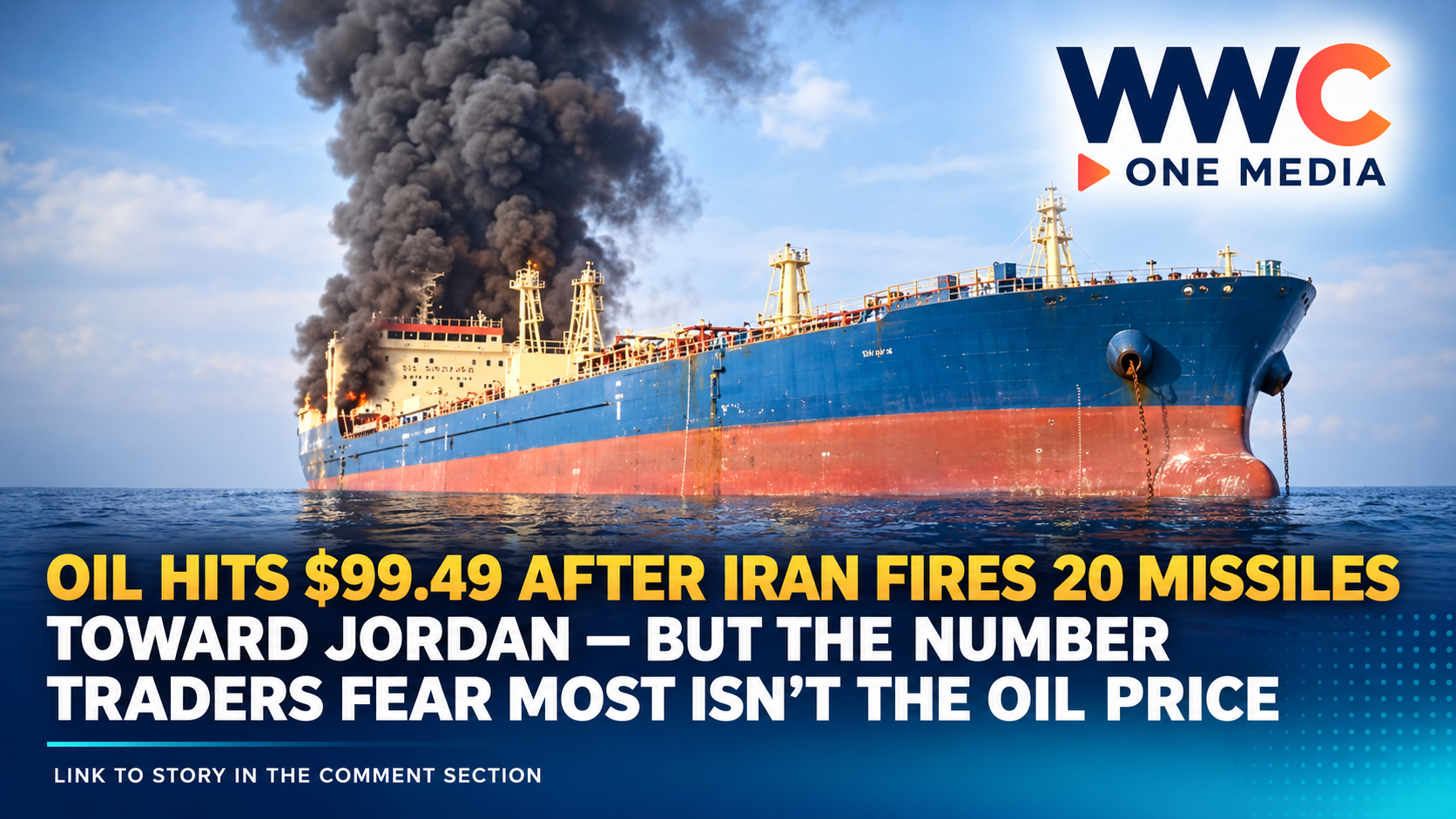
Oil prices surged for a fourth straight session on Wednesday, September 9, moving within striking distance of $100 a barrel after Iran launched a fresh round of ballistic missiles toward U.S. military targets in Jordan and the Gulf, deepening fears that an expanding Middle East conflict could further disrupt some of the world’s most important energy routes.
Brent crude futures jumped $1.57, or 1.6%, to $99.49 a barrel in early Asian trading at 0001 GMT, while U.S. West Texas Intermediate crude climbed $1.60, or 1.72%, to $94.63 a barrel, according to Reuters data carried by Channel News Asia. Brent has now risen roughly 25% since early August as hopes for a durable end to the six-month conflict have faded.
But the latest oil rally is about much more than a single missile attack.
Markets are increasingly focused on whether the escalating confrontation between Iran and the United States will further restrict tanker traffic through the Strait of Hormuz, one of the most important oil shipping chokepoints on Earth.
Iran Says It Targeted U.S. Forces in Jordan
Iran’s Revolutionary Guards said they launched ballistic missiles against two U.S. destroyers and what Tehran described as a U.S. military base at Al Azraq in Jordan, saying the operation was retaliation for American attacks on Iranian oil tankers.
Jordan’s military gave a different but complementary account of what happened in its airspace.
According to Jordan’s state news agency, the country’s air-defense systems intercepted 18 of 20 ballistic missiles originating from Iranian territory. The other two reportedly landed in unpopulated areas.
No casualties were reported.
The interception prevented a potentially far more serious incident on Jordanian territory, but traders appear to be pricing in what the attack represents: the conflict is continuing to spread beyond Iran itself and into countries hosting American military forces.
Jordan has become particularly exposed because of its close security relationship with Washington. AP has reported that the United States operates from multiple military installations in the kingdom, making Jordan strategically important to U.S. operations in the region — and increasingly vulnerable as the confrontation with Tehran widens.
Washington Says More Iranian Oil Tankers Could Be Hit
The missile attack came amid an increasingly dangerous cycle of retaliation involving warships, oil tankers and energy infrastructure.
U.S. Secretary of State Marco Rubio warned that Washington intends to continue attacking Iranian oil tankers when Iran attempts to strike American naval vessels.
U.S. Central Command said American forces destroyed five Iranian crude oil carriers on September 8 following attempted missile attacks against a U.S. Navy warship over the previous two days.
That escalation matters to oil markets because commercial energy infrastructure and shipping are becoming increasingly entangled with the military confrontation.
Reuters reported earlier this week that U.S. and Iranian forces had traded attacks involving tankers and warships, while Iran warned that energy infrastructure across the Gulf could become vulnerable if attacks on Iranian assets continued.
And that is where the market’s biggest fear begins.
Strait of Hormuz Is the Number Traders Are Watching
Before the current disruptions, the Strait of Hormuz carried enormous volumes of global energy.
U.S. Energy Information Administration data show that about 20.9 million barrels per day of oil and petroleum liquids moved through Hormuz during the first half of 2025 — equivalent to roughly 20% of global petroleum liquids consumption and around one-quarter of globally traded maritime oil.
More than 20% of global liquefied natural gas trade also passed through the strait.
Asia has the most direct exposure.
The EIA estimated that 89% of crude oil and condensate passing through Hormuz went to Asian markets during the first half of 2025. China, India, Japan and South Korea together accounted for 74% of those flows.
Those historical figures do not represent today’s reduced wartime traffic, but they demonstrate why even partial disruption to the waterway can reverberate quickly through Asian fuel markets, shipping costs and inflation.
Reuters reported this week that an average of only 10 commodity vessels a day had passed through the Strait of Hormuz during the previous 10 days, the lowest level since May.
That is the figure energy traders will be watching almost as closely as the price of Brent itself.
Why Oil Has Not Blown Past $100 Yet
Despite months of supply disruption and renewed military escalation, Brent has so far struggled to remain decisively above the psychologically important $100 mark.
There are several reasons.
Reuters reports that Gulf producers have been using alternative export routes, including pipelines and other ports, while additional production from countries outside OPEC — including the United States, Canada and Guyana — has helped cushion the global supply shock.
Demand weakness, particularly in China, and large inventories have also prevented geopolitical risk from translating directly into even higher crude prices.
The EIA says Saudi Arabia and the United Arab Emirates have pipeline systems capable of bypassing Hormuz, although their combined alternative capacity can replace only a fraction of the enormous volumes that normally travel through the strait.
In other words, the world has alternatives.
It just does not have enough alternatives to make Hormuz irrelevant.
Could Oil Hit $120?
That possibility is now part of the market conversation.
Goldman Sachs has said oil could rally toward $120 a barrel if attacks on shipping intensify, according to Reuters.
The Financial Times has similarly reported that traders and analysts are increasingly concerned about prolonged disruption to Middle Eastern supplies as inventories outside China have fallen and attacks have spread across regional energy infrastructure.
Still, $120 oil is a risk scenario rather than a certainty.
Reuters analysis notes that continued flows through Hormuz, alternative export routes, expanding non-OPEC production and weaker global demand are all acting as counterweights to the geopolitical premium currently embedded in crude prices.
That makes the next stage of the conflict critical.
If tanker traffic stabilizes and Washington and Tehran avoid another major escalation, the market could shed part of its geopolitical risk premium.
If attacks increasingly target tankers, ports, refineries or shipping lanes, however, the calculation changes rapidly.
The Bigger Economic Risk Goes Beyond the Oil Market
A sustained move above $100 would have consequences extending far beyond energy traders.
More expensive crude can eventually feed into gasoline, diesel, aviation fuel, shipping and manufacturing costs, while putting renewed pressure on inflation at a time when major central banks are already weighing difficult interest-rate decisions.
Those concerns were visible on Wall Street Tuesday. U.S. stocks fell as the surge in oil prices revived inflation fears, with the S&P 500 declining 0.6% and the Dow Jones Industrial Average dropping 1.2%, according to AP.
The issue for markets is therefore no longer simply whether Brent touches $100.
It is whether $100 becomes temporary — or the starting point for another energy shock.
For now, Jordan says the incoming missiles were largely intercepted and caused no casualties.
The oil market may not be as easy to shield.
With Iran threatening retaliation, Washington attacking Iranian energy assets and fewer vessels moving through the Strait of Hormuz, every new exchange risks turning a geopolitical confrontation into a global supply problem.
And if traffic through the world’s most important oil chokepoint deteriorates further, the next headline may not be about oil approaching $100.
It may be about how far above it prices can go.
WWC ONE MEDIA M.J.E