
Philippine Courts Are Short 463 Judges — But the Bigger Problem Is Why Some New Courts Still Can’t Open

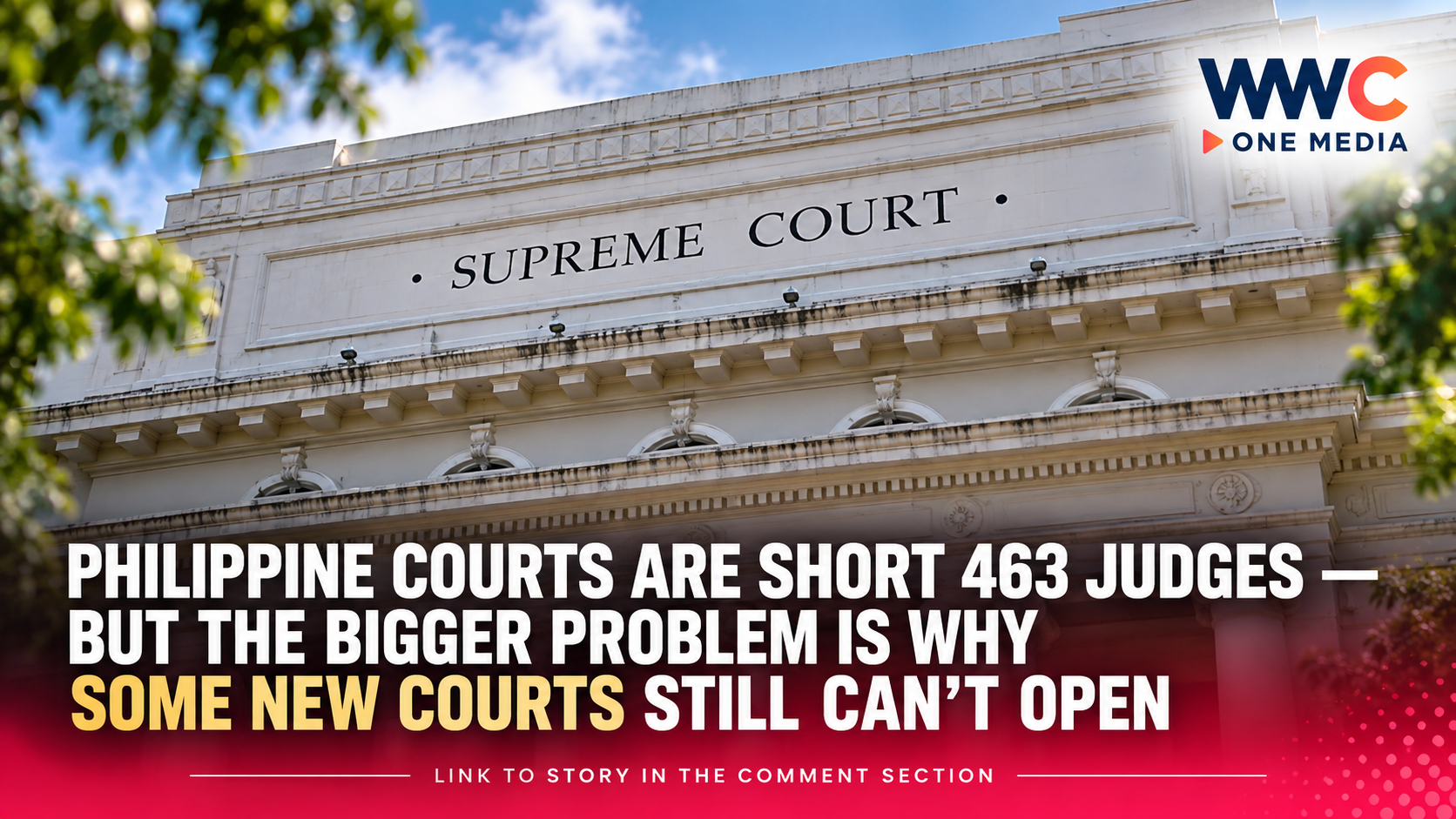
MANILA, Philippines — Hundreds of judgeships across the Philippine judiciary remain vacant even as new courts are being created to bring justice closer to communities — exposing a staffing problem that lawmakers warn could keep cases trapped in already congested court dockets.
Court Administrator Ma. Theresa Dolores Gomez-Estoesta told the House Committee on Appropriations that 463 judge positions are currently vacant, representing 16.7 percent of the Judiciary’s authorized judicial positions.
The disclosure came during congressional deliberations on the Judiciary’s proposed 2027 budget, after lawmakers raised questions over why shortages persist despite the creation of additional Regional Trial Courts, Family Courts and other judicial branches.
The number is significant not simply because hundreds of seats remain empty. Every unfilled judgeship can potentially mean heavier caseloads for sitting judges, slower hearings and longer waits for litigants seeking decisions.
And in some places, the problem begins even before anyone can apply for the bench.
Some new courts exist on paper — but are not yet fully organized
Gomez-Estoesta explained that some newly created courts remain “unorganized” because they are still awaiting a Notice of Organization, Staffing and Compensation Action, or NOSCA, from the Department of Budget and Management.
The document is important because it formally authorizes the organization and staffing of newly created offices and positions.
Without the required staffing action, the Judiciary may be unable to proceed normally with filling positions in those courts.
That distinction is important: the Judiciary did not say that every one of the 463 vacant judgeships is caused by delayed NOSCAs. Rather, officials identified the staffing-document process as one of the obstacles affecting the organization of some newly created courts.
The concern drew an immediate reaction from Cagayan de Oro Rep. Rufus Rodriguez, a vice chair of the House appropriations panel.
Rodriguez noted that some courts had already been created five to seven years ago, arguing that communities in various cities and provinces urgently need those courts to become operational as case backlogs continue to mount.
A 2025 law could change the process
The possible breakthrough may come from Republic Act No. 12233, the Judiciary Fiscal Autonomy Act, which President Ferdinand Marcos Jr. signed into law on August 14, 2025.
The law strengthens the Judiciary’s constitutional fiscal autonomy and gives the Supreme Court greater authority over its organizational and personnel requirements.
One provision directly addresses the staffing bottleneck: DBM is required to act within 120 days after receiving a Supreme Court request for a NOSCA covering newly created positions.
If DBM fails to act within that period, the Supreme Court may take appropriate measures under the authority granted by the law.
For a court system struggling to fill hundreds of judgeships, that provision could become critical.
But another piece of the reform is still being completed.
Supreme Court Associate Justice Jose Midas Marquez told lawmakers that the implementing rules and regulations for the Judiciary Fiscal Autonomy Act had already been submitted to the Court En Banc and were under review.
With the Supreme Court on recess in September, Marquez said approval of the rules would be pushed when the Court resumes in October.
He also stressed that several provisions of the law are self-implementing, meaning the Judiciary does not necessarily have to wait for the complete IRR before exercising powers already provided by the statute.
That could allow the Judiciary to move toward organizing courts and eventually referring judgeship vacancies to the Judicial and Bar Council, which screens applicants for judicial appointments.
DBM says only three staffing requests are pending
There is another important detail in the budget hearing.
DBM Director Carlos Castro told lawmakers that the agency currently had only three pending Judiciary budget requests related to the creation of positions.
Castro also said funding could be sourced from the Miscellaneous Personnel Benefits Fund when the positions are eventually filled.
That suggests the vacancy problem is more complicated than a single backlog sitting inside one government agency.
Judicial appointments require several stages — from formally organizing and funding a court, to opening the judgeship for applications, screening nominees through the JBC and ultimately appointing qualified judges.
Any slowdown along that chain can leave a courtroom without a permanent judge.
Judiciary budget set for a major increase
The staffing issue is unfolding as the Judiciary prepares for a sizable funding increase.
Under the proposed 2027 national budget, the Judiciary would receive approximately ₱86.27 billion, up 22.2 percent from its roughly ₱70.6-billion 2026 allocation.
Around ₱45.9 billion of the proposed 2027 budget is earmarked for the Adjudication Program, covering personnel and operating requirements of the Supreme Court and lower courts as well as the Presidential Electoral Tribunal, Sandiganbayan, Court of Appeals and Court of Tax Appeals.
The House Committee on Appropriations has expressed broad support for the Judiciary’s spending plan, with lawmakers repeatedly linking adequate court funding to the need to reduce case backlogs and improve access to justice.
The Judiciary has also sought additional funding beyond the proposed allocation, including billions of pesos for major Hall of Justice construction projects in Cebu City and Cagayan de Oro.
But more money alone will not automatically place judges behind empty benches.
The real test: turning new courts into functioning courts
Creating additional courts is intended to spread caseloads, shorten proceedings and make the justice system more accessible — particularly in fast-growing cities and provinces where existing branches may be handling far more cases than originally anticipated.
Yet a newly created branch cannot substantially ease a backlog if it lacks a judge and the staff needed to operate.
That is why the 463 vacancies revealed in Congress have become more than a personnel statistic.
They represent a practical test of whether the Judiciary Fiscal Autonomy Act can translate institutional reform into functioning courtrooms.
The law has already changed the rules governing judicial finances and staffing authority. The proposed 2027 budget would also give the courts considerably more resources.
What remains to be seen is how quickly those changes can produce the result litigants are actually waiting for:
more judges hearing more cases — and fewer courtrooms waiting years to become fully operational.
WWC ONE MEDIA M.J.E