
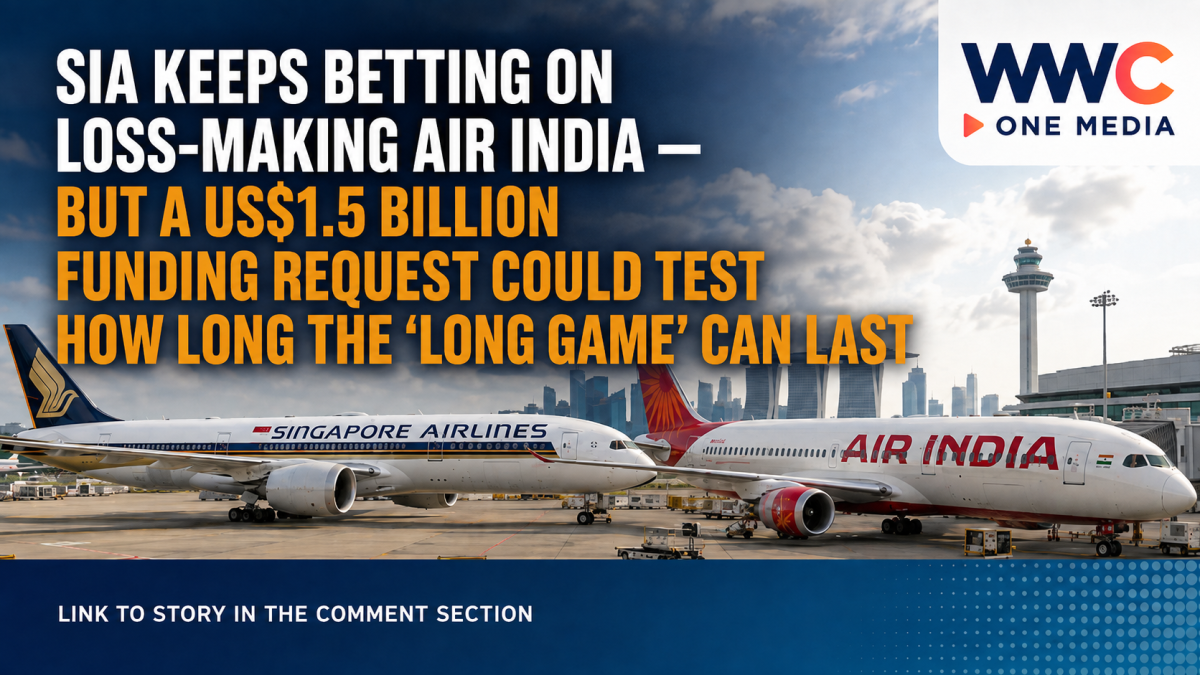
SINGAPORE — Singapore Airlines’ investment in Air India is entering perhaps its toughest test yet: the Indian carrier is burning through billions during a massive overhaul, its owners have been approached for another US$1.5 billion in fresh equity, and Tata Sons has warned that a full turnaround could take as long as a decade.
Yet SIA is showing no sign that it is ready to abandon the bet.
The Singapore carrier holds a 25.1% stake in Air India, with Tata Sons controlling the rest. SIA obtained the stake after the merger of its former Indian joint venture Vistara with Air India was completed in November 2024. For SIA, the transaction was never simply about buying into one airline — it was a strategic route into one of the fastest-growing aviation markets in the world.
Now that strategy is colliding with an expensive reality.
Air India and budget carrier Air India Express recorded combined losses of about US$2.33 billion in the financial year ended March 2026, more than double the previous year’s losses, according to Reuters reporting. Air India itself reported a net loss of about ₹222.38 billion, or US$2.32 billion, for the year.
And the bill for fixing the airline is still growing.
Another US$1.5 Billion Could Be Needed
Air India is seeking approximately US$1.5 billion in fresh equity from Tata Sons and Singapore Airlines, according to people familiar with the discussions cited by Reuters.
The funding has not been finalised, an important distinction amid speculation over how much more money SIA could ultimately put into the carrier.
Singapore Airlines has said its board will carefully consider requests for additional capital while taking into account Air India’s strategy as well as the SIA Group’s own capital requirements.
If a US$1.5 billion injection were funded strictly according to existing ownership percentages, SIA’s 25.1% portion would mathematically amount to roughly US$376.5 million. That is an illustrative calculation, however — not an announced SIA commitment.
The growing capital requirement has intensified questions in Singapore over just how much financial pain SIA should accept before its India strategy begins delivering measurable returns.
Why SIA Is Still Holding On
The answer is bigger than Air India’s latest profit-and-loss statement.
SIA has described India as an important part of its multi-hub strategy, giving the group exposure beyond its Singapore home base.
Its stake in Air India offers something extremely difficult to recreate from scratch: access to a vast domestic network, valuable airport slots, international traffic rights and a position inside an aviation market with enormous long-term growth potential.
Air India could also eventually strengthen Delhi and Mumbai as international connecting hubs, potentially capturing passengers who currently travel between India and the rest of the world through competing hubs in Southeast Asia and the Middle East.
That is the strategic prize SIA appears unwilling to surrender.
SIA chief executive Goh Choon Phong has repeatedly characterised the India investment as a long-term undertaking, saying the company understood even during the Vistara years that building a major position in the country would be a “long game”.
But the ‘Long Game’ Just Got Longer
The problem is that the turnaround timetable has stretched dramatically.
When Tata regained control of the formerly state-owned Air India in January 2022, the airline launched a five-year transformation programme known as Vihaan.AI.
By July 2026, Tata Sons chairman N Chandrasekaran was warning that completing Air India’s transformation could instead require up to a decade.
He cited persistent supply-chain problems, legacy systems, organisational culture, fleet renewal requirements and the need to expand the airline’s technical workforce. The carrier has also been hit by high fuel costs and geopolitical disruptions affecting important international routes.
Pakistan’s airspace restrictions on Indian airlines and disruption linked to conflict in the Middle East have further complicated Air India’s international operations and raised costs.
That means SIA may have to wait years — while potentially committing more capital along the way — before it knows whether the investment can generate returns matching the risk.
SIA Is Already Feeling the Financial Impact
The consequences are no longer confined to Air India’s accounts.
Singapore Airlines reported a S$76 million net loss for the first quarter of its 2026 financial year, despite record revenue, as higher fuel costs and a larger share of losses from Air India weighed on its results.
That has sharpened scrutiny of the investment.
Temasek, the Singapore state investment company and SIA’s majority shareholder, publicly backed SIA’s long-term Air India strategy in late August while acknowledging the complexity of the turnaround.
The debate nevertheless intensified after Air India’s latest request for capital, with questions emerging in Singapore over the potential exposure of SIA — and indirectly one of Singapore’s most prominent state-linked investments — to a carrier still posting heavy losses.
Air India Is Trying to Change the Equation
There are signs the overhaul is moving beyond branding and aircraft interiors.
Air India has been upgrading cabins, lounges and onboard service while overhauling parts of its fleet and integrating operations following the Vistara merger.
More significantly, the airline appointed former Ethiopian Airlines chief Tewolde Gebremariam as chief executive and managing director on August 5, succeeding Campbell Wilson.
Tewolde spent more than a decade leading Ethiopian Airlines and is credited with helping transform it into one of Africa’s largest airline groups. Air India said his appointment followed a search for a leader with experience in large-scale airline transformation, operational excellence and profitable expansion.
He inherits a daunting list of problems.
Beyond its financial losses, Air India continues to face regulatory and safety scrutiny following the deadly Boeing 787 crash in Ahmedabad in June 2025, which killed 260 people. Fleet refurbishment has also been slowed by global supply-chain shortages, while the airline is managing an enormous aircraft order book as it tries to replace ageing planes and expand.
What SIA Needs to See Next
For Singapore Airlines, the argument for remaining invested is straightforward: walking away would mean potentially giving up a strategic position in a market that could become even more important to global aviation.
But market size alone does not guarantee profits.
What matters now is whether Air India can begin converting its advantages — its domestic scale, international network, airport access and powerful Tata backing — into improving operational performance and progressively smaller losses.
That is why the next stage of Air India’s turnaround may matter more than another upgraded cabin or aircraft delivery.
SIA needs evidence that each new dollar invested is moving Air India closer to sustainable profitability rather than simply financing another year of restructuring.
And that is where the US$1.5 billion question becomes critical.
The request itself does not mean SIA has lost faith in Air India. But after record losses and a turnaround timetable that could stretch toward a decade, every additional capital injection raises the threshold Air India will eventually have to clear for the investment to be judged a success.
SIA entered India expecting a long game.
The question now is how long — and how expensive — that game can become before one of Asia’s most respected airlines decides the potential prize is no longer worth the price.
WWC ONE MEDIA MJE




Leave a Reply