
Singapore MPs’ Allowance Jumps to S$18,500 a Month — But the Bigger Change Could Be What It’s No Longer Tied To

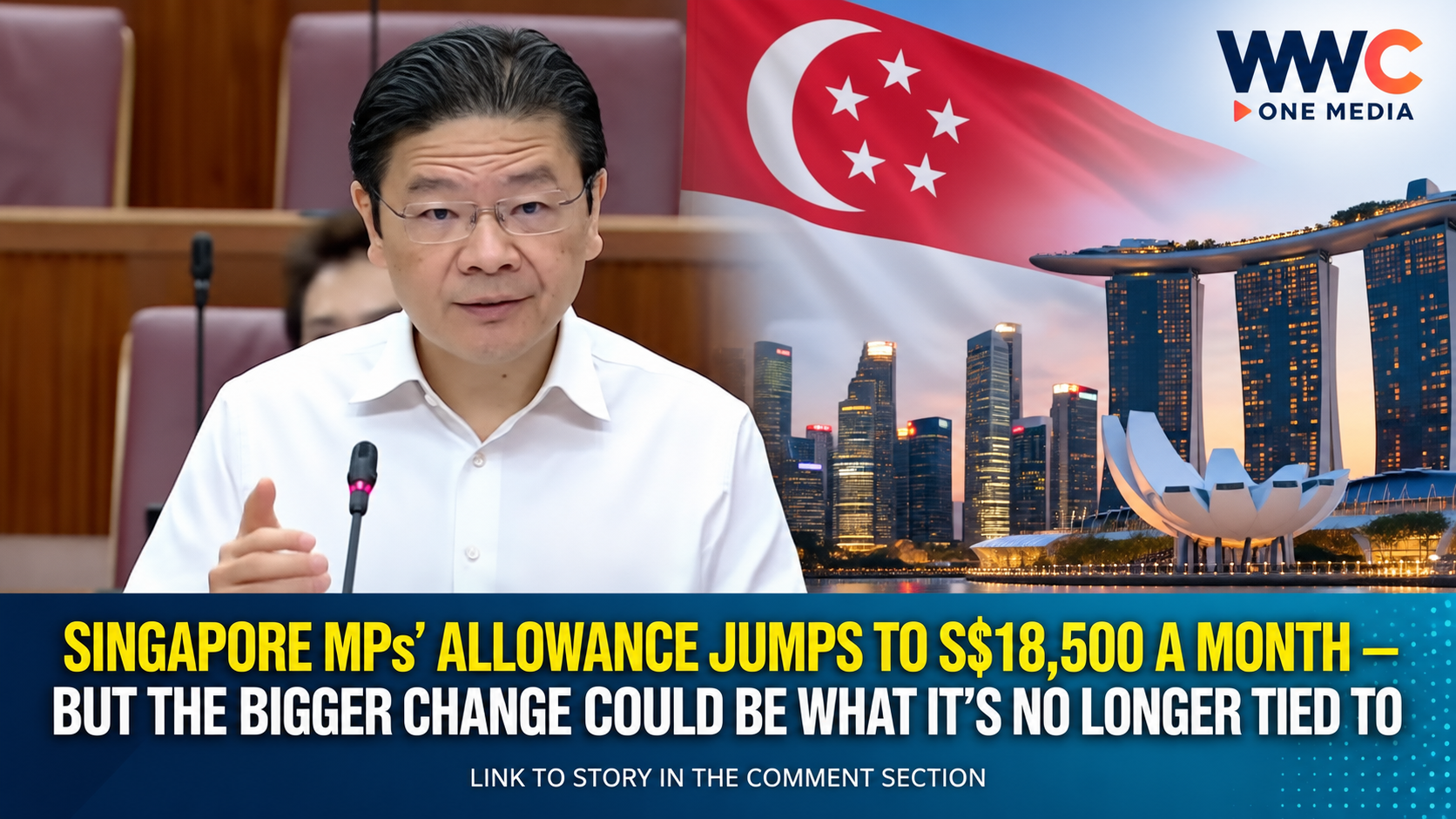
SINGAPORE — Members of Parliament in Singapore will see their monthly allowance rise sharply from S$13,750 to S$18,500 from October 15, 2026, as the government moves ahead with one of the most closely watched updates to political compensation in more than a decade.
The S$4,750 monthly increase works out to roughly 34.5%, immediately putting the size of the adjustment in the spotlight.
But the bigger structural change may still be ahead.
The government is also studying whether allowances for MPs and other community-related political roles should continue to be linked to the salary benchmark used for entry-level ministers — potentially rewriting a system that has shaped parliamentary compensation since the 2012 political-pay reforms.
Why Singapore Is Raising MPs’ Allowances
Prime Minister Lawrence Wong announced the new allowance in Parliament on Tuesday, September 8, saying Singapore does not view an MP’s compensation as merely symbolic.
MPs carry responsibilities both inside Parliament and in their constituencies, including representing residents, scrutinising government policy, debating legislation and voting on national budgets.
Coordinating Minister for Public Services Chan Chun Sing said the latest increase was intended to account for inflation since the previous framework was established.
The government accepted the review committee’s view that the MP allowance set following the 2012 review had been appropriate at that time, making an inflation-linked update reasonable after more than a decade.
The change means an elected MP will receive S$18,500 per month, compared with S$13,750 previously.
That is an additional S$4,750 per month, equivalent to S$57,000 across 12 regular monthly payments. However, that simple comparison should not be confused with an MP’s complete annual package because Singapore’s established framework also provides for additional components such as a 13th-month payment and an annual variable component.
The Bigger Question: Should MP Pay Still Be Linked to Ministers?
For years, an MP’s annual allowance has been pegged at 17.5% of the MR4 benchmark, the reference salary used for an entry-level minister.
That arrangement dates back to the major political-pay restructuring introduced following the 2012 review.
But the latest independent committee, chaired by Gerard Ee, concluded that MPs and mayors perform roles that differ from those of full-time political appointment holders.
The committee therefore recommended examining whether payments for these community-related positions should be determined using a separate basis rather than automatically following the MR4 ministerial benchmark.
The government has agreed to study that proposal.
In practical terms, the immediate S$18,500 increase will still proceed on October 15, while officials work on a possible new formula for future adjustments.
That distinction could prove more significant over the long term than the headline increase itself: Singapore is not merely adjusting the number — it is reconsidering the mechanism that determines the number.
NCMP Allowance Will Double as a Share of MP Compensation
Non-Constituency Members of Parliament, or NCMPs, will also receive a significant adjustment.
Their allowance will increase from 15% to 30% of an elected MP’s annual allowance, translating into S$5,550 a month under the revised structure.
The government said this reflects the expansion of NCMP parliamentary responsibilities following the introduction of full voting rights for NCMPs in 2017.
The revised NCMP allowance will also take effect on October 15.
For Nominated MPs, or NMPs, the existing 15% peg will remain.
MPs’ Increase Comes During Wider Political Salary Review
The MP allowance announcement forms part of a much broader and politically sensitive review of how Singapore compensates its political leaders.
Separately, political office holders are set to receive a one-off salary adjustment of up to 9%.
For an MR4 minister currently earning the S$1.1 million reference salary, a full 9% adjustment would lift that figure to roughly S$1.2 million annually.
That should not be confused with the committee’s newly recommended S$1.8 million MR4 benchmark.
Prime Minister Wong made clear that ministers will not immediately be moved to the S$1.8 million level. Future changes after the one-off adjustment will depend on factors such as performance, responsibilities and the minister’s position within the salary range.
That nuance is important because some descriptions of the political-pay review can make it appear as though every entry-level minister will immediately begin collecting S$1.8 million a year. The government’s announced implementation does not do that.
Why Singapore Pays Political Leaders Differently
Singapore has long defended relatively high political salaries on the grounds that government must be able to attract capable people who could otherwise command significantly higher compensation in the private sector.
The ministerial benchmark has historically been linked to the earnings of the top 1,000 Singapore citizen earners, with a discount built in to reflect public service.
Wong told Parliament that competitive compensation gives Singapore a better chance of convincing high-calibre candidates to enter politics. He said he had personally approached senior civil servants and private-sector chief executives before the last general election, only for several to decline.
Reuters noted that political salaries remain a sensitive issue in Singapore, especially because the amounts are far above what most residents earn. Singapore's median monthly income was S$5,775 in 2025, according to figures cited by Reuters.
That makes the debate more than an accounting exercise.
It goes directly to a longstanding policy question: How much should Singapore pay to attract political talent while maintaining public confidence that political service remains fundamentally about service rather than remuneration?
“Clean Wage” Principle Remains
Despite the changes, the government is retaining what it calls Singapore’s “clean wage” principle for political compensation.
Under this approach, compensation is intended to be transparent rather than supplemented by extensive hidden benefits or perks.
The government said existing benefit provisions will remain, including medical coverage through the Medisave-cum-Subsidised Outpatient scheme.
The 2012 review similarly described MPs as receiving allowances for the time and expenses associated with their parliamentary work while treating the MP role as distinct from a full-time executive political appointment.
Political Debate Is Not Over
The September 8 announcements do not close the issue.
Parliament is scheduled to debate the government's response to the political-salary review on Thursday, September 10, keeping scrutiny focused not only on how much MPs and ministers receive but also on the philosophy behind Singapore's political compensation system.
For MPs, the immediate headline is straightforward: S$13,750 becomes S$18,500 a month from October 15.
But the more consequential story could be what happens afterward.
If Singapore eventually separates MP and mayor allowances from the MR4 ministerial benchmark, the government will have to answer a much harder question:
What exactly should an MP’s public-service responsibilities be worth — and what should determine that figure the next time political pay comes under review?
WWC ONE MEDIA M.J.E