
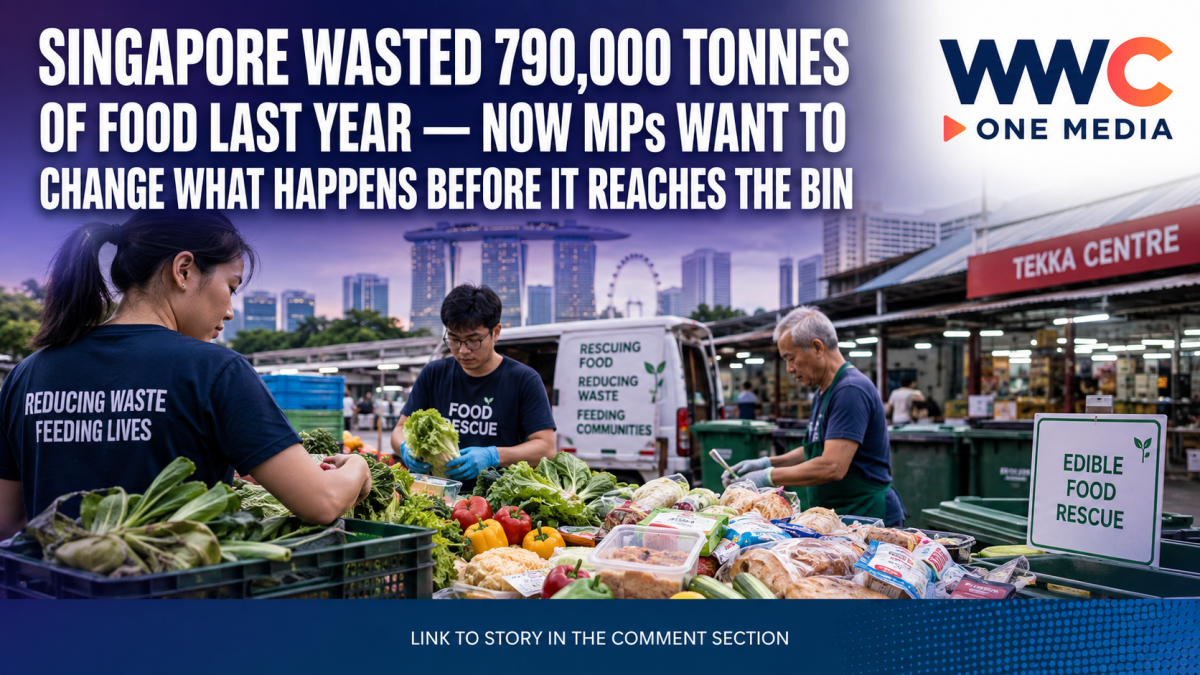
SINGAPORE — Singapore lawmakers are preparing to put food waste and food security under fresh scrutiny, as the city-state confronts a difficult contradiction: it remains heavily dependent on overseas food supplies while throwing away hundreds of thousands of tonnes of food every year.
The People’s Action Party’s Government Parliamentary Committee (GPC) for Sustainability and the Environment is set to table a private member’s motion calling for stronger food resilience and a more coordinated national effort to reduce food waste. The motion is scheduled to be debated when Parliament’s next sitting begins on September 8, 2026.
The proposal will be introduced by GPC chair Poh Li San, deputy chair Nadia Ahmad Samdin, and fellow committee members Valerie Lee and Ng Shi Xuan. Their push comes as geopolitical instability, climate shocks and disruptions to major shipping routes are adding new pressure to food and energy supply chains.
790,000 tonnes of food wasted in one year
The scale of Singapore’s food-waste problem is significant.
According to the National Environment Agency, Singapore generated about 790,000 tonnes of food waste in 2025, up from 784,000 tonnes in 2024. Food waste represented roughly 11% of all waste generated, while only 18% was recycled. About 649,000 tonnes were disposed of rather than recycled.
That means that despite years of sustainability campaigns and waste-reduction measures, the national food-waste recycling rate has remained stuck at around 18% for several years.
Poh said the parliamentary motion will examine whether Singapore can attack the problem earlier in the food chain—not simply after unwanted food has already become waste.
Among the areas expected to come under discussion are better demand forecasting by importers and suppliers, stronger food-redistribution networks and additional support for organisations that rescue edible surplus food before it is discarded.
Three food-rescue organisations highlighted by Poh—The Food Bank Singapore, Food Rescue Sengkang and Fridge Restock Community—collectively rescue about 2,400 tonnes of food annually, according to figures she cited.
That figure illustrates the scale of the challenge. It is equivalent to only about 0.3% of Singapore’s total annual food-waste tonnage, although the comparison is not exact because not all food classified as waste is edible or suitable for redistribution.
Poh is expected to call for grants that could help food charities expand their operations. She also wants authorities to consider measuring food loss—food spoiled before it can be consumed—separately from food that is discarded unnecessarily, potentially giving policymakers a clearer picture of where intervention would have the greatest impact.
The bigger issue: Singapore imports more than 90% of its food
Waste reduction is only one side of Singapore’s food-security equation.
The Singapore Food Agency says the country still imports more than 90% of its food, leaving it exposed when wars, export restrictions, disease outbreaks, extreme weather or transportation disruptions hit international supply chains.
Singapore has attempted to reduce that vulnerability by spreading its supply network across more countries. In 2025, the Republic sourced food from more than 180 countries and regions, compared with about 140 roughly two decades earlier.
But diversification does not eliminate global risk.
Shipping through the Strait of Hormuz, one of the world’s most strategically important energy routes, has recently been disrupted by escalating Middle East tensions. Reuters reported on September 2 that commodity-vessel traffic remained below its recent average as renewed US-Iran hostilities increased uncertainty around the waterway.
Higher energy, freight, fertiliser and agricultural costs can eventually work their way through food supply chains, making the question of resilience more immediate for import-dependent economies such as Singapore.
Singapore has already rewritten its farming strategy
The parliamentary debate will also come less than a year after Singapore significantly revised its approach to local food production.
The government replaced its earlier “30 by 30” ambition—which sought to produce 30% of Singapore’s nutritional needs locally by 2030—with more targeted goals under Singapore Food Story 2.
By 2035, authorities aim for local farms to supply 20% of Singapore’s fibre consumption, covering selected vegetables, beansprouts and mushrooms, and 30% of protein consumption, specifically eggs and seafood.
Singapore remains well short of the fibre target. SFA figures show locally produced food supplied around 8% of fibre consumption and 25% of protein consumption in 2025.
Reuters reported when the previous 30-by-30 strategy was dropped that limited land, high operating costs and difficulties developing the agri-food sector had complicated Singapore’s attempt to rapidly expand domestic production. The Straits Times similarly reported that the revised targets followed a year-long review amid challenges including high costs and pressure on local farms.
Singapore Food Story 2 now takes a broader approach built around four pillars: diversifying imports, international partnerships, stockpiling and growing food locally.
Could food waste become part of Singapore’s security strategy?
That is where the coming parliamentary motion could broaden the debate.
Food security is traditionally discussed in terms of farms, imports, emergency reserves and international suppliers. But the GPC’s argument effectively raises another question: What is the value of securing additional food supplies if substantial amounts of food already inside Singapore are ultimately discarded?
Nadia Ahmad Samdin is also expected to raise the question of how Singapore can put food resilience higher on the regional agenda when the country assumes the ASEAN chairmanship in 2027, as well as whether agricultural land should be managed as a diversified “portfolio” of farms rather than simply evaluated project by project.
The GPC conducted two public engagement sessions involving about 130 people in May and July ahead of the motion.
The proposals are not government policy yet, and their eventual impact will depend on what Parliament and the government decide after the debate.
But the numbers already frame the problem clearly: Singapore imports more than 90% of its food, local farms currently supply only a fraction of several major food categories, and the country generated 790,000 tonnes of food waste in a single year.
For one of the world’s most import-dependent economies, reducing that waste may increasingly be viewed not merely as an environmental campaign—but as part of the country’s food-security strategy.
WWC ONE MEDIA MJE



Leave a Reply