
Singapore Seeks Deeper South Korea Defence Ties as Global Supply Chains Face Growing Risks

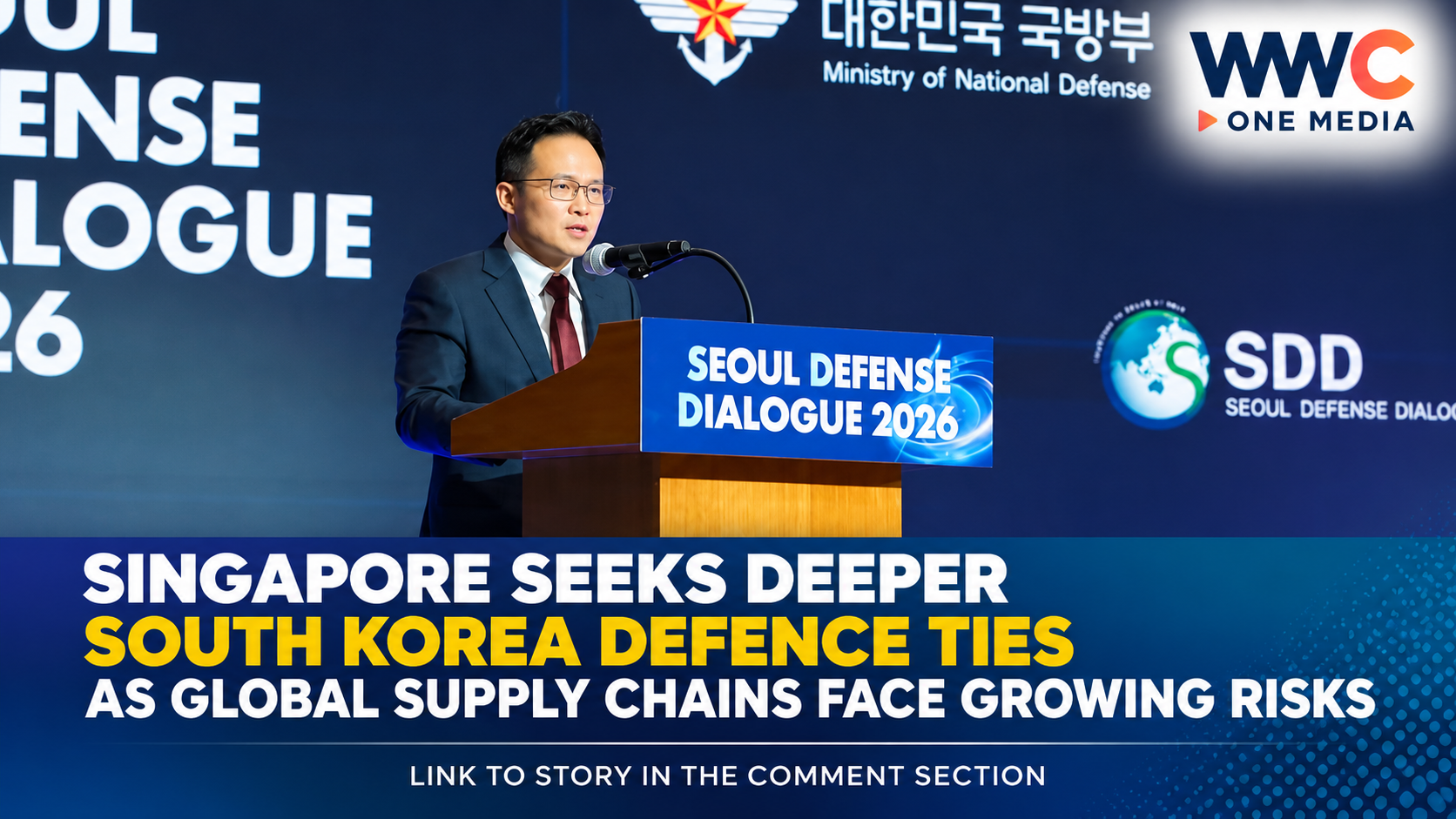
SINGAPORE — Singapore is looking to deepen defence cooperation with South Korea as growing geopolitical tensions and disruptions to global trade expose vulnerabilities in critical supply chains, Minister of State for Defence Desmond Choo said.
Speaking at the 15th Seoul Defence Dialogue in South Korea on Sept. 8, Choo stressed that countries cannot rely solely on domestic production and stockpiles to protect their defence capabilities. Instead, he called for stronger partnerships among trusted countries.
'We are simply stronger together'
Choo warned that supply chains built over decades are increasingly under pressure from conflicts, trade restrictions, export controls and disruptions at major shipping routes.
He pointed to the ongoing conflict in the Middle East, noting that about 90 per cent of oil passing through the Strait of Hormuz is bound for Asia, including Singapore.
A disruption at a single strategic chokepoint, he said, can trigger consequences thousands of miles away, affecting everything from energy and fertiliser supplies to shipping and defence-related goods.
For Singapore, a small and highly open economy, Choo said resilience cannot be achieved by trying to produce every critical capability domestically.
Instead, the country must strengthen its network of trusted partners.
Singapore eyes South Korea defence technology
Choo highlighted South Korea's advanced defence ecosystem, including its major defence companies, industrial capabilities and research and development expertise.
Singapore is particularly interested in expanding cooperation with South Korean defence agencies and companies in emerging technologies.
Potential areas include unmanned systems as well as chemical and biological defence, with South Korea's Agency for Defense Development already described as an important partner.
Choo said Singapore sees considerable room to expand bilateral defence technology cooperation and wants to do more with South Korea's defence sector.
The comments came as Singapore and South Korea continue to strengthen broader military ties and exchanges.
Building stronger defence supply chains
Choo outlined three broad approaches Singapore is pursuing to improve supply-chain resilience.
The first is deeper government-to-government cooperation. Singapore has established supply-chain resilience agreements with countries including New Zealand and Australia, while defence-related agreements with partners such as the United States, Australia, France, Germany and Italy are aimed at strengthening access to equipment, platforms and related support during disruptions.
The second is expanding defence technology cooperation with countries that possess advanced capabilities, particularly South Korea.
The third is continued investment in Singapore's own defence industry, including logistics, sustainment and maintenance, repair and overhaul services.
Singapore is also investing in technologies such as artificial intelligence, predictive maintenance and advanced manufacturing to strengthen its aerospace and defence capabilities.
Local industry also plays a role
Choo stressed that supply-chain resilience is not only about government agreements and international partnerships.
Singapore's private sector, including small and medium-sized enterprises, also has an important role to play.
He cited the locally developed Hunter Armoured Fighting Vehicle, which involved more than 100 local SMEs producing more than 1,400 parts for each vehicle, as an example of how domestic industrial capabilities can contribute to defence resilience.
He also emphasised the importance of training and developing logisticians who can manage increasingly complex supply networks.
Defence resilience becomes strategic priority
The Seoul Defence Dialogue, organised annually by South Korea's Ministry of National Defense, brings together government officials and experts to discuss security issues affecting the Asia-Pacific.
On the sidelines of the forum, Choo met South Korea's Vice Minister of National Defense Lee Doo-hee. The two reaffirmed friendly bilateral defence relations and discussed strengthening military-to-military exchanges, defence technology cooperation and multilateral cooperation through the ASEAN Defence Ministers' Meeting-Plus.
As geopolitical tensions reshape global trade and expose vulnerabilities in critical supply chains, Singapore is betting that stronger defence partnerships — particularly with capable partners such as South Korea — will be essential to keeping the country's security capabilities resilient in an increasingly uncertain world.
WWC ONE MEDIA J.M.D