
Singapore Teens Rank No. 2 in PISA’s New Digital Problem-Solving Test — But One Weak Spot Stands Out

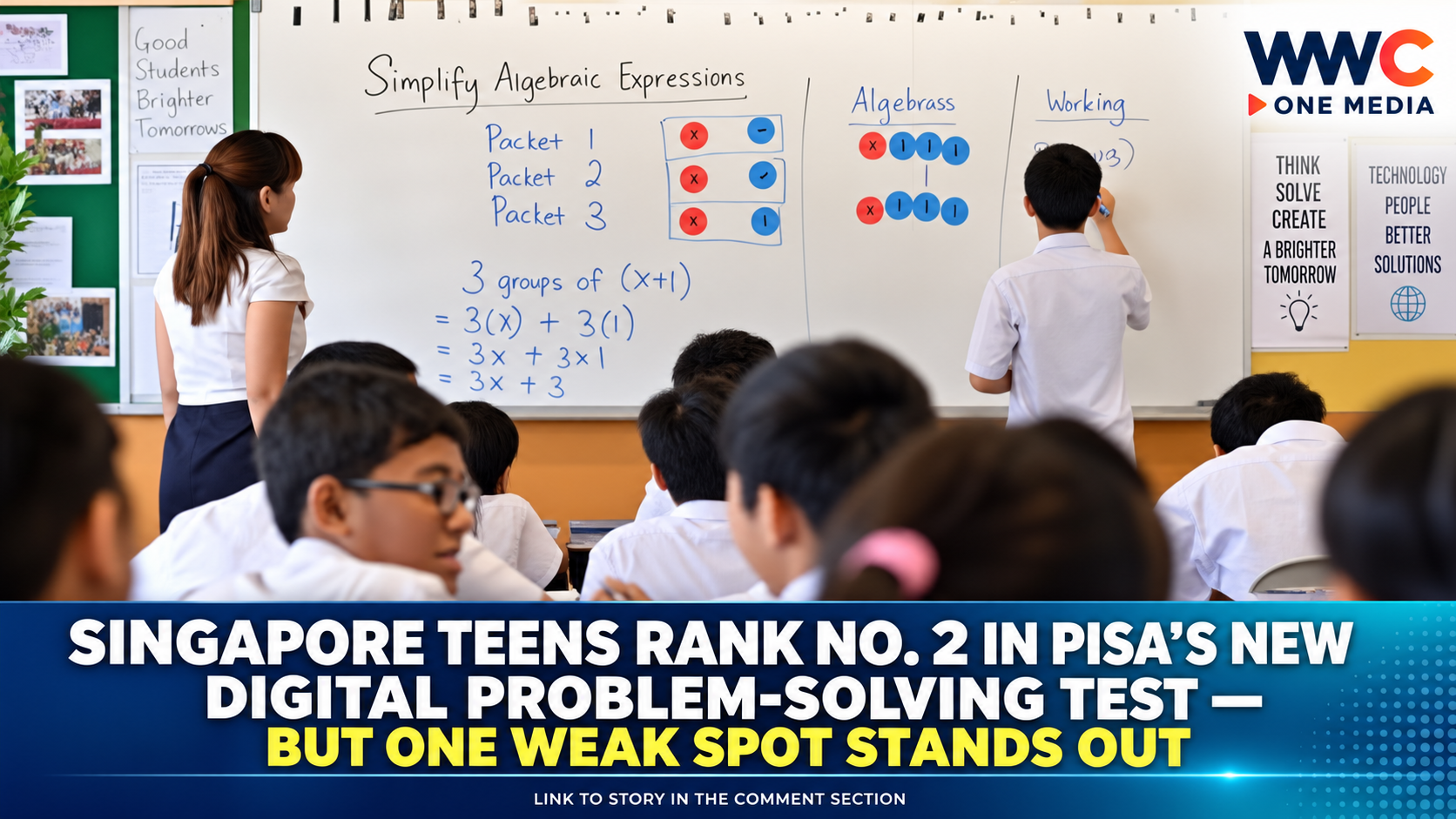
SINGAPORE — Singapore’s teenagers have delivered another eye-catching result on the global education stage, ranking second in a new international assessment measuring how well students can use digital tools and computational thinking to solve complex, real-world problems.
But buried beneath the headline ranking is a more complicated picture of Singapore’s students — one that combines extraordinary academic and digital performance with weaker perceptions of support at home.
Singapore’s 15-year-olds placed second in computational problem solving in the Programme for International Student Assessment, or PISA 2025, behind Macau and ahead of the participating Chinese provinces and municipalities of Beijing, Shanghai, Jiangsu and Zhejiang.
It was the first time PISA assessed the competency as part of its new Learning in the Digital World domain, designed to examine whether students can do more than simply operate technology.
The OECD says the assessment looks at whether young people can learn independently in digital environments, use computational tools to investigate systems, represent ideas and solve unfamiliar problems.
That distinction matters.
This is not simply a test of who can code fastest or who spends the most time using laptops.
It asks something potentially more important for an AI-driven economy: Can students figure out what to do when technology gives them a complicated problem they have never seen before?
MORE THAN HALF OF SINGAPORE STUDENTS REACHED THE TOP LEVELS
About 6,600 Singapore students from 145 public secondary schools and 12 private schools participated in PISA 2025.
More than half of Singapore's students were classified as top performers in computational problem solving, compared with roughly one-quarter of students across OECD countries on average, according to Singapore's Ministry of Education.
MOE said the students demonstrated a strong ability to conduct experiments, analyse data and build, test and debug computational solutions.
The assessment went well beyond conventional multiple-choice questions.
In one exercise, students had to programme a robotic claw to sort objects in a simulated recycling operation.
Another required students to model how different types of exercise could affect fitness, with the scenario involving an application designed to help astronauts remain healthy in low-gravity conditions.
These examples illustrate what PISA is attempting to measure: not memorised programming syntax, but whether students can investigate a problem, work with data, construct a solution and correct it when something goes wrong.
WHY THIS TEST MAY MATTER MORE IN THE AI ERA
The OECD argues that computational problem solving is becoming increasingly important even for people who will never become programmers.
As artificial intelligence, simulations, algorithms and digital systems spread into workplaces, employees increasingly need to understand how to break complicated problems into manageable parts, analyse information and work effectively with computational tools.
PISA's Learning in the Digital World assessment therefore combines computational practices with elements of self-regulated learning — including whether students can decide how to approach unfamiliar tasks, use available learning resources and monitor their own progress.
Globally, more than 760,000 students across 91 countries and economies took part in PISA 2025, according to the OECD. The latest edition also collected information on subjects increasingly central to education policy, including students' curiosity, persistence, agency and use of artificial intelligence for schoolwork.
That makes Singapore's performance particularly notable as governments worldwide debate a difficult question: whether schools should restrict technology because of distraction risks or embrace it more aggressively because digital competence is becoming indispensable.
International coverage of the new PISA results has highlighted that tension.
The Guardian reported that digital distraction remains a serious classroom problem in countries such as Australia, while broader PISA results have also raised concerns about declining reading performance internationally and changing digital habits among young people.
Singapore's results suggest that access to devices alone is not the objective. The more important question is whether students learn to use those devices deliberately to investigate, reason and create.
SINGAPORE ALSO REMAINS NEAR THE TOP IN READING, MATHS AND SCIENCE
The digital result was not Singapore's only strong showing.
Singapore ranked first in reading and second in mathematics and science in PISA 2025.
In mathematics and science, the participating Chinese education system of Beijing, Shanghai, Jiangsu and Zhejiang ranked ahead of Singapore, while Singapore remained ahead in reading.
Singapore had topped all three traditional PISA subjects — mathematics, reading and science — in the previous 2022 assessment.
It also recorded the highest proportion of what MOE described as academic all-rounders in 2025.
About 15 per cent of Singapore students were top performers across mathematics, reading and science simultaneously, compared with an average of around 3 per cent across participating OECD systems.
Singapore also ranked second in PISA's new environmental science module. Around 27 per cent of Singapore students reached the top two proficiency levels, compared with an OECD average of just 7 per cent.
SINGAPORE IS EXPANDING COMPUTING — BUT THE TIMING MATTERS
The results also arrive as Singapore expands computing education.
The Straits Times reported that from 2026, computing is being made available as an elective to a broader range of upper-secondary students under Singapore's G1, G2 and G3 subject framework.
The expanded syllabuses include programming, algorithms, data analysis, digital making, cybersecurity and exposure to emerging technologies such as artificial intelligence.
The policy cannot be credited for the PISA 2025 result because the students were assessed before the 2026 expansion.
But the direction is significant: Singapore is moving toward making computational thinking accessible to a wider range of students rather than treating computing as a specialised skill reserved primarily for technically advanced learners.
And there is historical precedent for Singapore performing strongly in this area.
Singapore students have previously ranked at or near the top of international assessments involving problem solving and creative thinking, including finishing first in PISA 2022's creative-thinking assessment.
BUT ONE SET OF NUMBERS SHOULD GET PARENTS' ATTENTION
For all the impressive academic results, PISA uncovered a less flattering trend.
Singapore students continued to perceive their families as less supportive of their learning than students across OECD countries on average.
Only about 49 per cent said they had weekly conversations with family members about how well they were doing at school.
The OECD average was about 60 per cent.
Even more strikingly, only 39 per cent of Singapore students said family members regularly showed interest in what they were learning, compared with an OECD average of 58 per cent.
MOE said similar concerns had emerged in PISA 2022 and that the figures declined further in 2025.
That produces one of the most important contradictions in the latest results.
Singapore's teenagers are among the world's strongest performers when asked to analyse information, solve unfamiliar problems and manipulate sophisticated digital tools.
Yet many do not feel that the people closest to them are sufficiently engaged with what they are learning.
PISA does not establish that weaker perceived family support causes poorer outcomes — and Singapore's extraordinary academic results clearly show that the relationship is not straightforward.
But MOE itself said children benefit from stronger interactions with parents and pointed families toward government resources intended to strengthen parent-child connections around learning.
ANOTHER WARNING SIGN: PHYSICAL ACTIVITY
There was another area where the results were less encouraging.
Although more Singapore students said they exercised outside school than in 2022, 23 per cent still reported doing no exercise outside school at all.
Taken together, those findings offer a reminder that PISA's latest edition is increasingly looking beyond exam scores.
The question is no longer simply whether students can outperform their international peers.
It is whether education systems are producing young people who can learn independently, use technology responsibly, stay physically and socially healthy and continue adapting after they leave school.
THE BIGGER TEST STARTS AFTER THE RANKING
Singapore's second-place finish in computational problem solving is undoubtedly another major international endorsement of its education system.
It suggests that its students are not merely good at reproducing formulas or memorising material. Many appear capable of analysing unfamiliar situations, experimenting, interpreting data and building digital solutions — precisely the abilities employers increasingly say will matter in workplaces transformed by automation and AI.
But rankings can only reveal part of the story.
Singapore now faces a more consequential challenge: turning world-leading teenage academic performance into lifelong adaptability while ensuring technology becomes a tool for deeper thinking rather than distraction.
And perhaps most importantly, the latest PISA results raise a question that no global ranking can answer:
Can a school system prepare children for an increasingly digital future if many of those children still feel that the people at home are not fully connected to what they are learning?
WWC ONE MEDIA M.J.E