
Singapore, Thailand Revive Leaders’ Retreat After 11 Years as Wong and Anutin Push AI, Energy and ASEAN Cooperation

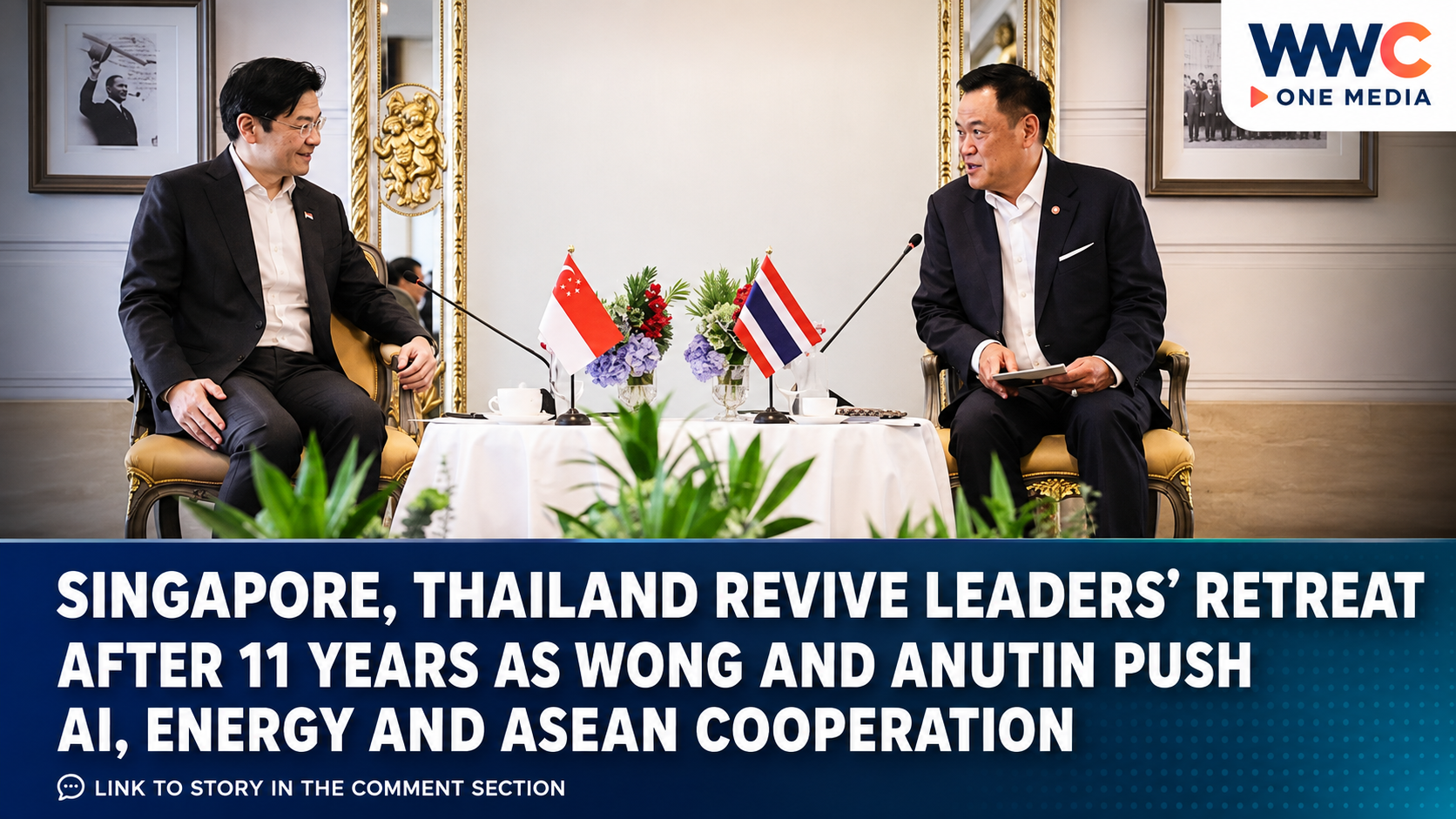
BANGKOK — Singapore and Thailand are moving to turn six decades of close relations into a more ambitious strategic partnership, with Prime Ministers Lawrence Wong and Anutin Charnvirakul reviving their countries’ Leaders’ Retreat after an 11-year break and setting their sights on artificial intelligence, energy security, food supplies and ASEAN’s next chapter.
The leaders met in Bangkok on Wednesday, September 2, for the fifth Singapore-Thailand Leaders’ Retreat — the first since 2015 and the first involving Wong and Anutin.
At the center of the meeting was a new Memorandum of Understanding on social sector development, but the discussions stretched far beyond social welfare. Both governments are increasingly looking at how two of Southeast Asia’s most economically connected countries can work together on problems that are becoming regional rather than purely national.
Under the new social-development agreement, Singapore and Thailand will exchange personnel and expertise, share research on social-welfare policies and programs, organize visits involving social-service institutions, and conduct joint training and capacity-building programs. Cooperation could also extend to issues involving women, families and broader social development.
But the more consequential part of the Bangkok meeting may be what comes next.
From Rice and Payments to AI
Wong said both governments want to convert previously identified priorities into concrete projects, with food security among the most immediate areas of cooperation.
Thailand is one of the region’s major agricultural producers, while Singapore has developed itself as a logistics and trading hub. The two countries already signed a rice-trade cooperation agreement during Anutin's November 2025 visit to Singapore, aimed at improving Singapore's supply resilience while creating opportunities for Thai exporters.
Thai government information released after that earlier visit said the arrangement envisaged Thailand supplying 100,000 tonnes of rice over a five-year cooperation period.
The economic relationship is already substantial. Singapore's Ministry of Trade and Industry said bilateral trade reached about S$44.5 billion in 2024, making Thailand Singapore's ninth-largest trading partner globally and third-largest within ASEAN that year.
Singapore was also Thailand's biggest source of foreign direct-investment applications in 2024, accounting for 357.5 billion baht, or around 43% of Thailand's total FDI applications, according to Singapore's MTI.
Thailand's foreign ministry said ahead of Wednesday's retreat that Singapore has remained Thailand's largest foreign investor for three consecutive years and its largest ASEAN investor for more than a decade.
AI Is Emerging as the New Frontier
Artificial intelligence was another major subject.
Wong said manufacturing, healthcare and tourism could become practical areas for Singapore-Thailand AI collaboration, while both sides could exchange experience on deploying AI safely and responsibly without unnecessarily slowing innovation.
That makes the partnership potentially more significant than a traditional government-to-government technology agreement.
Thailand offers a large industrial, tourism and consumer economy where AI applications can be deployed at scale. Singapore, meanwhile, has developed a strong regional position in technology, finance, research and digital infrastructure.
Combining those strengths could produce projects designed not merely for the two domestic markets but eventually for wider Southeast Asian use.
A Payment Link That Could Become Much Bigger
The two governments also want to expand digital connectivity.
Singapore's PayNow and Thailand's PromptPay were linked in 2021, creating what their governments described as the world's first linkage between two national real-time payment systems.
Instead of stopping with a bilateral connection, Wong said the next step is to link additional countries through a common multilateral framework while creating more opportunities for fintech companies and other digital businesses.
If that effort grows, it could contribute to ASEAN's broader push toward more seamless regional payments — reducing the friction involved when businesses, tourists and consumers move money across Southeast Asian borders.
Energy Security Moves Higher Up the Agenda
Energy was another strategic focus.
Singapore and Thailand are looking at the ASEAN Power Grid, carbon-credit cooperation and other mechanisms to improve energy resilience.
The wider objective of the ASEAN Power Grid is to make cross-border electricity trading easier, allowing countries with different energy resources and demand patterns to support one another through a more interconnected regional system.
Singapore and Thailand have already been involved in regional electricity-connectivity initiatives, while both governments have also been exploring cooperation involving clean energy and carbon markets.
The Bigger Story: ASEAN 2027 and 2028
The Bangkok meeting also carries a geopolitical dimension that could outlast any individual agreement signed this week.
Singapore is scheduled to chair ASEAN in 2027, followed by Thailand in 2028.
Wong said the back-to-back chairmanships create a rare opportunity for the two governments to develop a multi-year ASEAN agenda, allowing major projects to continue rather than being reset every time the rotating chairmanship changes.
The leaders agreed that their teams should work on such an agenda to create continuity between Singapore's and Thailand's respective chairmanships.
That could prove especially important for initiatives that cannot realistically be completed within a single ASEAN chairmanship, including regional energy networks, payment connectivity, digital rules and cross-border infrastructure.
The Thai government had also identified clean energy, rice trade, cross-border payments, tourism and the fight against online scams as practical areas for the renewed partnership. Ahead of the meeting, Bangkok said the countries intended to endorse a forward-looking strategic partnership covering their future relationship.
Why the 11-Year Gap Matters
The Leaders’ Retreat is considered the highest-level bilateral platform between Singapore and Thailand.
Its revival after more than a decade therefore carries symbolic as well as practical significance.
Wong described bilateral relations as being in “excellent shape,” pointing to strong institutional connections and trust between the two countries' leaderships.
Yet Wednesday's meeting suggests both sides want more than ceremonial reassurance.
Their agenda increasingly reflects the pressures reshaping Southeast Asia itself: securing food and electricity supplies, adapting industries to AI, fighting transnational scams, moving money more efficiently across borders and keeping ASEAN initiatives moving despite geopolitical and economic uncertainty.
For Singapore and Thailand, the test will now be whether the renewed Leaders’ Retreat can translate those ambitions into projects people and businesses can actually see.
And with the two countries preparing to lead ASEAN in consecutive years, the partnership being built in Bangkok may ultimately matter far beyond Singapore and Thailand.
WWC ONE MEDIA MJE