
Singapore–Thailand Ties “In Excellent Shape” as Wong and Anutin Revive Leaders’ Retreat After 11 Years

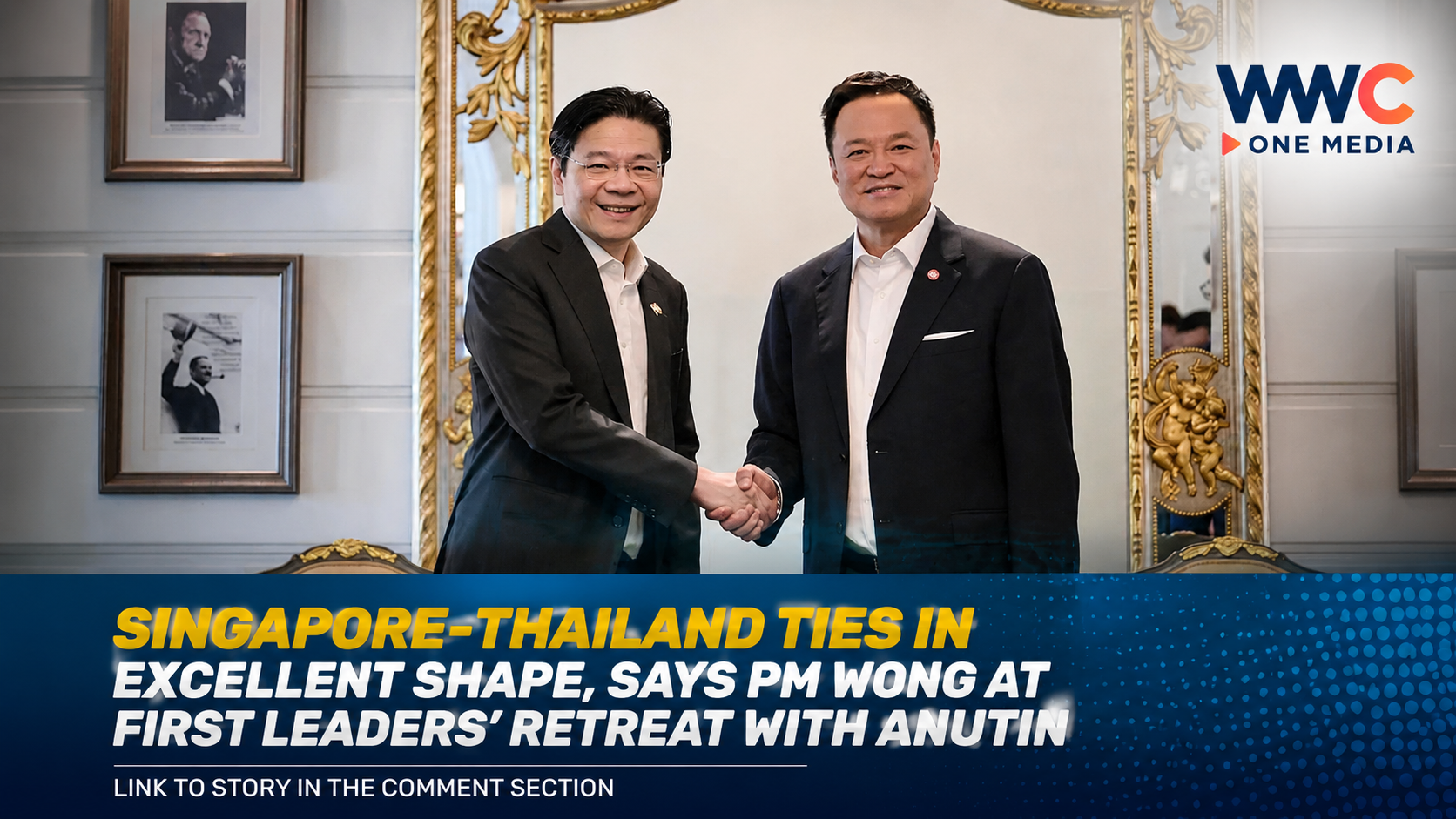
BANGKOK — Singapore and Thailand are stepping up their strategic partnership after more than a decade without a leaders’ retreat, with Prime Ministers Lawrence Wong and Anutin Charnvirakul agreeing to deepen cooperation in energy, food security, artificial intelligence, digital connectivity, defence and the wider ASEAN agenda.
Speaking in Bangkok on Wednesday, Sept. 2, Wong said Singapore–Thailand relations were in “excellent shape,” citing strong trust between the two governments and long-standing institutional ties.
The remarks came during the 5th Singapore–Thailand Leaders’ Retreat, the first such meeting between Wong and Anutin and the first leaders’ retreat between the two countries since 2015.
The meeting marks a significant effort to give fresh momentum to a relationship that has developed across trade, investment, defence, technology and people-to-people links.
A partnership being built for the next phase
Wong and Anutin agreed to advance what Singapore and Thailand describe as a “Forward-Looking Strategic Partnership.”
The two governments said the next phase of cooperation will focus on building economic resilience while expanding collaboration in the green and digital economies, artificial intelligence, energy security, connectivity, food security and efforts against transnational crime.
Wong said the two countries had held “candid and productive” discussions and were focused on turning existing areas of cooperation into concrete projects.
Thailand’s position as a major food producer and Singapore’s role as a regional logistics and trading hub could create opportunities to strengthen food supply chains, particularly as both countries face a more uncertain global environment.
The two sides also discussed energy resilience, including cooperation involving the ASEAN Power Grid and carbon credits.
AI, digital payments and connectivity move higher on the agenda
Artificial intelligence emerged as another major area of cooperation.
Wong said Singapore and Thailand could explore practical AI applications in sectors including manufacturing, healthcare and tourism while sharing experiences on how to encourage innovation while deploying the technology safely and responsibly.
Digital connectivity is also expected to become a larger part of the relationship.
Singapore and Thailand were pioneers of the PayNow–PromptPay linkage, launched in 2021 as the first connection between two national real-time payment systems. The leaders now want to explore how similar connectivity can be expanded through a broader multilateral framework.
Physical connectivity is also on the table, with Singapore indicating that its companies could contribute expertise to Thailand’s efforts to strengthen infrastructure, transport networks and its position as a regional logistics hub.
The bigger story: ASEAN
But perhaps the most consequential part of the meeting extends beyond the two countries themselves.
Singapore will chair ASEAN in 2027, followed by Thailand in 2028.
That creates an unusual opportunity for the two governments to coordinate regional priorities across consecutive chairmanships rather than treating each presidency as a separate one-year agenda.
Wong said the two sides would work toward a multi-year ASEAN agenda designed to maintain continuity and momentum on initiatives requiring sustained regional cooperation.
The joint statement says Singapore and Thailand intend to coordinate on regional integration, connectivity, resilience and cooperation with external partners while maintaining ASEAN centrality. The leaders also reaffirmed their support for an open, rules-based and inclusive regional architecture.
The timing is significant. ASEAN is facing growing geopolitical and economic pressures, making continuity between successive chairmanships potentially important for issues that cannot be resolved within a single year.
Defence cooperation remains a pillar
Despite the growing emphasis on technology and economic cooperation, defence remains an important part of the bilateral relationship.
Singapore has long conducted military training in Thailand, and Wong said Singapore appreciated Thailand's continued hosting of Singapore Armed Forces training activities.
The leaders agreed to maintain and deepen defence and security cooperation while also expanding cooperation in areas such as combating transnational crime.
A new social-sector agreement
The leaders also witnessed the signing of a new memorandum of understanding covering social-sector development.
The agreement provides for exchanges between relevant institutions, knowledge and research sharing, visits to social-service institutions and joint capacity-building activities such as workshops and training.
The cooperation can also extend to areas involving women, families and social welfare and development.
CNA reported that the agreement was signed by Singapore Social and Family Development Minister Masagos Zulkifli and Thailand’s Social Development and Human Security Minister Nikorn Soemklang.
Strong economic foundations
The renewed political engagement comes on top of substantial economic ties.
Singapore has remained one of Thailand’s largest foreign investors, while both governments have sought to deepen trade and investment links as global supply chains face increasing uncertainty.
The relationship has also expanded beyond traditional commerce. During Anutin’s official visit to Singapore in November 2025, the two countries signed agreements covering rice trade and healthcare cooperation, while also discussing digital cooperation, carbon credits, cybercrime and renewable-energy connectivity.
The two countries celebrated 60 years of diplomatic relations in 2025, giving the latest retreat an additional backdrop of more than six decades of bilateral ties.
What comes next?
The immediate headline from Bangkok is that Singapore and Thailand remain close.
But the more important question is what the two governments can actually deliver from the ambitious agenda they announced.
The leaders have tasked their ministers and agencies with following up through existing mechanisms such as the Singapore–Thailand Civil Service Exchange Programme and the Singapore–Thailand Enhanced Economic Relationship platform.
And with Singapore preparing to lead ASEAN in 2027 and Thailand taking over in 2028, their partnership could soon extend far beyond bilateral relations.
For Wong and Anutin, the 2026 retreat was not simply a return to an old diplomatic format. It was an attempt to build a coordinated roadmap for the next phase of Singapore–Thailand relations — and potentially for ASEAN itself.
Sources: The Straits Times, Channel NewsAsia, Singapore Prime Minister’s Office, Singapore Ministry of Foreign Affairs, and Thailand’s government and Ministry of Foreign Affairs.
WWC ONE MEDIA G.A