
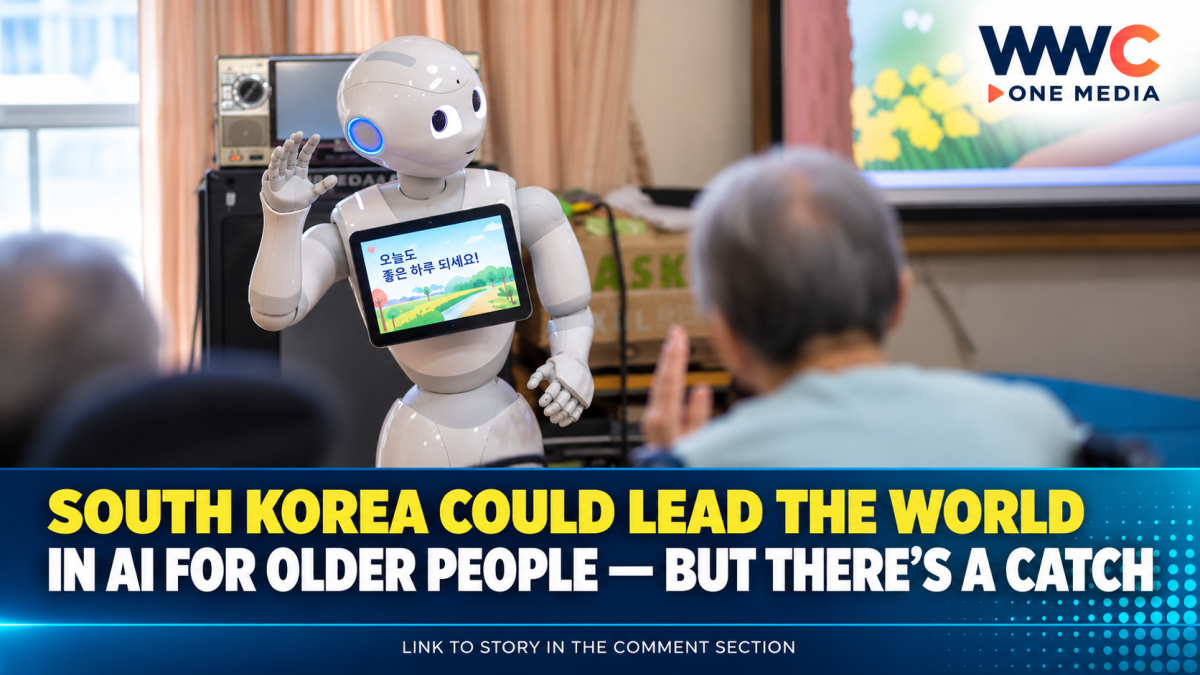
South Korea’s rapidly aging population could give the country an unexpected advantage in the global artificial intelligence race — if it can make sure AI works for older people rather than leaving them behind.
That is the assessment of Zvezdan Pirtosek, the U.N. Independent Expert on the enjoyment of all human rights by older persons, who says South Korea is uniquely positioned to develop and test AI systems designed around the needs, rights and experiences of older adults.
Pirtosek made the remarks during an interview with The Korea Times on the sidelines of the 6th ASEM Forum on Human Rights of Older Persons in Seoul.
His argument is straightforward but potentially far-reaching: South Korea is experiencing two transformations at the same time — one of the world’s fastest demographic shifts and rapid technological adoption.
That combination could allow Korea to become a global testing ground for what age-inclusive artificial intelligence should look like.
But there is a warning attached.
If AI is designed without older people at the table, the same technology that promises greater independence could instead create a new form of digital exclusion.
Korea has entered the super-aged era
South Korea’s demographic transformation is happening at extraordinary speed.
According to the Korea Times report, people aged 65 and older now account for more than 20 percent of the country’s population, making South Korea a super-aged society. The country’s fertility rate also remains among the world’s lowest, at around 0.8.
Research from the Carnegie Endowment for International Peace underscores the scale of the demographic shift.
The organization says South Korea crossed the 20-percent threshold in 2024 and projects that people aged 65 and above could account for 30 percent of the population by 2036 and more than 40 percent by 2050.
It also notes that Korea reached super-aged status in less than 25 years — a much faster transition than many other developed countries experienced.
That speed is putting pressure on healthcare, social welfare, caregiving and the labor force.
And that is where AI could become increasingly important.
Why AI could change elderly care
Artificial intelligence is already being used in areas that directly affect older people.
AI-powered systems can assist with health monitoring, identify potential falls, provide reminders, help people access information and support independent living.
At the ASEM forum in Seoul, Pirtosek said AI could help address some of the pressures facing aging societies, particularly as shortages of care workers become more severe.
South Korea is already experimenting with these technologies.
A recent report by Gulf News, citing AFP, highlighted the use of AI companion dolls among elderly South Koreans living alone. The devices can converse with users, remind them to eat or take medication and help establish daily routines.
The report said around 14,500 AI companion dolls were being used across South Korea through individual ownership, government programs and care facilities.
That gives Korea something few countries can easily replicate: a real-world environment in which new technologies can be tested against the needs of one of the world’s fastest-aging populations.
But the UN expert says technology alone is not enough
Pirtosek’s message is not simply that Korea should build more AI.
It is that Korea should build better AI for older people.
He urged policymakers to adopt a principle he described as “rights before scale.”
That means human rights, privacy, informed consent and individual autonomy should be considered before AI systems are rolled out widely across healthcare, welfare and other essential services.
One of his strongest recommendations is also one of the simplest:
Older people should participate in designing AI from the beginning.
Rather than asking seniors whether they like a finished product, developers should involve them earlier — including when deciding what problems AI should solve, what data can be collected, what consent should look like and how success should be measured.
That could fundamentally change how technology for seniors is designed.
The hidden danger: AI ageism
The push for age-inclusive AI comes with another problem that experts are increasingly highlighting: AI itself can carry age bias.
At the Seoul forum, Justyna Stypinska of the Berlin Social Science Center presented research examining what experts describe as “AI ageism.”
The concern is that age-related stereotypes can enter AI through training data, algorithms, product design and even government policy.
Older people may be portrayed primarily as vulnerable people who need assistance rather than as active decision-makers, workers, consumers and citizens.
That distinction matters.
If AI systems are trained to see older adults primarily as dependent, the technology could unintentionally reinforce the very stereotypes it is supposed to overcome.
Stypinska’s research also found that generative AI can produce relatively homogeneous representations of older adults, with generated images more frequently portraying older people as white and male.
The digital divide could become an AI divide
There is another risk.
As governments and businesses move services online, people who struggle with digital technology can find themselves increasingly excluded.
For older adults, that problem could become even more serious when traditional websites and human assistance are replaced by AI-driven interfaces.
Imagine a healthcare system where an AI assistant becomes the main gateway to appointments, medication information or welfare benefits.
What happens to someone who cannot confidently use it?
What happens if the AI misunderstands an older person’s request?
And what happens if an automated decision affects someone’s access to essential services?
Pirtosek warned that once AI becomes the routine gateway to healthcare, welfare or care services, mistakes and biases can be reproduced at scale.
That is why he called for timely human review before consequences become irreversible.
Korea already has the technology — now comes the governance test
South Korea’s technological infrastructure gives it a significant head start.
But international research suggests the country is not alone in confronting the challenge.
In June, the International Telecommunication Union, EY and the Korea Advanced Institute of Science and Technology (KAIST) held a global webinar examining AI and ageing.
Their joint report, Artificial Intelligence and Ageing: Inclusive Pathways for Older Persons in a Digital World, focuses on digital inclusion, participation and well-being among older people.
The project also illustrates Korea’s potential role in the global discussion.
KAIST researchers Moon Choi and Ern Chern Khor contributed to the research, which examined both opportunities and challenges created by AI as societies age.
The message emerging from that work is consistent with the Seoul forum: simply giving older people access to technology is not enough.
They must be able to understand it, participate in shaping it and benefit from it without sacrificing their rights.
AI could help solve Korea’s care-worker problem
The economic argument is also becoming harder to ignore.
As Korea’s population ages, the pool of working-age people available to provide care is shrinking.
Carnegie’s analysis says the country’s working-age population is projected to fall substantially, increasing pressure on traditional family-based care and public services. It also notes that people aged 65 and older account for a disproportionately large share of healthcare use.
That creates a difficult equation:
More older people + fewer caregivers + greater demand for services.
AI cannot solve that equation by itself.
But it could potentially help caregivers monitor patients, identify risks earlier, automate routine tasks and allow some older adults to remain independent for longer.
The technology therefore has the potential to become part of a much broader response to demographic change.
But Korea must avoid replacing people with machines
That may be the most important warning coming from the UN expert.
AI should supplement human care — not automatically replace it.
Pirtosek called for legal protections, independent oversight and public understanding alongside technological development. He also said governments should preserve human-led or hybrid alternatives for people who cannot or do not want to use AI-based services.
That principle could become increasingly important as AI moves deeper into everyday life.
An AI companion might reduce loneliness.
An automated system might detect a fall.
An algorithm might identify a health risk.
But none of those technologies eliminates the human need for dignity, choice, social connection and personal care.
Korea’s experiment could become a global model
What makes South Korea’s situation unusual is the collision of two trends that other countries will eventually face more intensely: rapid population aging and rapid AI adoption.
That means Korea has an opportunity to learn earlier — and potentially make mistakes earlier — than countries that are only beginning to confront the same demographic pressures.
Pirtosek said Korea could develop and test comprehensive AI models and policies that other countries could learn from.
But he also urged Korea to share not only its successful experiments but its failures and unintended consequences.
That could be just as valuable.
A technology that works perfectly in a laboratory but excludes millions of older users is not an AI success story.
The real AI race may not be about who builds the smartest machine
The global AI competition is usually measured in computing power, chips, models and investment.
But South Korea’s demographic challenge raises another possibility.
The next major AI race could be about who learns to build technology that works for an aging population.
South Korea already has the digital infrastructure.
It has a rapidly aging population.
It has world-class technology companies and research institutions.
And it now has an opportunity to test whether artificial intelligence can genuinely improve the lives of older people at scale.
But the UN expert’s warning is crucial: the goal should not be to make older people adapt to AI. The goal should be to make AI adapt to older people.
If Korea gets that balance right, its aging crisis could become an unexpected source of global leadership.
If it gets it wrong, the country could end up creating a highly advanced digital society in which some of the people who need technology most are the ones least able to use it.
And that is the real test of Korea’s AI future.




Leave a Reply