South Korea Faces Massive Power Demand Surge as AI Boom Fuels Nuclear Expansion Debate

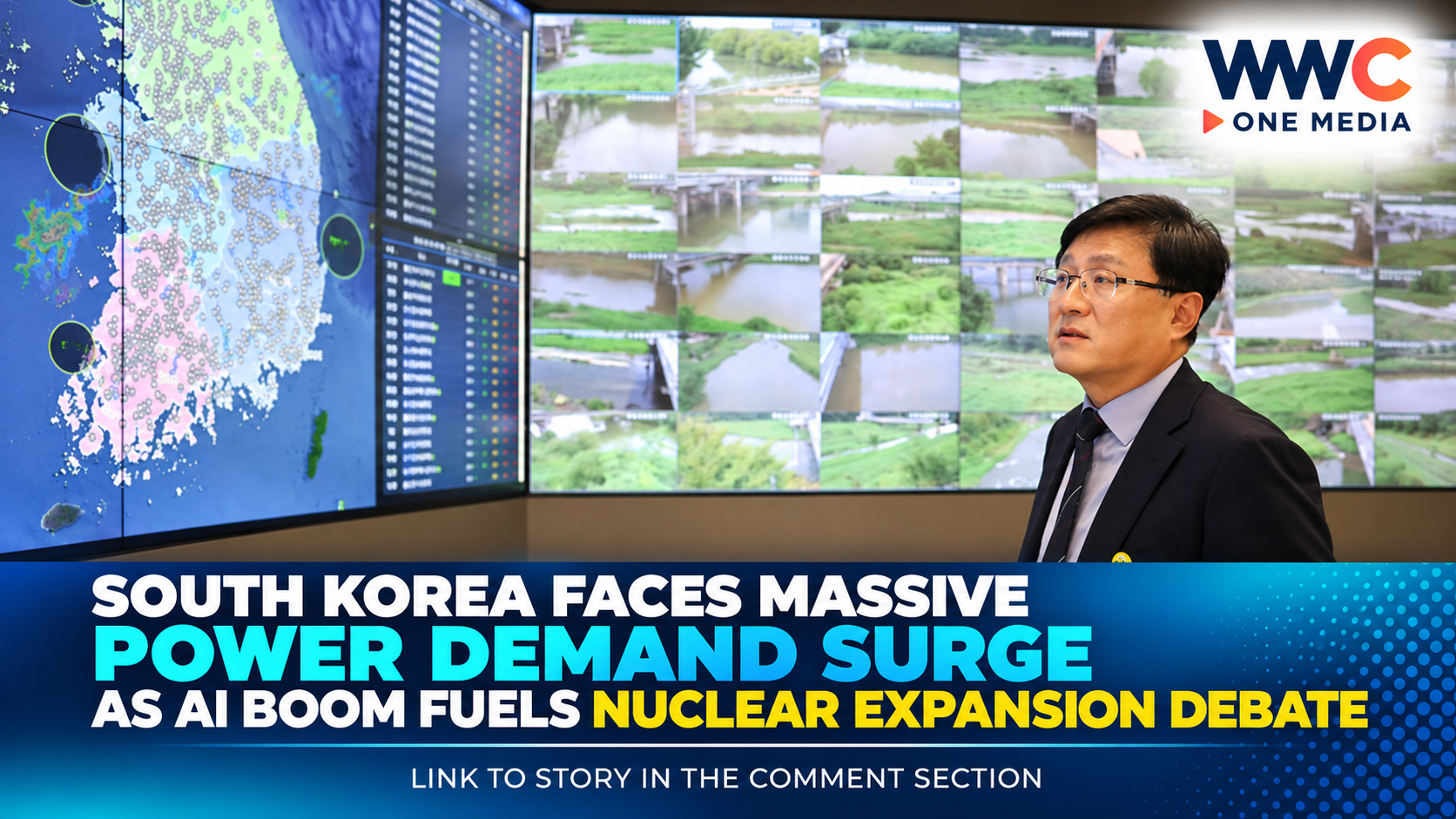
SEOUL, South Korea — South Korea is bracing for a dramatic increase in electricity demand as the artificial intelligence boom accelerates semiconductor production and drives a rapid expansion of data centres, forcing the country to reconsider how quickly it should expand nuclear power.
The additional electricity needed from AI-related projects alone could reach 25 to 30 gigawatts, roughly equivalent to the output of 20 nuclear reactors, according to South Korean officials.
AI and chips push electricity demand higher
South Korea's world-leading semiconductor industry is at the centre of the expected surge.
Major chipmakers Samsung Electronics and SK Hynix are expanding production facilities, while new AI data centres are being planned to meet growing demand for computing power.
The electricity requirements are coming on top of broader increases linked to the electrification of transport and heating, putting additional pressure on the country's power system.
The AI boom is also strengthening South Korea's position as a major technology and semiconductor hub. Semiconductor products accounted for 41 per cent of the country's exports in the first eight months of 2026, reflecting the extraordinary growth in global AI-related chip demand.
Government weighs more nuclear reactors
The expected power shortfall has revived debate over nuclear energy.
South Korea's Energy Minister Kim Sung-whan said the government is preparing an updated long-term energy roadmap extending to 2040, which could include plans for additional nuclear reactors.
Nuclear power currently supplies nearly one-third of South Korea's electricity, with 26 reactors operating nationwide. Renewable energy, by comparison, accounts for about 11 per cent of the country's power supply.
The government is also targeting the phase-out of coal-fired power generation by 2040, although some coal plants could remain available as emergency reserves.
Public support grows, but opposition remains
The nuclear expansion debate is taking place against a complicated public backdrop.
Around 79 per cent of South Koreans surveyed support the construction of new nuclear facilities, according to figures cited by the government.
But support for nuclear energy does not eliminate local opposition.
In Ulsan, where a new nuclear facility has been proposed, concerns over safety and the potential risks associated with nuclear power remain significant.
The debate reflects a wider challenge for South Korea: finding enough reliable electricity to power its technology-driven economy while maintaining public confidence in the safety of its energy infrastructure.
Data centres become strategic energy consumers
The growing demand from AI data centres is changing the way governments view electricity supply.
Large computing facilities require enormous amounts of electricity around the clock, making stable and predictable power increasingly important to technology companies.
US technology firms, including Nvidia, are reportedly interested in establishing data centres in South Korea, partly because of the country's reliable electricity infrastructure.
That potential investment could further increase pressure on Seoul to secure long-term power supplies.
South Korea faces a difficult energy balancing act
The country now faces several competing priorities: supporting its semiconductor and AI industries, reducing coal use, expanding renewable energy and ensuring a stable electricity supply.
Nuclear power offers a large source of continuous generation, but new reactors require substantial investment, lengthy construction periods and strong public confidence.
Renewables can also play a growing role, but their intermittent nature means additional grid infrastructure and storage may be needed as their share increases.
For South Korea, the challenge is no longer simply how to produce more electricity. It is how to build an energy system capable of supporting one of the world's fastest-growing AI economies without compromising reliability, affordability or safety.
As AI transforms South Korea's economy, it is also forcing the country to confront a fundamental question: how much more nuclear power will be needed to keep the machines — and the industries behind them — running.
WWC ONE MEDIA J.M.D