
Thai Doctor Probed After Allegedly Insulting Gold-Card Patients—Now 26,544 Could Be Affected

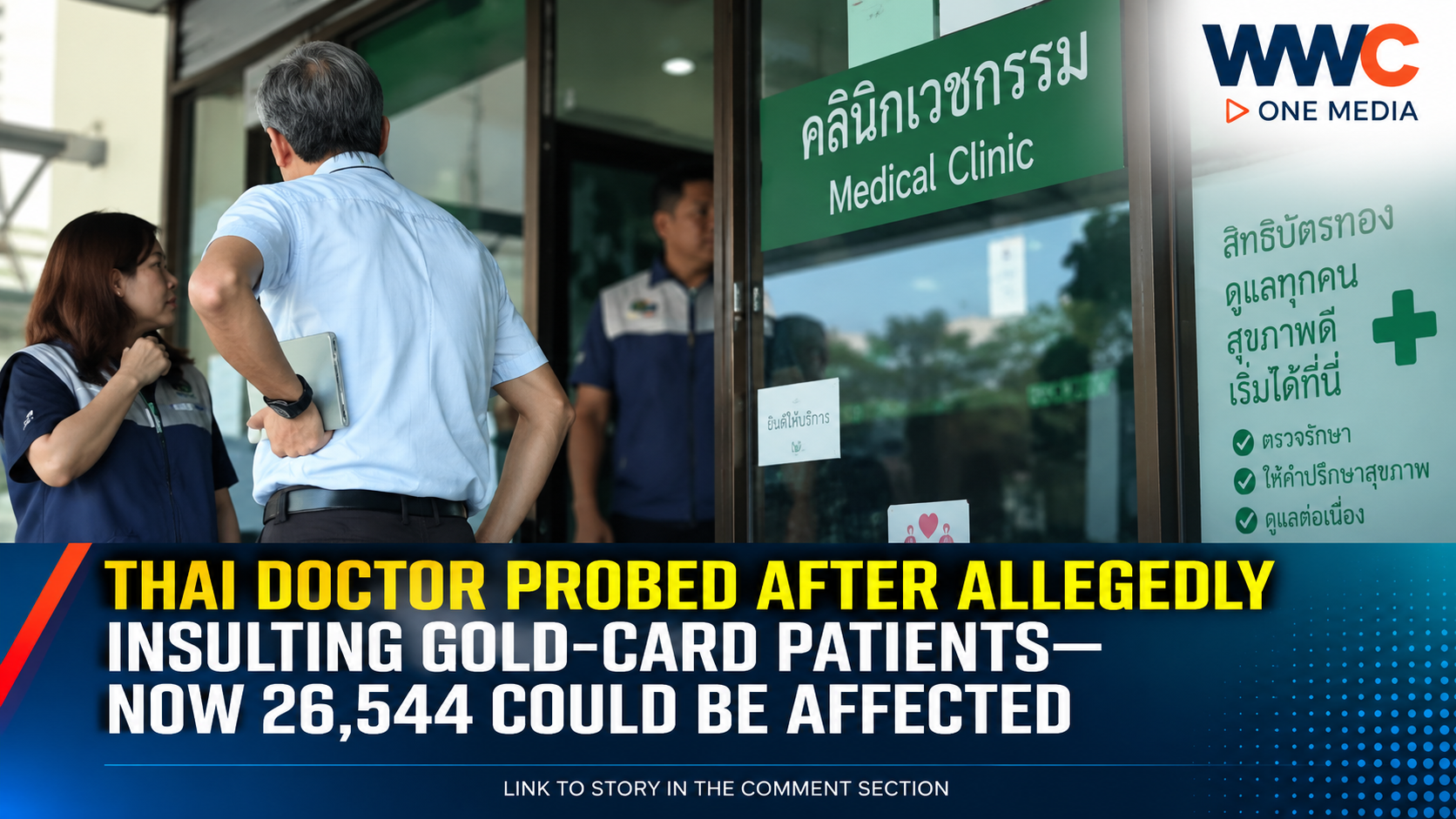
BANGKOK — A controversy over a doctor allegedly insulting patients who use Thailand’s universal healthcare scheme has escalated into a wider investigation after health authorities found several problems at the clinic involved, while Thailand’s Medical Council prepares to examine whether the doctor breached professional ethics.
The case began after a patient complained about allegedly abusive and demeaning language used by a doctor at a private clinic in Khlong Sam Wa district of Bangkok. The doctor was accused of making disparaging remarks about patients using the 30-baht Universal Coverage (Gold Card) scheme.
What initially appeared to be a dispute between a doctor and a patient has now expanded into questions surrounding medical ethics, patient dignity, referral procedures, medicine supplies and the clinic's compliance with healthcare regulations.
Medical Council launches ethics examination
Thailand's Medical Council has said it will examine the facts and evidence surrounding the doctor's conduct.
Medical Council Secretary-General Dr Ittaporn Kaewcharoen said physicians are required to treat patients equally regardless of which healthcare scheme they use.
The council pointed to its 2022 regulations on professional medical ethics, particularly provisions requiring doctors not to engage in conduct that damages the dignity of the medical profession and requiring medical practitioners to act politely and without coercion.
Importantly, the investigation is not yet a finding that the doctor is guilty of professional misconduct.
Authorities still have to examine evidence from both sides before determining whether disciplinary or other action is warranted.
Doctor says patient confronted him first
The doctor has disputed the account surrounding the confrontation.
According to reporting by Hfocus, the doctor told officials by telephone that the patient had allegedly become confrontational first. He said the audio recording that subsequently circulated publicly was made during a moment of anger after he felt provoked.
He also cited accumulated stress from seeing large numbers of patients.
The doctor reportedly said messages sent to the complainant were prompted after he felt that his personal time had been disturbed. He later indicated that he was considering leaving the medical profession and might eventually give his own account publicly.
The complainant, however, disputes that version.
She told officials that she did not behave aggressively toward the doctor and said she has an audio recording of a conversation with a clinic nurse that she believes supports her account.
That conflicting evidence is now part of the wider fact-finding process.
Inspectors discover other problems at the clinic
The controversy took a new turn when officials from Thailand's Department of Health Service Support (HSS) and the National Health Security Office (NHSO) inspected the clinic on Sept. 4.
Officials said they found several issues involving the facility's operation.
Among the preliminary findings were:
- No doctor was present as a regular practitioner at the facility during the inspection.
- The clinic did not have a currently operating medical-facility director because the previous director had stopped working there.
- Officials identified concerns involving charges.
- There were issues concerning patient referrals.
- Some chronic-disease patients had reportedly been given medication for only three to seven days, requiring more frequent visits.
The HSS said these matters could represent non-compliance with Thailand's Health Facility Act of 1998 and other applicable requirements.
The agency said it would collect additional information and proceed according to its legal authority.
NHSO considers suspending three clinics
The investigation could have consequences far beyond the individual doctor.
The NHSO is considering suspending contracts for three clinics in the Hathai Rat network that serve patients under the Gold Card system.
According to Hfocus, the three facilities and the number of registered beneficiaries are:
| Clinic | Gold Card beneficiaries |
|---|---|
| Hathai Rat Khlong Sam Wa Medical Clinic | 9,260 |
| Hathai Rat Medical Clinic, Nong Chok branch | 10,215 |
| Minburi Plus Medical Clinic | 7,069 |
| Total | 26,544 |
If the contracts are suspended, the affected patients are being directed toward designated public health centres in their areas. The Bangkok Metropolitan Administration has been coordinating arrangements to accommodate them.
Patients experiencing difficulties can also contact Thailand's NHSO hotline at 1330, which operates around the clock.
Why were some patients receiving only a few days of medicine?
The NHSO has also provided an explanation for another complaint surrounding the clinic.
Officials said the agency had previously detected irregularities involving reimbursement claims made by the clinic and its network.
As a result, payments were temporarily suspended while the matter was investigated.
According to the NHSO, the resulting liquidity problems reportedly contributed to the clinic limiting the amount of medication provided to some patients, including prescriptions lasting no more than seven days.
That issue is separate from the alleged insulting remarks, but it has become part of the broader examination of how the clinics were operating.
Referral requests are also under scrutiny
The NHSO has clarified that patients cannot necessarily demand a referral simply by requesting one.
Dr Weerapun Leethanakun, NHSO deputy secretary-general, said referrals depend on a medical assessment.
If a primary-care clinic determines that a patient's condition exceeds its capacity to treat, it can arrange a referral to an appropriate hospital.
The clarification came amid complaints concerning the handling of referral requests at the clinic.
Government: Gold Card patients deserve equal dignity
Thailand's government has also stepped into the controversy.
Deputy government spokesperson Ploytalae Laksameesangchan said the Ministry of Public Health had ordered an immediate fact-finding investigation and that the Medical Council was examining the professional-ethics aspect of the case.
The government stressed that a person's healthcare entitlement should never determine how that person is treated.
Its position is that patients using the state-funded universal healthcare system have the same human dignity as patients using other forms of healthcare coverage.
The government also rejected the characterization of the Gold Card as a lesser form of healthcare for disadvantaged patients, emphasizing that Thailand's universal healthcare system has operated for more than two decades.
Medical Council warns doctors about what they say
The controversy has also triggered a broader warning from the Medical Council about communication between doctors and patients.
Dr Ittaporn emphasized that medical treatment is not limited to examination, diagnosis and prescribing medication.
A doctor's words, tone and manner can also affect treatment.
Patients often visit doctors when they are already sick, anxious or frightened. Relatives can also be under significant emotional pressure.
The Medical Council therefore says doctors need to manage disagreements carefully—even when they are under heavy workloads or dealing with difficult interactions.
The council also highlighted a modern complication: digital communications can become evidence.
Phone calls, text messages, chat conversations and social-media posts can potentially be preserved and later submitted as evidence during an investigation.
The bigger issue: trust in Thailand's healthcare system
The case has become bigger than one alleged confrontation.
For patients, particularly those relying on Thailand's universal healthcare programme, the controversy raises concerns about whether they can expect respectful treatment regardless of their financial circumstances or healthcare entitlement.
For doctors, meanwhile, the case highlights another difficult reality: medical professionals work under significant pressure and can encounter large numbers of patients, emotional confrontations and demanding workloads.
The Medical Council has acknowledged that doctors can experience fatigue and stress but says those pressures do not remove the obligation to communicate professionally.
And for health authorities, the controversy has now evolved into a much wider regulatory matter involving clinic standards, reimbursement irregularities, medicine access, referrals and the continuity of care for thousands of patients.
What happens next?
The doctor's professional conduct remains under investigation, and the Medical Council has yet to make a final determination.
At the same time, health authorities are continuing to examine the clinic's compliance with regulations, while the NHSO considers whether to suspend contracts involving three clinics serving 26,544 Gold Card beneficiaries.
The key point for readers is that the allegations against the doctor have not yet been conclusively adjudicated.
But the controversy has already prompted government intervention and a broader inspection—and what began with a dispute over allegedly offensive remarks has now raised much larger questions about patient dignity, medical ethics and access to Thailand's universal healthcare system.
WWC ONE MEDIA M.J.E