
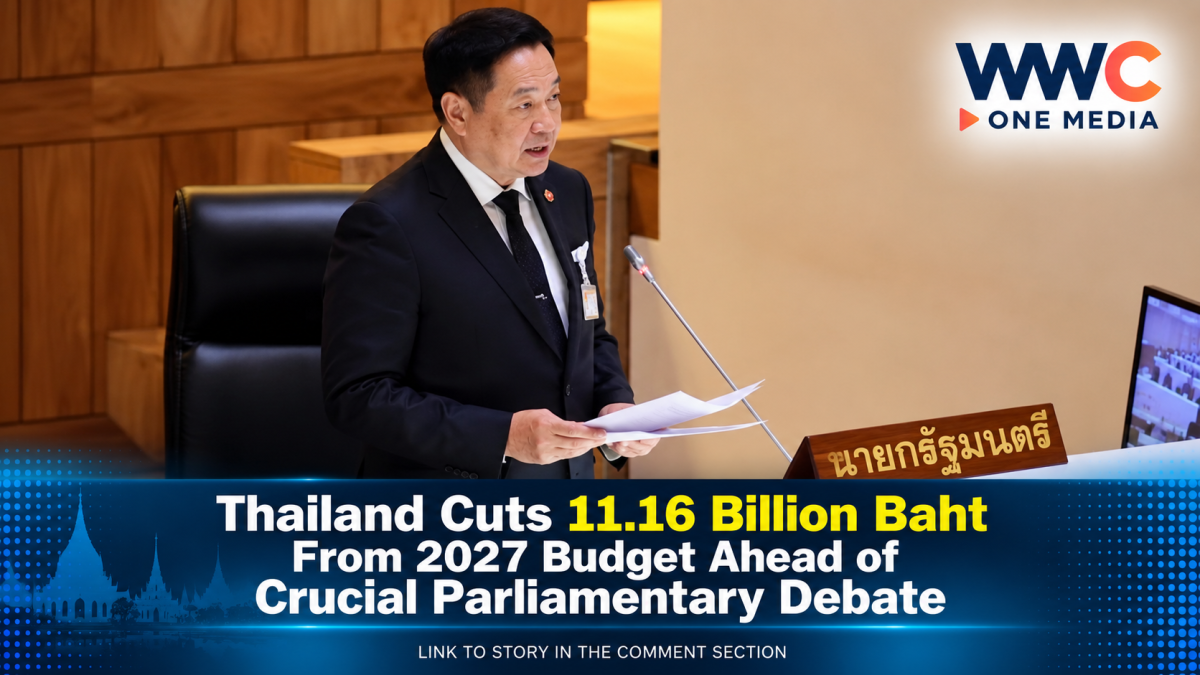
BANGKOK, Thailand — Thailand’s proposed 2027 national budget has been cut by more than 11.16 billion baht ahead of a crucial three-day parliamentary debate, setting the stage for intense scrutiny over how the government plans to spend nearly 3.8 trillion baht.
The House of Representatives is scheduled to debate the 2027 Budget Bill during its second and third readings from Sept. 7 to Sept. 9, after a parliamentary committee completed its review of the government’s spending plan.
The proposed budget remains worth about 3.788 trillion baht, but lawmakers on the committee agreed to trim a total of 11.162 billion baht from various spending allocations before redistributing funds to other areas.
More Than 11 Billion Baht Cut Before House Debate
The committee’s revisions affected spending across nearly all ministries and government agencies.
The Ministry of Natural Resources and Environment recorded the largest reduction at about 3.278 billion baht.
It was followed by the Ministry of Defence, which saw approximately 1.228 billion baht cut, and the Ministry of Interior, where around 912 million baht was removed from the proposed allocation.
While the cuts are significant, the money is not simply being removed from the overall spending framework.
Much of it is being redistributed to areas the committee considers necessary.
Government agencies were allocated about 10.891 billion baht based on what the committee described as operational needs, while another 271 million baht was directed toward state bodies including Parliament, courts, constitutional independent organizations and the Office of the Attorney General.
Central Budget Receives the Biggest Increase
One of the largest beneficiaries of the budget reshuffle is Thailand’s central budget.
About 6.044 billion baht has been added to central government funds, including reserves intended for emergencies and urgent situations.
The additional funding could be used to respond to major disasters, national security concerns and other crises that cannot easily be covered through agencies’ regular budgets.
Another 4.5 billion baht was allocated to revolving funds, while smaller increases were directed toward independent organizations, Parliament and other government programs.
The redistribution is expected to become a major point of discussion as lawmakers begin debating the revised bill.
Opposition Signals Tough Questions
The budget debate is taking place against an increasingly tense political backdrop.
Opposition lawmakers have signaled that they intend to closely examine government spending and push for further changes during the parliamentary proceedings.
People’s Party lawmaker Sirikanya Tansakun said the opposition could refuse to support the budget if proposed changes are not accepted, while also questioning spending allocations that she argued could overlap with other government financial programs.
The opposition has also suggested that the budget debate could provide an opportunity to raise broader questions about government policy and administration.
Prime Minister Anutin Charnvirakul, however, said lawmakers have the right to question the budget and seek explanations, while emphasizing that the proceedings are not a no-confidence debate.
Government MPs Told to Prepare
Government parties have also been preparing for the three-day parliamentary session.
Anutin said government MPs understand their responsibility to attend the debate and support the passage of the budget bill.
The prime minister said the government was ready to answer questions raised during the proceedings, with parliamentary committees expected to explain specific spending proposals and revisions.
The debate is considered one of the government’s most important parliamentary tests because the budget bill will determine how Thailand funds ministries, public services, infrastructure and national programs during the 2027 fiscal year.
Why the Budget Debate Matters
Thailand’s annual budget is more than a financial document.
It reveals the government’s priorities.
Every major allocation can become a political issue, particularly when lawmakers question whether money is being spent efficiently or directed toward the country’s most urgent needs.
The revised bill will now face detailed examination during the second reading before lawmakers vote on the legislation in its final stage.
With more than 3.7 trillion baht in national spending at stake, even relatively small changes can have significant consequences for government agencies and public programs.
The debate will also provide opposition parties with one of their biggest opportunities to challenge the government’s priorities inside Parliament.
Three Days That Could Shape Thailand’s Spending Plan
The Sept. 7-9 parliamentary session is expected to focus heavily on individual budget allocations, proposed cuts and the redistribution of government funds.
Lawmakers will have the opportunity to question committee decisions and seek amendments before the bill moves toward final approval.
The outcome will determine the shape of Thailand’s spending plan for 2027 — and could offer an early indication of how much political pressure Prime Minister Anutin’s government faces in Parliament.
More than 11 billion baht has already been cut before the debate even begins. Over the next three days, Thailand’s lawmakers will decide whether the revised budget survives scrutiny — or faces another round of political and financial battles.
WWC ONE MEDIA J.M.D



Leave a Reply