
Thailand’s ฿3.78 Trillion Budget Faces a Showdown—Now the Opposition Wants to Know Where the Money Is Going

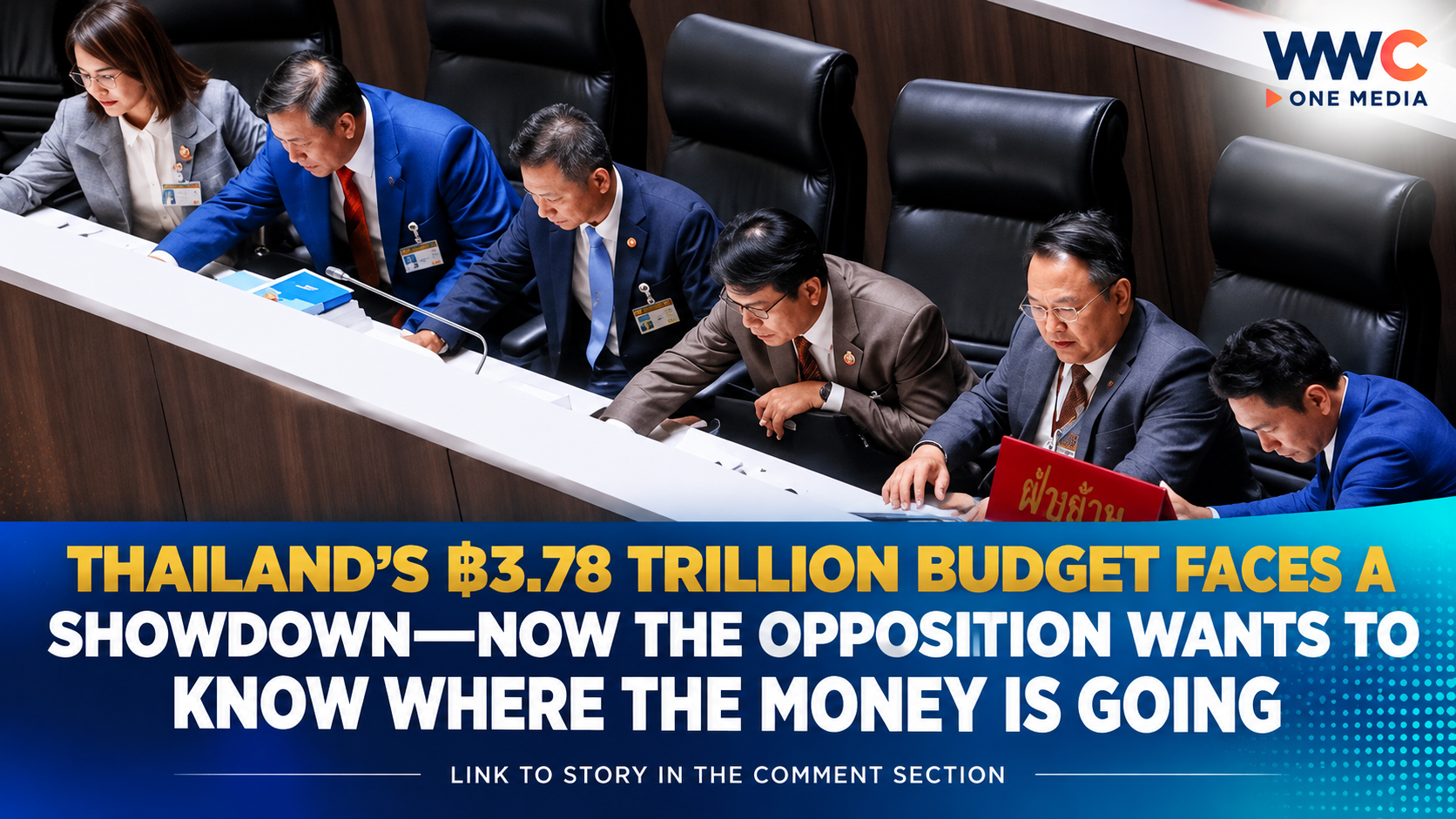
BANGKOK — Thailand’s opposition People’s Party is putting the government’s ฿3.78 trillion (about US$116 billion) fiscal 2027 budget under renewed scrutiny, warning that it will oppose the spending bill if the government refuses to remove allocations it considers duplicative, unnecessary or potentially vulnerable to irregularities.
The confrontation comes as lawmakers begin the second-reading debate on the massive budget bill, with scrutiny expected to continue through Wednesday.
People’s Party deputy leader Sirikanya Tansakul said the opposition would examine individual projects and allocations rather than simply challenge the overall size of the budget.
The party says taxpayers should not be asked to finance programs that overlap with existing measures or fail to demonstrate clear value.
The ฿12 billion allocation at the center of the argument
One of the People's Party's main targets is a ฿12 billion allocation in the Central Fund for economic rehabilitation.
Sirikanya argues that the allocation could overlap with the government's separate ฿400 billion borrowing program, which was established to stimulate the domestic economy and support the transition toward clean energy.
The criticism is essentially about whether Thailand should allocate additional budgetary resources to objectives that are already being financed through another major government borrowing program.
The People's Party says the government should explain the distinction and demonstrate why both funding streams are necessary.
Opposition also questions Thailand’s approach to the Deep South
The dispute extends beyond economic stimulus.
Sirikanya also questioned the government's budget for addressing unrest in Thailand's Deep South.
According to the People's Party, funding previously associated with a restorative plan has been moved into a strategic plan without significant changes to the underlying approach.
The opposition argues that the allocation continues to emphasize military operations rather than political approaches to dealing with insurgent groups.
That makes the debate about more than simply reducing expenditure. It also raises questions about whether government spending is aligned with the strategy policymakers say they want to pursue.
Investment spending falls while regular expenditure rises
Another major concern raised by People's Party MP Surachet Pravinvongvuth is the changing composition of Thailand's budget.
The government's own figures show that regular expenditure is projected at ฿2.786 trillion, accounting for about 73.6% of the 2027 budget.
By contrast, investment expenditure is set at approximately ฿789.2 billion, or about 20.8% of total spending.
Compared with fiscal 2026, regular expenditure increases while investment expenditure decreases.
The opposition argues that this trend deserves closer examination because investment spending is the portion of the budget most directly associated with building infrastructure and expanding the country's productive capacity.
Surachet also questioned whether a large share of investment spending is concentrated among roads and water-resource projects and alleged that many projects could ultimately benefit the same groups of bidders.
Those are political allegations from the opposition, not established findings of wrongdoing, and should not be treated as proof of procurement violations without further evidence.
Navy procurement also comes under the spotlight
The People's Party has additionally highlighted defense-related allocations.
Thai PBS World reported that Surachet questioned allocations involving the Royal Thai Navy, including procurement spending that the opposition says deserves greater scrutiny.
The issue comes amid a broader debate over Thailand's defense spending.
For fiscal 2027, Thailand's overall defense budget has been set at approximately ฿203.4 billion, only slightly below the previous year's ฿204.4 billion.
That means the government's wider push for fiscal restraint has not translated into a major reduction in defense spending.
What the government says about the ฿3.788 trillion budget
The government has defended the 2027 budget as a carefully constrained spending plan designed to deal with economic uncertainty while protecting national priorities.
The official budget totals ฿3.788 trillion, just ฿7.4 billion—or 0.2%—higher than the previous year's budget.
Government priorities include:
- economic restructuring and income distribution;
- national security and border protection;
- investment in new industries;
- education and healthcare;
- water management and disaster preparedness;
- environmental policies and the transition toward net-zero emissions; and
- public-sector reform and anti-corruption measures.
The government has also imposed restrictions on additional requests from state agencies, including a rule limiting additional allocations to 20% of the previous year's amount and requiring those requests to be for investment expenditure.
Thailand plans to borrow ฿788 billion
The numbers reveal why the budget debate is so politically sensitive.
Thailand expects net government revenue of about ฿3 trillion in fiscal 2027, while total planned expenditure reaches ฿3.788 trillion.
The difference will be covered by approximately ฿788 billion in borrowing.
In other words, the government is planning to spend substantially more than it expects to collect in revenue.
The government says the borrowing requirement is lower than in fiscal 2026, but the opposition argues that every allocation should therefore face even more rigorous scrutiny.
The bigger issue: Thailand’s shrinking fiscal room
The dispute is part of a much larger question confronting Thailand: how much room does the government still have to spend?
Recent analysis has highlighted the growing pressure from fixed expenditure, debt servicing and relatively weak economic growth.
A Thai Examiner report citing People's Party MP Anusorn Thamjai warned that Thailand could face significantly tougher fiscal choices by 2028 if recurring costs continue consuming a large portion of government resources. The MP called for cuts to unnecessary expenditure, tighter procurement controls and stronger action against corruption.
That concern is particularly relevant because regular expenditure already represents nearly three-quarters of the 2027 budget.
As fixed obligations grow, the government has less flexibility to redirect money toward infrastructure, economic stimulus or unexpected emergencies.
The opposition’s argument is not simply “cut the budget”
The People's Party's position is more specific than demanding across-the-board reductions.
Its argument is that Thailand should first eliminate spending that can be shown to be:
duplicative, unnecessary, questionable or poorly justified.
That distinction matters.
Cutting essential public services could hurt citizens, while eliminating overlapping programs or poorly justified projects could potentially free resources without reducing critical services.
The party has therefore positioned its opposition as an attempt to scrutinize how taxpayer money is spent, rather than simply reducing the government's total spending figure.
Why this budget fight matters
The 2027 budget is one of the clearest tests yet of the government's ability to balance competing pressures.
Thailand wants to maintain economic growth, strengthen national security, improve infrastructure and support households.
At the same time, it must manage debt, interest payments and recurring government expenses.
That leaves Parliament facing a difficult question:
Which spending should be protected—and which spending can Thailand afford to eliminate?
The People's Party says it will examine the details and vote against the bill if the government refuses to address what it considers unnecessary or duplicative allocations.
The government, meanwhile, maintains that the budget has already been prepared under tight fiscal limits and is designed to balance immediate needs with longer-term national investment.
And that sets up the next major test: whether the government can defend the individual projects lawmakers are now putting under the microscope.
WWC ONE MEDIA M.J.E