
Tung Chee-hwa, Hong Kong’s First Chief Executive Under Chinese Rule, Dies at 89

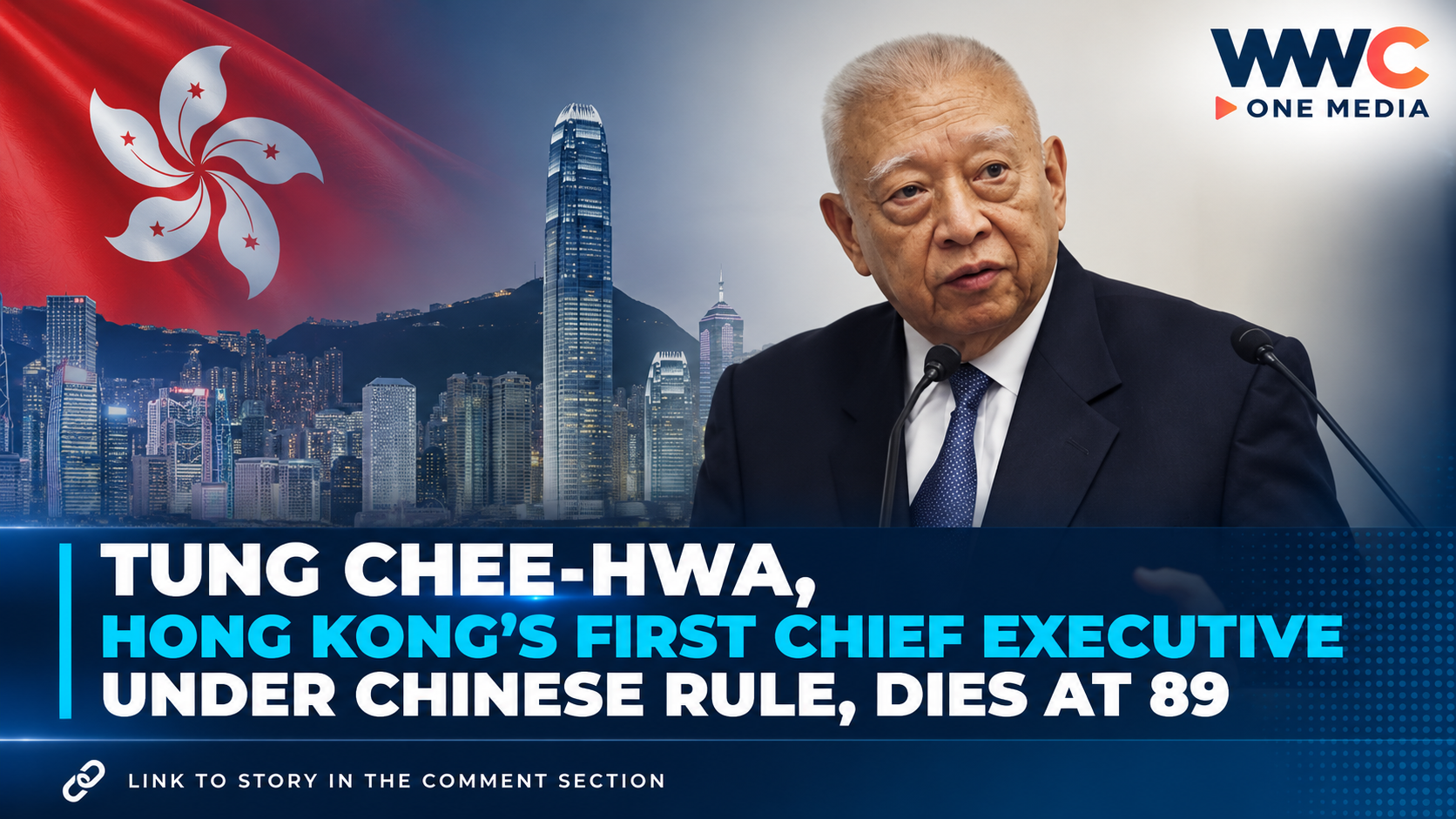
HONG KONG — Tung Chee-hwa, Hong Kong’s first chief executive after the city’s return from British to Chinese rule, has died at the age of 89, marking the end of a political career that helped shape the territory’s early years under the “one country, two systems” framework.
Tung’s office said he passed away peacefully on Tuesday in the presence of his family. No cause of death was immediately disclosed.
First leader after the 1997 handover
A former shipping tycoon with limited political experience, Tung was selected by a Beijing-backed 400-member committee to become Hong Kong’s first chief executive when British rule ended on July 1, 1997.
His administration was tasked with putting into practice the “one country, two systems” arrangement, under which Hong Kong was promised a high degree of autonomy while remaining part of China.
In his inaugural address, Tung pledged to preserve Hong Kong’s way of life, its open economy and the rule of law while working toward a more democratic society.
But his eight years in office would become increasingly difficult as Hong Kong confronted economic turmoil, public-health crises and growing demands for political reform.
Leadership tested by crisis and protests
Tung took office just as Hong Kong entered a turbulent period.
The Asian financial crisis battered the territory’s economy, while outbreaks of bird flu and later SARS placed further pressure on his administration. Critics accused his government of responding slowly and ineffectively to some of the crises.
His popularity suffered another major blow in 2003, when his government sought to introduce controversial national security legislation under Article 23.
The proposed law, which included offences such as treason and sedition and expanded police powers, was widely viewed by critics as a threat to civil liberties. An estimated half a million people took part in a mass protest against it.
Tung eventually backed down and the legislation was shelved. The episode became a turning point in Hong Kong’s increasingly tense political relationship with Beijing.
Resigned in 2005 but remained influential
Despite the controversy surrounding his leadership, Tung was re-elected unopposed in 2002.
He resigned in March 2005, citing deteriorating health, halfway through his second term. His departure came after years of declining popularity and growing political pressure.
After leaving Hong Kong’s top office, Tung remained influential in Chinese politics. He became a vice chairman of the Chinese People's Political Consultative Conference, China's top political advisory body, and continued to advocate closer ties between Hong Kong and the mainland.
He also remained a strong supporter of Beijing’s policies during the pro-democracy protests of 2019 and backed the national security law imposed on Hong Kong in 2020. He later supported the city’s electoral reforms that further reduced the role of opposition politicians.
A businessman who became a historic political figure
Born in Shanghai in 1937, Tung was the eldest son of shipping magnate Tung Chao-yung, founder of the Orient Overseas shipping empire.
He studied marine engineering at the University of Liverpool before working for General Electric in the United States and later joining his family's shipping business in Hong Kong.
The family company, Orient Overseas Container Line, grew into a major international shipping group before eventually being acquired by China's state-owned Cosco.
Tung’s political career began before the handover, when he served on Hong Kong’s Executive Council and helped shape discussions surrounding the territory’s future.
His selection as chief executive placed him at the centre of one of the most consequential transitions in modern Hong Kong history.
Legacy shaped by a changing Hong Kong
Tung's legacy remains closely tied to the difficult question of how Hong Kong would balance its promised autonomy with Beijing's growing political influence.
His tenure saw the first major confrontation between the city's population and the central government over the boundaries of that arrangement. The protests of 2003 were followed years later by even larger pro-democracy movements, particularly in 2014 and 2019.
In his later years, Tung largely withdrew from public life. He had not appeared publicly for several years before his death.
Tung Chee-hwa leaves behind a complicated political legacy: he was the man chosen to lead Hong Kong into its first chapter under Chinese sovereignty, and his turbulent tenure foreshadowed many of the political battles that would define the city for decades to come.
WWC ONE MEDIA J.M.D