
52 Singaporeans Arrested in China Over Suspected Pyramid Scheme — What Authorities Discovered in Guangxi

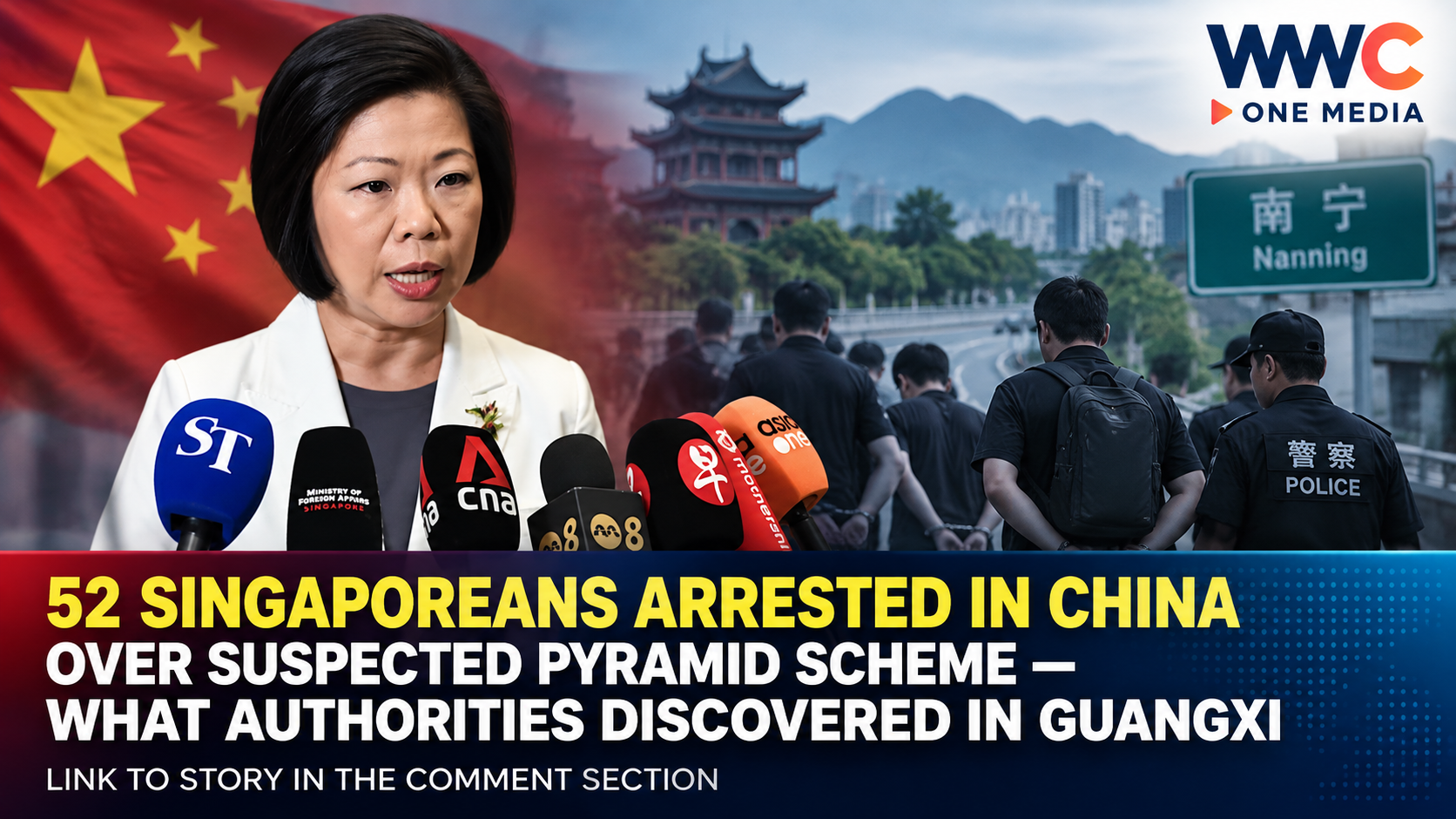
SINGAPORE — A major law-enforcement operation in southern China has put 52 Singaporean citizens behind bars, after Chinese authorities arrested and detained them in Guangxi over suspected involvement in pyramid-scheme activities and related offences.
Singapore's Ministry of Foreign Affairs (MFA) and Singapore Police Force (SPF) confirmed the arrests on September 4, 2026, saying investigations by Chinese authorities are still underway. The Singapore Government has since stepped in to provide consular assistance to all 52 detainees and maintain contact with their families.
The scale of the case is striking. CNA reported that the arrests are believed to represent the largest number of Singaporeans arrested and detained overseas at one time. Three sources also told CNA that some of the Singaporeans had been detained since at least mid-July.
Singapore Government makes three visits to detainees
Singapore's diplomatic response has already involved multiple visits.
The Singapore Embassy in Beijing and Consulate-General in Guangzhou have visited all 52 Singaporeans to check on their welfare and provide consular assistance. Officials have also conveyed requests from detainees, passed messages between them and their families, and helped with administrative matters.
Second Minister for Foreign Affairs and Home Affairs Sim Ann said she had met the families of most of the detainees.
She stressed that Singapore would continue supporting its citizens while respecting China's legal process.
“We’re doing all we can to help them through an understandably difficult time.”
At the same time, Singapore has made clear that consular assistance does not mean intervening in China's investigation or judicial proceedings. MFA said Singaporeans travelling or living overseas remain subject to the laws of the country they are in.
What exactly are the Singaporeans accused of?
At this stage, Singaporean and Chinese authorities have not publicly disclosed detailed allegations against each of the 52 individuals.
The official description is that they were arrested and detained following a Chinese law-enforcement operation targeting suspected pyramid-scheme activities and related offences in Guangxi.
The SPF has contacted its Chinese counterparts to seek additional information, while Chinese authorities continue their investigation.
That distinction matters: being arrested or detained does not by itself establish guilt. The case remains under investigation.
The Nanning connection
Separate reporting by CNA has provided a possible glimpse into the type of operation under investigation.
CNA reported that at least a dozen Singaporeans had previously been approached by fellow Singaporeans regarding a purported business and investment opportunity in Nanning, the capital of Guangxi. According to CNA, the alleged operation appeared linked to the notorious “1040 Sunshine Project”, although authorities have not publicly stated that all 52 detainees were involved in that specific scheme.
The reported recruitment method is particularly significant.
People were allegedly invited to China to learn about an exclusive business opportunity, sometimes through acquaintances or former colleagues. One Singaporean interviewed by AsiaOne described being invited on a partly sponsored trip to Guangxi in 2018 after being told it involved a business opportunity.
Such recruitment through personal networks can make questionable investment propositions appear more trustworthy because the initial approach comes from someone the prospective investor already knows.
Why the “1040 Sunshine Project” is raising attention
The so-called 1040 Sunshine Project has long been associated with illegal pyramid-selling operations in Guangxi.
Reports cited by The Straits Times and The Business Times describe a pattern in which recruits can be promised enormous future returns while being encouraged to bring additional participants into the network. The schemes can also invoke supposed investment opportunities, government-linked development projects or other claims designed to make the operation appear legitimate.
However, it is important not to automatically equate the current arrests with that particular scheme. MFA and SPF have not publicly identified the specific pyramid scheme allegedly connected to the 52 Singaporeans.
China has been intensifying its crackdown
The arrests come against the backdrop of a much broader Chinese campaign against illegal pyramid selling.
According to The Straits Times, Chinese authorities investigated more than 200,000 cases involving pyramid schemes and direct-selling violations between 2021 and 2025, based on figures from China's State Administration for Market Regulation.
China has also strengthened enforcement measures.
Changes to its public-security framework that took effect in January 2026 expanded the ability of police to impose administrative penalties on certain rank-and-file participants in pyramid schemes, according to The Straits Times.
Under Chinese criminal law, organising or leading pyramid-selling activities can carry significant penalties, with more serious cases potentially resulting in lengthy imprisonment.
What happens next?
The immediate focus is now on the Chinese investigation and determining the individual circumstances of the 52 Singaporeans.
Singapore says it will continue engaging Chinese authorities, provide consular assistance and press for due process for its citizens. But Singapore has also made clear that it will not interfere with China's judicial proceedings.
For Singaporeans and other Southeast Asians, the case carries a wider warning.
MFA has specifically urged people to exercise caution when approached about schemes involving recruitment of participants, substantial upfront payments or unusually high promised returns, whether the opportunity is offered locally or overseas.
What makes the Guangxi case especially significant is not simply the number 52.
It is the possibility that an investment pitch presented as a private business opportunity may have drawn Singaporeans into a much larger network now facing Chinese law-enforcement scrutiny.
And with investigations still ongoing, the biggest unanswered question is this: how extensive was the alleged network, and what role did each of the 52 Singaporeans actually play?