
AI’s Data Center Boom Could Cost US$31.6 Trillion by 2050 — But One Bottleneck Could Stop the Buildout Cold

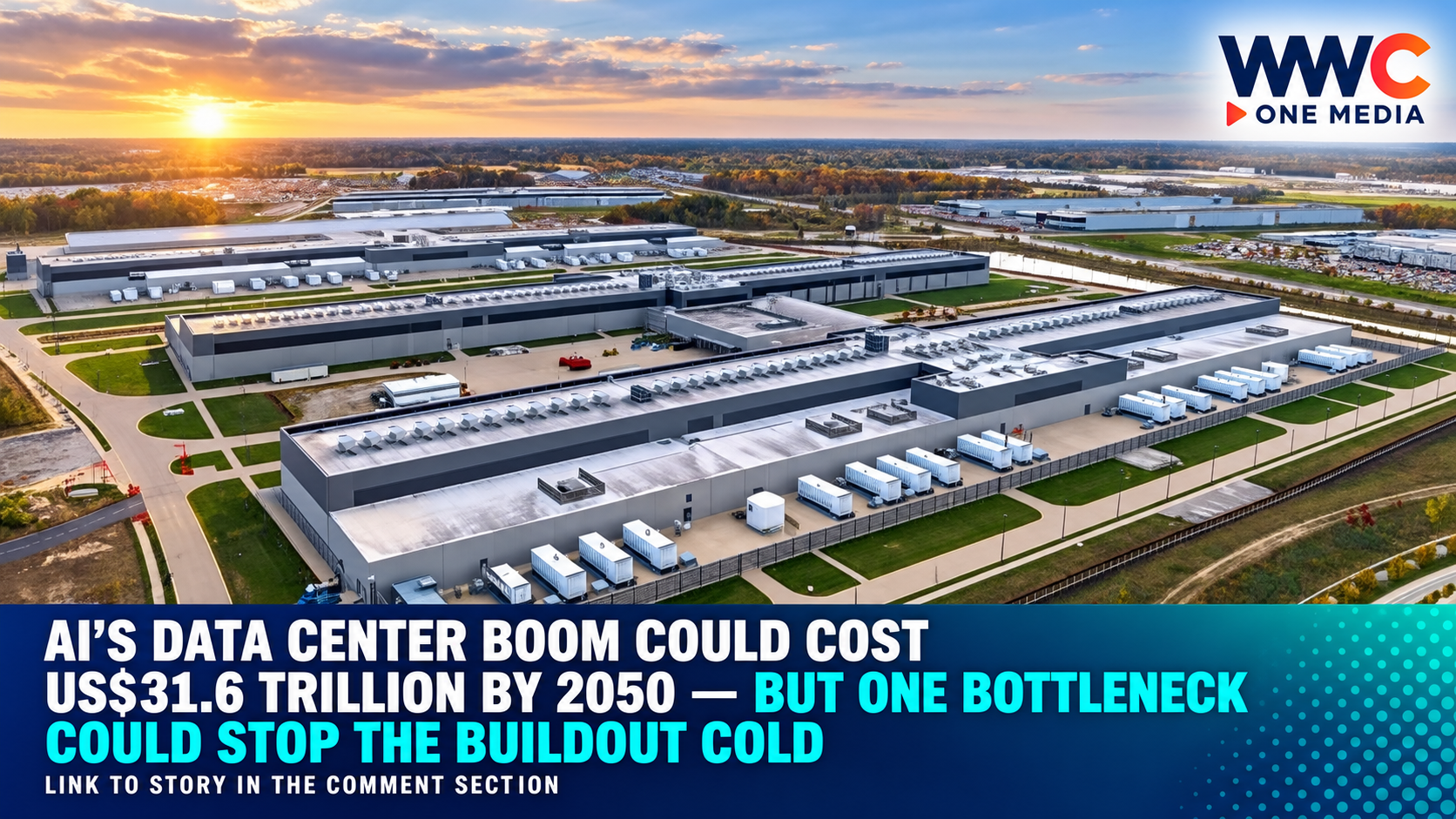
Global spending on data centers could reach US$31.6 trillion through 2050 as artificial intelligence drives an unprecedented race for computing power, but electricity shortages, chip restrictions and growing public resistance could determine which countries actually cash in on the boom.
The global race to build the infrastructure behind artificial intelligence is rapidly becoming one of the biggest capital-investment stories in modern economic history.
PricewaterhouseCoopers said in its newly released Global Data Centre Outlook 2026–50 that cumulative capital expenditure on data centers could reach US$31.6 trillion between 2026 and 2050 under its central scenario.
If AI adoption accelerates faster than expected, PwC estimates spending could climb to nearly US$50 trillion. A slower-growth scenario, however, could pull the total down toward roughly US$22 trillion, highlighting just how much of the forecast depends on future AI demand.
The projections were reported by Bloomberg and published by the Taipei Times on September 4.
But the enormous headline number hides a potentially bigger story: having enough money to build the infrastructure may not be the hardest part.
Power could become AI’s biggest bottleneck
PwC identified electricity availability as perhaps the most critical factor determining where new data centers will ultimately be built.
AI computing facilities require enormous amounts of reliable electricity, not only to operate increasingly powerful processors but also to cool the densely packed servers running around the clock.
The International Energy Agency has separately projected that global data-center electricity consumption could more than double to around 945 terawatt-hours by 2030, slightly more than Japan’s current annual electricity use.
AI-powered accelerated servers are expected to account for a major share of that increase.
That means countries hoping to attract billions of dollars in AI infrastructure will increasingly be competing not only on taxes, land and connectivity, but on their ability to deliver large quantities of dependable and increasingly low-carbon power.
US expected to dominate — but Asia is a major prize
Under PwC's central forecast, the United States could attract about US$15.1 trillion, almost half of projected global data-center capital expenditure through 2050.
The Asia-Pacific region could receive around US$8.2 trillion, followed by Europe at approximately US$5.6 trillion, the Middle East at US$1.1 trillion and Africa at about US$255 billion.
China and India are expected to be important drivers of additional demand because of their enormous populations, expanding digital economies and considerable room for AI adoption across businesses and consumer services.
Asia's position could become even more significant if governments increasingly insist that sensitive data and AI workloads remain inside their own borders.
PwC modeled a “data sovereignty” scenario in which governments and regulated industries become less willing to depend on overseas infrastructure for strategically important workloads.
Interestingly, that scenario could benefit several emerging Asian markets.
PwC specifically identified India, Vietnam, Indonesia, the Philippines and Thailand as markets that could receive additional investment because large domestic demand currently relies partly on infrastructure located in regional hubs.
Under that scenario, Asia-Pacific cumulative data-center capex could rise about 7 percent above PwC's central forecast.
Taiwan could sit at the center of the hardware boom
Taiwan has another reason to watch the US$31.6 trillion buildout closely: much of the money will not be spent on concrete buildings.
PwC estimates an increasingly large share will go toward the technology inside them — including servers, networking equipment, CPUs, GPUs and storage systems.
Unlike buildings, those components must repeatedly be replaced as computing technology advances.
PwC says GPUs and servers typically go through refresh cycles of roughly four to six years, creating a recurring investment cycle rather than a one-time infrastructure build.
That has major implications for the global semiconductor supply chain.
Taiwan Semiconductor Manufacturing Co has already said AI demand is rising so quickly that even dramatically accelerating factory expansion has not been enough to fully satisfy customers.
At Semicon Taiwan this week, TSMC deputy co-chief operating officer Cliff Hou said the company is building 25 semiconductor fabrication and advanced-packaging facilities worldwide this year, including 13 in Taiwan, compared with roughly five or six facilities annually in earlier periods.
Reuters has also reported that the data-center investment boom is spreading beyond AI-chip companies such as Nvidia to power and cooling suppliers, including Taiwan's Delta Electronics, as operators struggle to supply electricity and manage heat generated by increasingly dense AI systems.
But communities are beginning to push back
Even before the full-scale AI infrastructure boom arrives, public opposition is already delaying projects.
Data Center Watch found that at least 75 US data-center projects worth about US$130 billion were blocked or delayed during the first quarter of 2026 alone.
The group said the value of projects affected in just those three months was roughly comparable with the total for all of 2025.
Community concerns range from electricity and water consumption to noise, environmental impact and the possibility that households could end up shouldering higher utility costs.
Reuters reported in August that lenders financing US data-center projects are paying increasing attention to community acceptance, permitting and regulatory risk when evaluating deals.
The issue has become significant enough that political resistance can now affect whether projects secure financing and ultimately proceed.
Another problem is emerging: not every proposed data-center project may actually be real.
Reuters reported this week that requests for new US grid connections associated with data centers have surpassed 700 gigawatts, prompting regulators to scrutinize whether some applications represent genuine projects or speculative “ghost demand.”
Texas has responded by tightening scrutiny of new connection requests as grid planners try to distinguish serious projects from proposals that may never be built.
Chips could redraw the investment map
Semiconductor availability represents another major wildcard.
PwC modeled a scenario in which geopolitical tensions significantly disrupt the international flow of advanced chips.
Under that scenario, cumulative global data-center investment through 2050 could fall from US$31.6 trillion to about US$25.5 trillion — a reduction of roughly US$6 trillion.
Markets with reliable access to advanced processors would gain an enormous strategic advantage, while regions dependent on imported GPUs could see projects delayed or redirected elsewhere.
The real US$31.6 trillion race
The scale of PwC's forecast makes the AI revolution look like a competition for money.
Increasingly, it looks more like a competition for electricity, semiconductors, cooling technology, regulatory certainty and public acceptance.
The capital appears ready.
The demand for computing power appears real.
But the countries that ultimately capture the trillions flowing into AI infrastructure could be those that solve the physical problems behind artificial intelligence before their competitors do.
And that may be the biggest twist in the AI boom: the next generation of AI leaders might be determined as much by power grids and infrastructure as by algorithms.
WWC ONE MEDIA J.M.D