
Bangkok’s 577CLUB Was Raided and Faced Closure Last Year — So How Was It Still Operating When Officials Returned?

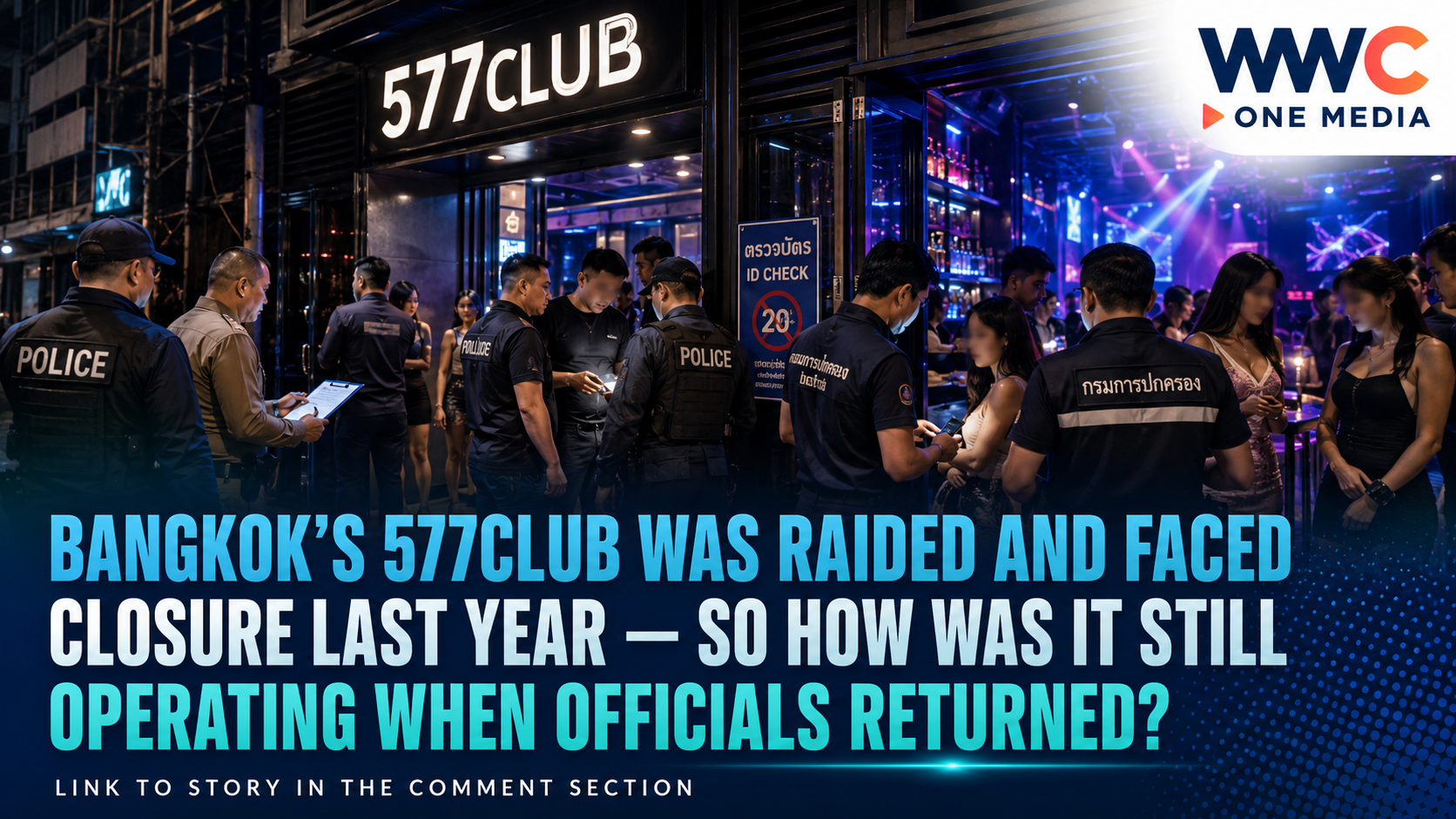
BANGKOK — A Huai Khwang nightclub that authorities say was already raided a year ago has been hit again in a dramatic early-morning operation, with officials uncovering suspected narcotics, unauthorized foreign workers and fresh questions over whether the business was being operated through Thai nominees for foreign interests.
The raid is now widening beyond the club itself. Bangkok police have ordered an investigation into the local police station’s handling of the establishment, while Interior Ministry officials are examining an allegation that a person claiming police connections may have helped the venue continue operating.Deputy Interior Ministers Polapee Suwunchwee and Worasit Liangprasit joined Department of Provincial Administration special operations officers in raiding 577CLUB on Soi Pracha Uthit 11 in Huai Khwang at roughly 1:30 a.m. on Saturday, August 29.
Authorities said the venue was operating into the early hours despite government records showing that it did not have an entertainment-venue licence. The operation followed complaints and an undercover investigation after officials learned that the club had continued doing business following an earlier raid on August 16, 2025.
Drugs found as patrons are tested
According to Khaosod English, officers checked 132 customers — 65 Thai nationals and 67 Chinese nationals — after shutting down the music and ordering the venue’s lights switched on.
Three patrons allegedly tested positive for narcotics: one Thai man and two people from Hong Kong. Authorities also reported finding two bags containing ketamine, including one in a women’s restroom and another on a customer’s table. The three patrons were taken for further legal proceedings.
Matichon subsequently confirmed that the three people who returned positive preliminary drug tests were turned over to Huai Khwang investigators.
Reports differ slightly on the proportion of Chinese customers inside the establishment. The Nation, citing the inspection, reported that roughly 70% of customers were Chinese, while Khaosod's published numerical breakdown listed 67 Chinese nationals among 132 customers checked. The discrepancy could reflect different stages or groups counted during the operation.
WeChat, Alipay and foreign workers raise nominee questions
What transformed the raid from a conventional nightlife enforcement operation into a potentially much bigger investigation was the club's business structure.
Officials said the establishment accepted payments through WeChat and Alipay, while Chinese employees reportedly assisted Chinese customers inside the venue. Authorities also found foreign nationals allegedly working without the required permits.
Despite a Thai national appearing in the formal business structure, officials said those circumstances raised suspicions that Thai nominees could have been used to operate the establishment on behalf of foreign investors.
That remains an allegation under investigation, not a proven finding of illegal nominee ownership.
The Interior Ministry has ordered officials to examine the company's ownership, accounts, employees and financial arrangements to determine who ultimately controlled and benefited from the business.
Then came the allegation involving a police officer
The most politically sensitive element emerged when a person presenting himself as connected to the business allegedly told officials about another individual who was said to have a police connection and an interest in the club.
According to officials quoted by The Nation and Khaosod English, the individual was allegedly described as having a stake in the establishment despite not investing money and as someone capable of helping resolve problems involving the club.
Authorities have not established that the person is actually a police officer or that any police official protected the business.
Polapee ordered Huai Khwang police to identify the individual and determine whether there was any genuine connection with law enforcement or with the venue's ability to keep operating.
That distinction is critical: at this stage, it is an allegation being investigated, not a finding of police corruption.
Bangkok police launch separate probe
Hours after the raid, the controversy escalated.
Metropolitan Police Bureau commissioner Pol Lt Gen Siam Boonsom ordered a fact-finding investigation into whether the superintendent of Huai Khwang Police Station had been negligent in allowing an allegedly unlicensed entertainment venue where drugs were found to continue operating.
The panel has been instructed to report its findings within seven days, according to Matichon.
That development could prove more consequential than the raid itself because investigators are now examining not simply what happened inside 577CLUB, but how the venue apparently managed to continue operating after previous enforcement action.
The club had already been raided in 2025
This is not 577CLUB's first encounter with authorities.
During an August 2025 raid, more than 300 customers and employees were reportedly found inside. Six people tested positive for narcotics, while authorities reported discovering substances including methamphetamine, ketamine and packets described as “happy water” in VIP areas.
The venue's manager was arrested at the time over allegations involving the lack of entertainment and alcohol licences, and authorities said they would seek a five-year closure.
Yet a year later, Interior Ministry officials say the establishment was operating again.
The Nation reports that the earlier case had been sent to the Bangkok Metropolitan Administration for consideration of a closure order. Polapee said the Department of Provincial Administration could now pursue a five-year shutdown without waiting for the BMA and demanded an examination of how the venue had continued functioning.
Huai Khwang is already under a much wider microscope
The raid comes amid a broader government crackdown on businesses in Huai Khwang suspected of licensing violations, illegal foreign employment and nominee ownership arrangements.
Earlier in August, the Thai government announced coordinated inspections involving the Department of Provincial Administration, Immigration Bureau, Department of Business Development, Department of Employment and Department of Special Investigation.
Those inspections identified businesses with possible licensing violations and ownership structures that authorities said required investigation for potential nominee arrangements.
Separate reporting by The Nation said officials were also tracing financial flows and examining allegations that payments had been made to government personnel by operators of some businesses in the district. Those allegations remain subject to investigation.
The bigger question is no longer what police found inside
Drugs, licensing violations and illegal workers would ordinarily make the raid significant on their own.
But 577CLUB presents authorities with a harder question:
If the establishment had already been raided, its licensing problems were known and authorities had previously sought its closure, how was it able to keep operating for another year?
That is why the next stage of the investigation matters more than Saturday morning's raid.
Investigators now have to establish who actually financed and controlled the club, whether nominee shareholders were involved, whether anyone in government or law enforcement helped shield the operation — and whether failures in the enforcement system allowed a previously targeted venue to return to business.
Until those investigations are completed, allegations concerning nominee ownership and police protection should be treated as unproven claims rather than established facts.