
Bombs, Fires and Sabotage Struck Thailand’s Deep South Overnight—What Happened Days Before Makes the Attacks Far More Significant

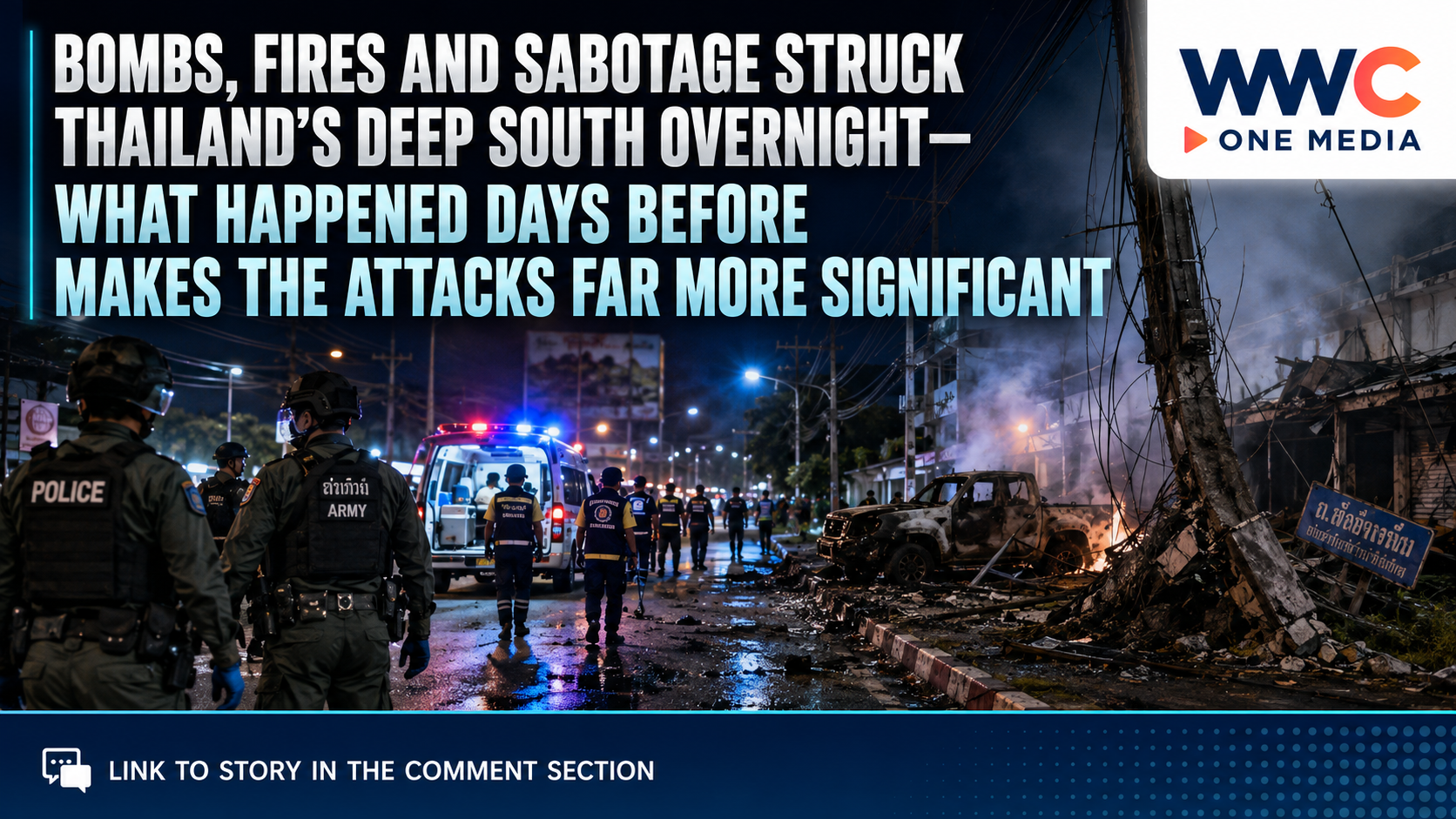
NARATHIWAT, Thailand — A wave of coordinated bombings, arson attacks and sabotage swept across Thailand’s insurgency-hit Deep South late Saturday, leaving at least two people injured, damaging government and commercial property and forcing authorities to impose an overnight curfew in Narathiwat.
Thailand’s Internal Security Operations Command, or ISOC, said 51 separate incidents were recorded across the southern border provinces between roughly 8 p.m. and midnight on August 22, with almost half concentrated in Narathiwat.
Among the targets were a local government office, telecommunications infrastructure, electrical poles, a convenience store and vehicles. A pickup truck was reportedly stolen during one attack on a subdistrict administrative office before later being found burned out on a road.
Authorities described the incidents as coordinated attempts to create widespread unrest rather than a single localized attack.
No organization had claimed responsibility as of Sunday.
Narathiwat Bears the Brunt
Narathiwat was the hardest-hit province, according to Thai security officials.
Two civilians were reported injured, while military authorities imposed a curfew lasting until 6 a.m. Sunday as security personnel moved to inspect multiple attack sites.
Narathiwat Governor Boonchuay Homyamyen said investigators were examining damage to government buildings, telecommunications towers and electricity infrastructure.
By Sunday morning, authorities said no additional attacks had been reported.
One of the injured civilians was reportedly wounded during a security operation following the attacks, highlighting the dangers faced by residents as authorities responded to the overnight violence.
The latest unrest once again puts Narathiwat at the center of Thailand’s decades-long struggle with separatist violence in its predominantly Malay-Muslim southern provinces.
Violence Comes Just Weeks After Five Soldiers Were Killed
The timing is particularly significant.
Only a month earlier, gunmen attacked a security checkpoint in Narathiwat, killing five soldiers and injuring six civilians, including a child.
Attackers reportedly arrived in vehicles, opened fire on security personnel and used explosive devices before escaping.
Prime Minister Anutin Charnvirakul condemned that July assault as a serious threat to Thailand’s national security and peace efforts.
The August 22 attacks now raise renewed questions over whether violence in the region is accelerating just as Bangkok is attempting to revive negotiations aimed at ending one of Southeast Asia’s longest-running insurgencies.
Thailand’s Peace Process Was Supposed to Be Moving Forward
Just days before the latest attacks, Thailand’s chief southern peace negotiator, Thanut Suvarnananda, said Bangkok was preparing to adopt a new strategy toward the conflict.
Instead of focusing primarily on short-term deals designed to reduce attacks, Thai negotiators have signaled a willingness to address deeper political questions, including decentralization and possible forms of local governance.
Thailand has also been considering measures such as pardons, sentence reductions or amnesty arrangements for some suspected insurgents.
Negotiators had reportedly been moving toward a preliminary framework that could potentially be signed as early as September.
But continued violence has complicated that process.
The deadly Narathiwat checkpoint attack in July had already contributed to the postponement of planned dialogue.
Now, the scale and coordination of the latest attacks may put even more pressure on both the government and separatist negotiators.
What Is Behind Thailand’s Deep South Conflict?
Thailand’s Deep South conflict is centered primarily in Narathiwat, Pattani and Yala, three predominantly Malay-Muslim provinces bordering Malaysia.
The region was historically part of the Malay Sultanate of Patani before being incorporated into what is now Thailand.
A renewed insurgency erupted in 2004, fueled by longstanding grievances involving political autonomy, cultural identity, language, security policy and relations between local communities and the central government.
More than 7,800 people have been killed since the insurgency intensified in 2004, according to figures cited by Reuters.
The Barisan Revolusi Nasional, widely known as the BRN, is considered the most influential separatist organization involved in the insurgency.
Formal peace negotiations facilitated by Malaysia began in 2013 but have repeatedly stalled because of political instability, disagreements between negotiating parties and recurring outbreaks of violence.
A Difficult Moment for Prime Minister Anutin
The attacks also come shortly before Prime Minister Anutin and members of his Cabinet are expected to travel to southern Thailand.
His government is scheduled to visit Hat Yai in nearby Songkhla province for discussions involving infrastructure investment, flood prevention and regional security.
That visit is now likely to take place under substantially tighter security conditions.
The challenge for Bangkok is increasingly complex.
A heavy security response may temporarily suppress attacks, but Thai negotiators themselves have acknowledged that aggressive measures such as village cordons, searches and checkpoints can deepen resentment among communities if they are perceived as excessive.
At the same time, repeated bombings and attacks on soldiers, public infrastructure and civilian areas make political concessions increasingly difficult for any government to sell domestically.
Thailand therefore faces the same dilemma that has defined the Deep South conflict for more than two decades: how to maintain security without undermining the political trust required for negotiations.
Why These 51 Attacks Matter
The relatively low casualty count could make Saturday night’s violence appear less significant than previous deadly bombings.
But the number, geographical spread and apparent coordination of the attacks may be more important than the casualty figures alone.
Striking dozens of locations within several hours can demonstrate organizational capability, disrupt communications and infrastructure, stretch security resources and generate fear across multiple communities at once.
And because the attacks happened only days after Thai officials publicly discussed a renewed peace strategy, they could also carry a political message.
Whether they were intended to derail negotiations, pressure Bangkok or demonstrate that armed networks remain capable of coordinated operations has not yet been established.
No group has claimed responsibility, and Thai authorities have not publicly identified the perpetrators.
For now, investigators are examining the attack sites while residents across the southern border provinces wait to see whether the violence was a one-night escalation — or the beginning of something larger.