
Can Dogs Really Sniff Out Cancer? India Is Combining Canine Noses With AI in a Bold New Detection Experiment

BENGALURU — Could your next cancer screening involve a dog and artificial intelligence?
It may sound like science fiction, but a startup in India is testing exactly that.
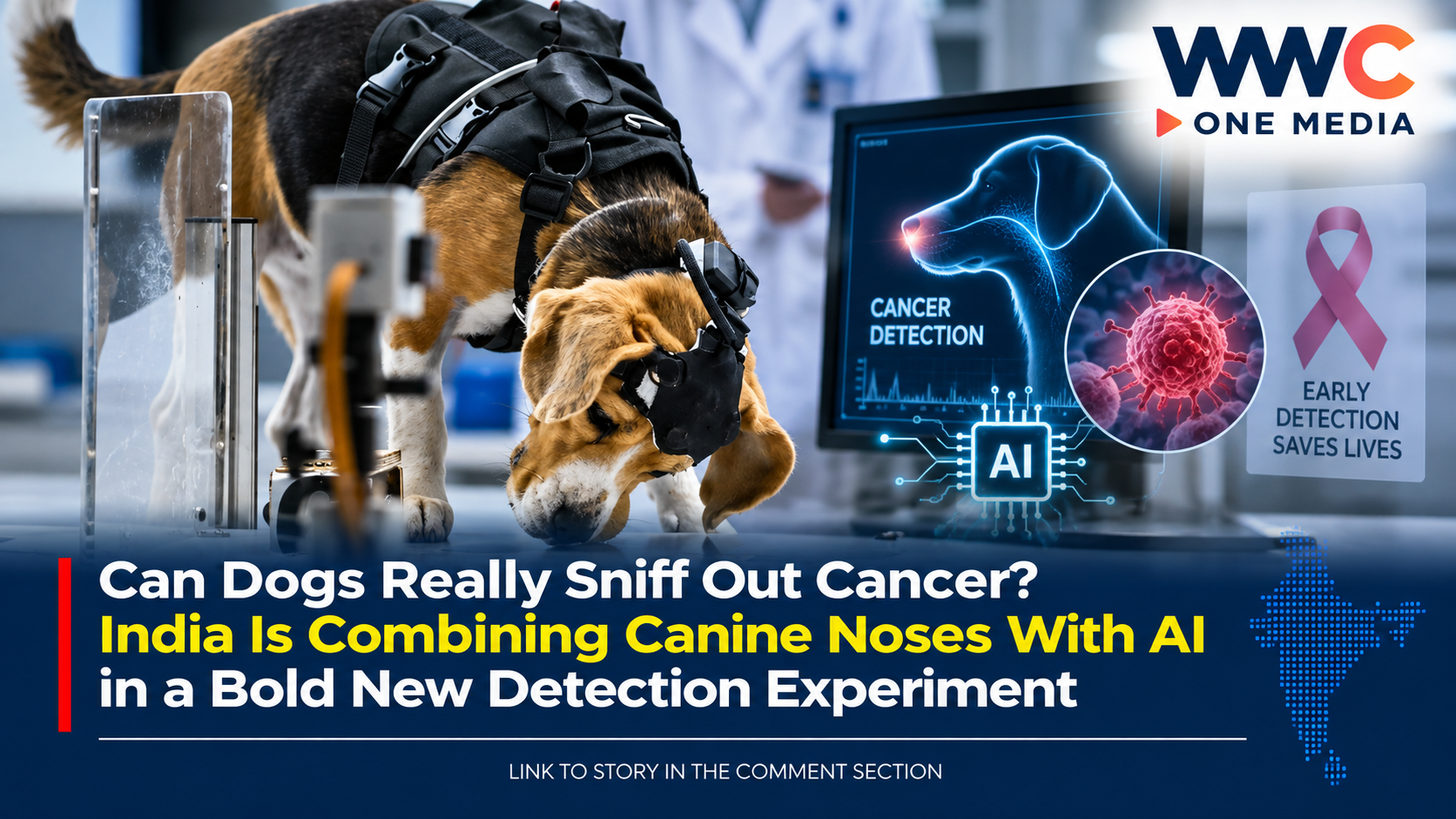
On a farm outside Bengaluru, dogs are being trained to sniff human breath samples for possible signs of cancer — while artificial intelligence monitors and analyses how the animals react.
The experimental project is being developed by Bengaluru-based startup Dognosis, which is attempting to turn dogs' extraordinary sense of smell into a data-driven tool for early cancer screening.
And one of its most unusual recruits is a rescue dog named Chloe.
When she goes to work, Chloe can wear a specially designed 3D-printed helmet and sensor-equipped harness that researchers use to collect information about her reactions to different samples.
The goal is not simply to ask whether a dog can smell cancer.
The bigger goal is to use AI to understand exactly how the dog reacts — and turn that reaction into measurable data.
Meet the cancer-sniffing dogs
Dogs have long been known for their extraordinary sense of smell.
They can detect:
- Drugs
- Explosives
- Missing people
- Electronic devices
- Certain diseases
Now researchers are investigating whether their noses could also help identify cancer.
The Dognosis project is training a group of about 15 dogs, including different breeds and rescue animals, to examine human breath samples for chemical signatures that may be associated with cancer.
The animals are trained using positive reinforcement.
When a dog correctly identifies a target scent, it receives a reward.
But researchers discovered that dogs do not all react in exactly the same way.
Some may freeze.
Some may scratch near a sample.
Others may show excitement.
That creates a challenge.
How do humans accurately interpret every reaction?
That is where artificial intelligence enters the picture.
AI is learning to read the dogs
Dognosis is using sensors and AI to analyse signals including the dogs':
- Brain activity
- Respiration
- Body movements
- Behavioural reactions
The aim is to transform a dog's natural response to scent into consistent, measurable information.
In other words:
The dog detects the smell.
The sensors record the reaction.
The AI looks for patterns.
It is an unusual combination of biology and technology.
And it could potentially solve one of the biggest challenges of using animals for medical screening: consistency.
A human observer might interpret a dog's behaviour differently.
AI could potentially identify subtle patterns across thousands of reactions.
How does the cancer test work?
The process is surprisingly simple.
A patient breathes into a cotton mask for around 10 minutes.
The mask is then sealed and sent to the laboratory.
The patient does not interact directly with the dogs.
Instead, the dogs examine the collected breath samples.
The theory behind the research is that cancer and other diseases can alter the chemicals released by the human body, potentially creating distinctive odour patterns.
Dogs have an enormous advantage when it comes to detecting scents.
They have around 300 million scent receptors, compared with roughly five million in humans, according to the AFP report.
That incredible sense of smell is now being tested as a possible medical screening tool.
The company says its early results are promising
Dognosis says a recent study involving more than 1,500 participants and six hospitals in Karnataka examined the technology's ability to identify multiple cancers.
The company reported an accuracy rate of more than 90% across seven major cancer types and is now planning further testing in real-world programmes.
That sounds impressive.
But there is an important distinction.
Promising results do not automatically mean the test is ready to replace conventional cancer screening.
Independent medical specialists quoted in coverage of the project described the findings as encouraging but called for continued research and real-world validation.
That next stage could be crucial.
Could dogs make cancer screening cheaper?
This is one of the biggest potential advantages.
Cancer screening can involve expensive equipment, specialist laboratories and trained medical professionals.
Those services are not always easily accessible.
Dognosis hopes that trained dogs could eventually provide a low-cost and non-invasive first layer of screening.
The idea would not be for a dog to diagnose cancer.
Instead, the system could potentially flag a sample for further medical testing.
That could work like this:
Step 1: Initial screening
A breath sample is collected.
Step 2: Canine detection
Trained dogs examine the sample.
Step 3: AI analysis
Sensors and AI analyse the animals' responses.
Step 4: Potential warning
A suspicious sample is identified.
Step 5: Medical confirmation
The patient undergoes established clinical testing.
That could be especially important in places where many cancer patients are diagnosed only after the disease has advanced.
Why early detection matters
The earlier cancer is detected, the more treatment options may be available.
That is why researchers around the world are searching for screening methods that are:
- Faster
- Cheaper
- Less invasive
- Easier to scale
- More accessible
Scientists are investigating blood tests, saliva tests, imaging technology and AI systems.
Researchers in India have also recently reported work on non-invasive oral cancer screening using saliva and mouth swabs.
The Dognosis experiment takes a very different approach.
Instead of creating an entirely new electronic sensor, it starts with one of nature's most powerful detection systems:
A dog's nose.
Then it adds artificial intelligence.
The dogs are not working all day
The startup says animal welfare is part of the programme.
According to the AFP report, the dogs' working time is limited to around 30 to 45 minutes a day.
The company uses positive reinforcement and automatic feeders to reward the animals during testing.
The dogs are also individually listed as trained sniffers by the company.
It is a far cry from a traditional medical laboratory.
But the developers believe the unusual approach could eventually become a scalable technology platform.
The real breakthrough may be AI, not just the dogs
Dogs have been investigated for disease detection for years.
The bigger innovation in the Dognosis approach may be the attempt to standardise what the animals do.
One dog might react by stopping.
Another might move differently.
Another might become visibly excited.
Without technology, interpreting those reactions could be subjective.
AI could potentially identify patterns that humans miss.
That is why the project is attracting attention.
It is not simply:
"Dogs can smell cancer."
It is:
"Can AI turn a dog's biological reaction into reliable medical data?"
That is a much bigger scientific question.
Could AI eventually replace the dogs?
Possibly — but not necessarily in the way people imagine.
The dogs themselves may help researchers understand which chemical patterns are important.
That information could eventually contribute to the development of electronic detection systems.
Scientists have long been working on so-called "electronic noses" capable of detecting chemical signatures.
A trained dog's nose could potentially act as a biological discovery tool.
AI could then help analyse the enormous amount of behavioural and sensor data produced during testing.
The ultimate technology may therefore look very different from today's experiment.
The startup wants to launch commercially
Dognosis hopes to move towards a commercial launch in 2027, according to AFP reporting.
The company says it is working with government medical institutions as part of its research and validation efforts.
But commercial availability would still depend on further testing, regulatory requirements and clinical validation.
That is important.
A high accuracy figure from an early study does not mean a technology has been fully proven for broad clinical use.
Medical screening tools need to be evaluated carefully for issues including:
- False positives
- False negatives
- Performance across different populations
- Consistency
- Reproducibility
- Real-world performance
Those questions will determine whether the technology can move beyond an experimental laboratory.
What happens if the dog gets it wrong?
This is one of the biggest challenges.
No screening test is perfect.
A false positive could cause anxiety and lead to unnecessary follow-up testing.
A false negative could potentially provide false reassurance.
That is why any dog-and-AI system would likely need to operate alongside established medical testing rather than replace it.
The safest potential role would be as an early warning or preliminary screening layer.
A positive signal would require confirmation.
A negative signal would not necessarily rule out disease.
That distinction is critical.
Dogs have already helped detect other illnesses
Cancer is not the only disease researchers have explored using canine scent detection.
Studies and research programmes have investigated whether trained dogs can detect signals associated with:
- Parkinson's disease
- COVID-19
- Diabetes
- Malaria
- Certain bacterial infections
The principle is similar.
Changes in the body can alter the chemicals a person releases.
Dogs may be able to detect some of those changes.
But translating that ability into a standardised medical test is much more difficult.
India could become a major testing ground
India has a huge population and a growing healthcare technology sector.
That makes affordable screening tools particularly important.
Advanced medical equipment can be expensive.
Specialist healthcare can also be unevenly distributed.
A non-invasive and potentially low-cost screening system could therefore have enormous appeal if it proves reliable.
The challenge is scale.
Can dogs and AI analyse millions of samples?
Can training be standardised?
Can different laboratories achieve the same results?
Can regulators approve the technology?
Those questions remain unanswered.
The future could look surprisingly different
Imagine visiting a healthcare centre.
Instead of immediately undergoing an invasive procedure, you could potentially:
Breathe into a mask.
Have the sample analysed.
Receive a screening result.
And if something unusual is detected:
Get referred for further testing.
That is the future Dognosis is exploring.
But researchers still have a long way to go.
The technology has caught global attention
The project has attracted international coverage because it sits at the intersection of several major technology trends:
Artificial intelligence.
Healthcare.
Early cancer detection.
Animal science.
Non-invasive diagnostics.
Recent reporting has also highlighted the startup's earlier efforts to train dogs to detect cancer traces in human breath.
The concept may sound strange.
But so did many technologies that are now part of modern medicine.
Could this change cancer detection forever?
It is too early to say.
The technology is experimental.
The reported results still need broader validation.
And dogs are unlikely to replace doctors, oncologists, scans or laboratory testing anytime soon.
But the research points to something fascinating.
Nature has already developed incredibly sophisticated biological sensors.
Artificial intelligence may help humans understand and use them in entirely new ways.
The bottom line
Yes, dogs may be able to detect scent changes associated with cancer.
But the real challenge is making that ability scientifically consistent and clinically reliable.
That is where India's Dognosis believes AI could make a difference.
The Bengaluru startup is combining trained dogs, breath samples, wearable sensors and artificial intelligence in an effort to develop a non-invasive cancer screening tool.
Its early findings are promising, with the company reporting more than 90% accuracy across seven cancer types in a study involving more than 1,500 participants.
But experts remain cautious.
The technology still needs further real-world and clinical validation before it can be considered an established medical screening method.
Still, the idea is remarkable.
One of the world's most advanced technologies may one day work alongside one of nature's oldest detection systems.
A dog's nose.
An AI algorithm.
And a simple breath sample.
Could that combination help detect cancer earlier?
India is now trying to find out.
WWC ONE MEDIA J.M.D