
Candaba Farmers Become Fishermen When the Rains Come—But What Their Nets Pull From the Floodwaters Shows Why This Pampanga Town Is Different

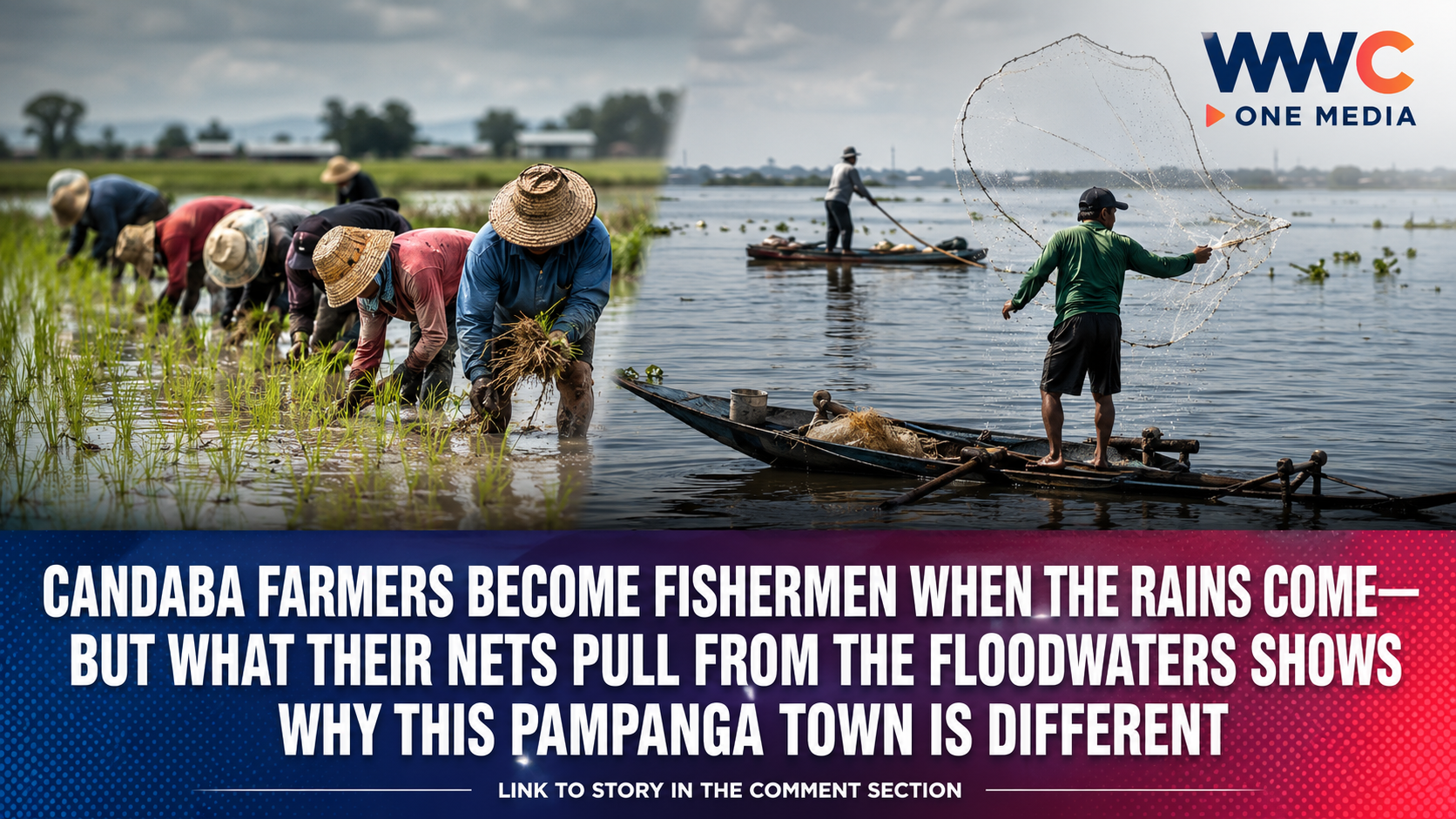
CANDABA, Pampanga — In many farming communities, prolonged rain and flooding can mean damaged crops and lost income. But in the low-lying wetlands of Candaba, Pampanga, the arrival of the rainy season can also signal something very different: the moment when some rice farmers temporarily put down their farming tools and become fishermen.
A GMA News report published on August 22 showed residents catching large quantities of freshwater fish from waterways connected to the Pampanga River, continuing a seasonal livelihood pattern that has existed in Candaba for generations.
Local fisherman Claren Dela Paz told GMA that fish become particularly abundant during the rainy season as they move upstream. He described catches as reaching not merely one ton but potentially “hundreds of tons,” although that figure was his estimate and was not independently documented in the report.
From Rice Fields to Fishing Grounds
For many residents, farming and fishing are not competing livelihoods. They are two parts of the same yearly cycle.
According to GMA, some of the fishermen featured in the report are also rice farmers. They cultivate and harvest rice during the drier months, roughly from December through May, before shifting their attention to fishing when the rainy season makes farming more difficult.
That seasonal transition is closely tied to Candaba's geography.
The municipal government describes the area as a complex of freshwater ponds, marshes and seasonally flooded grasslands sitting on a broad alluvial plain. Its wet season typically runs from around late May through October, while parts of the swamp regularly go underwater during periods of heavy rainfall.
Candaba is also a natural catch basin for water coming through several river systems, which is one reason flooding has become part of the municipality's environmental and economic rhythm.
The town itself lists farming and fishing as two major sources of livelihood, noting that both are strongly influenced by Candaba's swampy terrain and seasonal flooding.
A Simple Net, a Powerful Current
One traditional fishing method shown in the GMA feature uses a locally known net called a “bukatot.”
The net is stretched between bamboo poles and positioned in a creek or waterway, allowing fish moving with the current to enter the trap. Fishermen may wait only about 10 minutes before lifting the net and manually transferring the catch into sacks.
Among the fish reported were several types of carp, including Rohu, Common Carp and Silver Carp.
GMA reported that some specimens can grow extremely large, with fish weighing as much as about 15 kilograms. At the market, Silver Carp was being sold for roughly ₱25 to ₱30 per kilogram, while Common Carp was fetching about ₱70 per kilogram at the time of the report.
Those prices are snapshots from the featured sellers and should not be interpreted as fixed market prices throughout Pampanga.
Fishing During Flood Season Is Nothing New in Candaba
The practice documented by GMA is part of a much older Candaba tradition.
A 2022 SunStar Pampanga column described the Candaba Swamp—also locally called the Pinac—as farmland during the dry months and a floodplain during the rainy season. Rice fields can effectively transition into fishing areas as water rises, allowing some residents to alternate between farming and fishing depending on the season.
Research into fishing practices in Candaba Swamp has documented a diverse freshwater fish population as well.
A scientific study examining fishing communities in the wetland recorded 14 fish species, with tilapia, common carp and hito among the dominant species found in surveyed areas. The researchers also found that fishermen's earnings varied considerably depending on season and the size of their catches.
Earlier GMA reporting provides another example of the same phenomenon.
After Tropical Storm Pepito caused flooding in Candaba in October 2020, residents said fish from the Pampanga River moved into flooded communities. A barangay official at the time described residents catching fish when floodwaters arrived.
But Flooding Is Still a Serious Threat
The abundance of fish does not mean flooding is universally beneficial.
Recent events underline that contradiction.
Pampanga suffered an estimated ₱443.86 million in fisheries damage following flooding and weather disturbances associated with Tropical Depressions Luis and Maymay and the southwest monsoon, according to provincial figures reported by SunStar on August 17, 2026.
Candaba alone accounted for approximately ₱40.76 million in reported fisheries losses, demonstrating that the same waters capable of supporting seasonal fishing can also destroy commercial fish production and other agricultural livelihoods when flooding becomes severe.
A Philippine Rice Research Institute report released in August also identified flooding as a major agricultural challenge in Candaba. Because the municipality serves as a catch basin for water coming from areas including Nueva Ecija, floodwater can remain for extended periods and prevent farmers from planting normally.
So the story is more complicated than simply saying that floods are good for Candaba.
They can bring fish—and badly needed income—to some households while damaging rice fields, aquaculture operations and infrastructure elsewhere.
An Ecosystem Under Pressure
There is another concern beneath the unusual seasonal abundance.
The Philippine Information Agency has reported that the Candaba Swamp faces pressures from land conversion and environmental degradation. Farmers and fisherfolk interviewed for an earlier environmental assessment said fish catches had declined considerably compared with levels decades earlier.
The wetland is important not only for agriculture and fishing but also for biodiversity. Candaba is an important habitat for migratory birds along the East Asian–Australasian Flyway and has long been recognized as one of Central Luzon's significant wetland ecosystems.
That makes the seasonal transformation witnessed today more than an unusual livelihood story.
It is also a demonstration of how closely the lives of Candaba residents remain connected to the health of the wetland surrounding them.
Survival Through Adaptation
Perhaps the most striking part of Candaba's rainy-season fishing tradition is not the size of the fish or the quantity that can appear in the nets.
It is the adaptability of the people catching them.
During the dry months, the land provides rice.
When water covers those fields and waterways swell, residents look to the rivers and wetlands instead.
As one fisherman told GMA, doing nothing is not an option when a family's livelihood is at stake. The fish may be there, but someone still has to go into the water and catch them.
In a province where extreme rainfall can wipe out millions of pesos in agricultural production, Candaba offers an unusual example of communities adapting their livelihoods to a landscape they cannot completely control.
When the rains arrive, the farmers do not simply wait for the floodwaters to disappear. Some pick up their nets—and another season of survival begins.