
Cathay Pacific and Google Expand AI Trials to Stop Planes From Creating Heat-Trapping Contrails

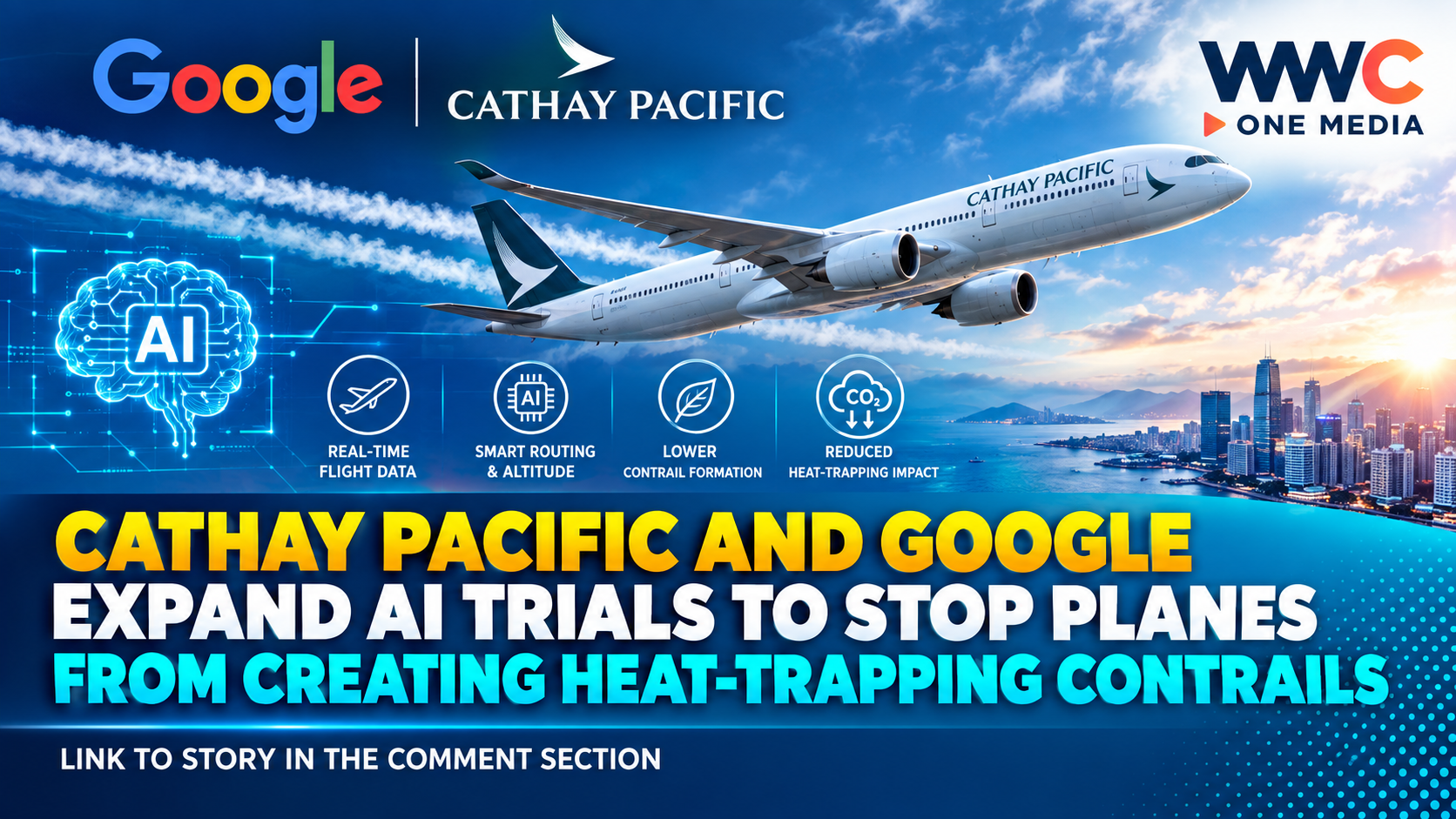
HONG KONG — Cathay Pacific and Google are expanding a potentially groundbreaking aviation experiment that uses artificial intelligence to help aircraft avoid creating climate-warming contrails, with the companies now preparing a much larger trial across Asia and trans-Pacific routes.
The partnership is testing whether small changes in an aircraft's flight altitude can prevent persistent condensation trails from forming in atmospheric conditions where they are most likely to trap heat.
An initial trial involving more than 80 Cathay Pacific flights produced an estimated 40% reduction in the warming impact of contrails, according to Google and Cathay.
The companies say the early results are encouraging enough to move the project into a second phase that will generate more real-world data and test whether the approach can work across a much wider range of routes.
The white trails behind planes may be doing more than people realise
Contrails — short for condensation trails — are the thin white streaks sometimes visible behind aircraft flying at high altitude.
They form when aircraft pass through sufficiently cold and humid air. While many disappear relatively quickly, some can persist and spread into wider cloud-like formations.
Those persistent contrails can have a warming effect by trapping heat in the atmosphere.
Google estimates that contrails account for roughly one-third of aviation's total climate impact, making them an increasingly important area of research alongside the industry's much larger focus on carbon dioxide emissions.
The significance is that contrails can potentially be reduced without replacing an aircraft or developing an entirely new fuel.
Instead, an aircraft may only need to make a relatively small adjustment to its altitude.
How AI could help pilots avoid them
Google's technology combines AI forecasting, satellite imagery and weather information to identify areas where persistent contrails are likely to develop.
The system can then recommend small changes in flight altitude so aircraft can avoid those atmospheric zones.
Rather than dramatically changing a flight's route, the idea is to make targeted adjustments within normal operational parameters.
Cathay has integrated the information into its flight operations through its Electronic Flight Folder, with dynamic forecasts also available through in-flight connectivity. The aim is to give pilots and flight teams useful information without disrupting normal cockpit procedures.
The approach is similar in principle to avoiding turbulence: identify potentially problematic atmospheric conditions and make a relatively small adjustment to the flight path.
Early trial produced a 40% reduction
The first operational trial began in late 2025.
More than 100 flights were initially targeted, although not every flight ultimately participated because of operational factors including airspace and payload restrictions.
More than 80 flights followed contrail-avoidance routes, with Google's analysis estimating that they reduced the warming impact of contrails by approximately 40%.
One particularly notable route was between Hong Kong and Singapore.
Google said early analysis indicated that interventions on this corridor accounted for more than half of the trial's total estimated climate impact reduction.
The results do not mean aviation's overall climate impact was reduced by 40%.
The figure specifically refers to the estimated warming impact from contrails on the flights involved in the trial.
Now the experiment gets much bigger
Cathay and Google are preparing a second phase involving a broader section of Cathay's network.
The new trial will include Asia-Pacific and trans-Pacific routes, including ultra-long-haul flights.
The nonprofit Contrails.org is also joining the project to help advance independent research into contrail formation and mitigation.
Cathay is particularly significant to the project because it is Google's first commercial airline partner in the Asia-Pacific region to test the technology and the first airline globally to trial contrail avoidance on ultra-long-haul flights.
That gives researchers an opportunity to gather data from atmospheric conditions that differ significantly from those encountered in earlier trials over the United States and North Atlantic.
Why the Asia-Pacific trial matters
Asia-Pacific is one of the world's busiest and fastest-growing aviation regions.
That makes it an important testing ground for technologies intended to reduce aviation's environmental footprint.
But atmospheric conditions are not identical everywhere.
A system that works effectively over one region may behave differently over another because of differences in humidity, temperature, weather patterns and airspace restrictions.
The expanded trial should therefore help researchers determine how consistently AI-based contrail avoidance works under different operational conditions.
It could work with today's aircraft
One of the most attractive aspects of the technology is that it does not require airlines to wait for a completely new generation of aircraft.
The system is designed to work with existing planes and conventional aviation fuel, using flight-planning adjustments rather than major hardware changes.
That could potentially make it faster and cheaper to deploy than some longer-term aviation climate technologies.
Google has described contrail avoidance as a potentially scalable way of addressing part of aviation's non-CO₂ climate impact, although the companies acknowledge that considerably more research is needed before its effectiveness at industry scale can be fully assessed.
But the technology is not a replacement for cutting CO₂
Cathay has stressed that contrail avoidance is only one part of its broader sustainability strategy.
Reducing carbon dioxide emissions remains a central priority, including through fleet modernization, greater operational efficiency and the use of sustainable aviation fuel.
The new AI system instead targets a different part of aviation's climate impact — the warming associated with persistent contrails.
That distinction is important because avoiding contrails does not make an aircraft carbon-neutral.
A flight still produces CO₂ and other emissions.
Researchers still need more evidence
Despite the promising early results, the 40% figure is an estimate from an initial operational trial, not proof that the same reduction will automatically occur across the entire aviation industry.
The larger second phase is intended to produce a stronger body of real-world evidence.
Researchers will need to determine how often contrail avoidance is possible, how much fuel or time different altitude adjustments require, how air-traffic constraints affect the strategy and whether the climate benefits remain significant when the approach is deployed at scale.
The companies themselves say further trials and research are needed before broader industry and policy decisions can be made.
A small change in the sky could have a much bigger impact
The experiment highlights an unusual possibility in the fight against aviation's climate impact.
Instead of waiting decades for radically different aircraft technology, airlines may be able to reduce some warming effects through better information and smarter flight decisions today.
If the larger trial confirms the early results, AI-guided contrail avoidance could eventually become another routine tool used by airlines alongside fuel efficiency, sustainable aviation fuel and newer aircraft.
For now, Cathay Pacific and Google are still testing the idea.
But if moving a plane slightly higher or lower at the right moment can prevent a heat-trapping cloud from forming thousands of metres above the Earth, the aviation industry's next climate breakthrough may not require a new aircraft at all — just a smarter way to fly the ones already in the sky.
WWC ONE MEDIA J.M.D