
China Warns of ‘Consequences’ as Taiwan Appears at Pacific Summit — But Palau Says Beijing Doesn’t Choose the Guest List

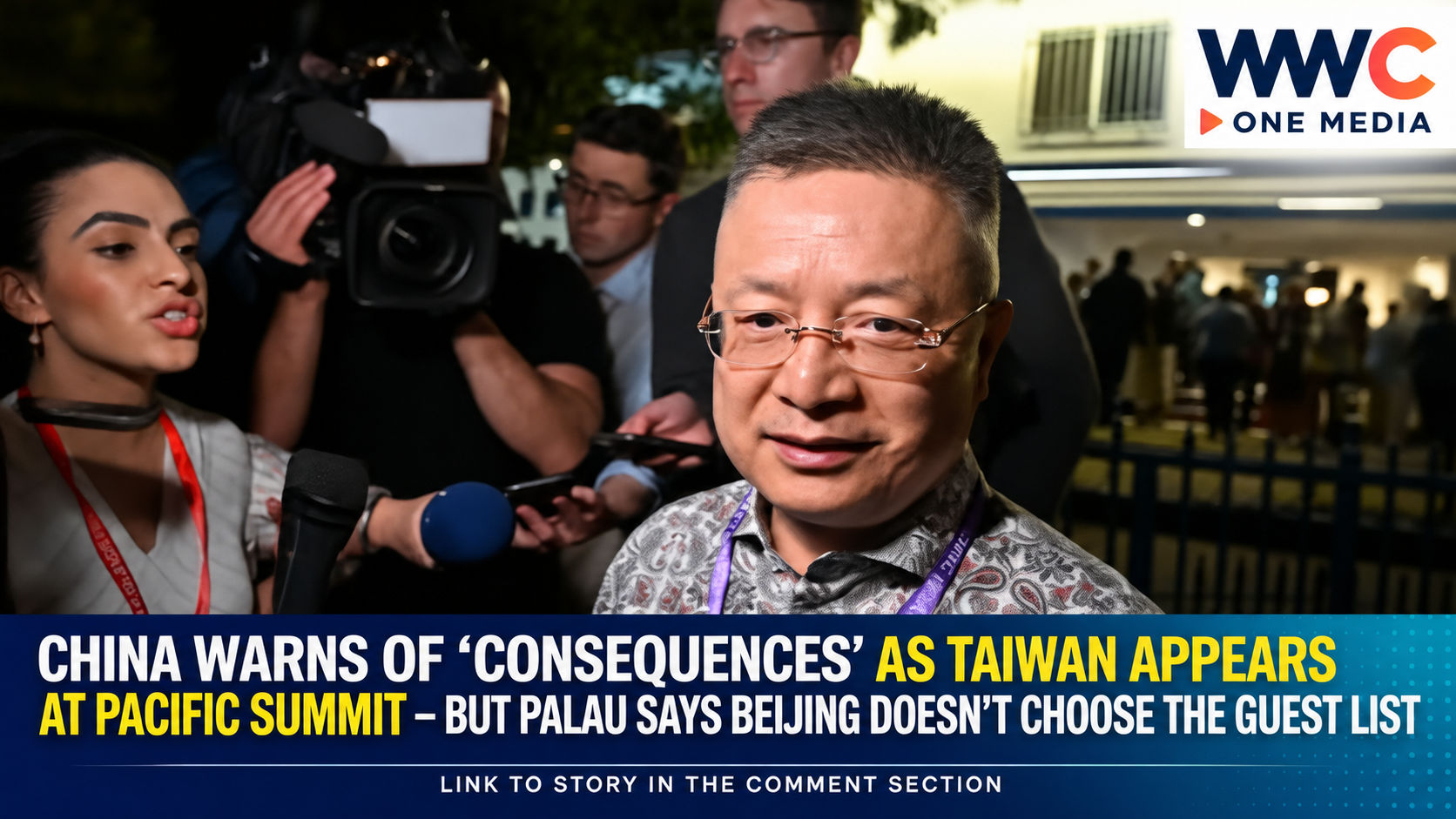
KOROR, Palau — A gathering designed to showcase Pacific unity instead became the latest arena in the escalating diplomatic contest between China and Taiwan, after Beijing warned of unspecified “consequences” over the presence of Taiwan’s foreign minister at the region’s most important political summit.
Chinese special envoy for Pacific island affairs Qian Bo confronted the issue after Taiwan’s Foreign Minister Lin Chia-lung attended the opening ceremony and other activities associated with the 55th Pacific Islands Forum Leaders Meeting in Palau.
Asked whether Taiwan would face consequences, Qian said there would “always be consequences,” while insisting that his comment was not a threat. He did not explain what Beijing might do.
That ambiguity immediately transformed what could have been a procedural dispute over invitations into a larger geopolitical question:
How far is China prepared to go to prevent Taiwan from maintaining even limited international representation in the Pacific?
And Palau’s answer was equally clear.
It would not allow outside powers to dictate the rules.
Palau delivers a message to Beijing — without naming Beijing
Palau President Surangel Whipps Jr., whose country hosted this year’s 18-member forum, used the opening ceremony to make a pointed statement about outside influence.
“Our partners are welcome to sail with us, but they do not choose our destination,” Whipps said, adding that the Pacific agenda must be driven by Pacific nations themselves.
Whipps did not need to name China.
The message was unmistakable.
Palau is one of only three Pacific Island Forum members that still maintain formal diplomatic relations with Taiwan, alongside Tuvalu and the Marshall Islands. Beijing has persuaded most other Pacific states that once recognized Taipei to switch recognition to the People’s Republic of China.
China considers democratically governed Taiwan part of its territory and says countries and international organizations should deal with Taiwan under Beijing’s one-China principle.
Taiwan rejects Beijing’s sovereignty claim, maintaining that the People’s Republic of China has never governed the island.
The Pacific has consequently become one of the remaining regions where the diplomatic competition between Taipei and Beijing remains especially visible.
Why was Taiwan at the summit at all?
This is where the diplomatic dispute becomes complicated.
Taiwan is not a member of the Pacific Islands Forum.
Neither is China or the United States.
But outside governments and organizations have historically participated through different partnership arrangements.
Reuters and AP describe Taiwan as a development partner of the forum, while China holds the higher-profile status of dialogue partner. The United States, Japan, India, Canada, Britain and the European Union are also among the forum’s external partners.
China, however, disputed Taiwan’s standing.
A Chinese Foreign Ministry spokesperson said Taipei was not qualified to participate in forum activities and accused Taiwan of using the gathering to seek international attention.
That position conflicts with the way Taiwan and several Pacific governments describe the forum’s longstanding arrangements.
An official Pacific Islands Forum communiqué from 2024 explicitly reaffirmed the leaders’ earlier decision governing relations with Taiwan/Republic of China.
Palau has therefore argued that inviting Taiwan is not an improvised political stunt but consistent with established forum practice.
Whipps later said both China and Taiwan were recognized partners under existing forum arrangements and argued those arrangements should be respected to preserve Pacific unity.
Taiwan’s foreign minister was not hiding in the background
Lin’s participation was highly visible.
He attended the opening ceremony, held meetings and took part in events connected with Taiwan’s Pacific cooperation programs.
Taiwan’s Foreign Ministry says Lin’s Aug. 27-Sept. 3 trip included the forum opening, the annual Taiwan/Republic of China–Pacific Islands Forum Countries Dialogue, and events showcasing Taiwanese cooperation in renewable energy, digital resilience, agriculture, health care and infrastructure.
Lin portrayed Taiwan not as an outside provocateur but as an established development partner.
“Taiwan is honoured to serve as a partner in the Pacific,” he said, according to Reuters.
He later accused Beijing of trying to dominate proceedings rather than respecting the host country’s decisions.
China rejected Taiwan’s criticism.
Then Australia and New Zealand stepped in
Beijing’s warning did not go unanswered.
Australian Prime Minister Anthony Albanese said decisions about attendance belonged to the Pacific Islands Forum itself.
“This is primarily a gathering of the Pacific family,” Albanese said.
New Zealand Foreign Minister Winston Peters was even more explicit in defending the forum’s independence, saying the bloc did not take instructions from countries outside the organization.
Australia’s official position going into the meeting was that the forum should remain the Pacific’s central political institution and that regional challenges should be addressed through solutions designed by Pacific countries themselves.
That language may sound diplomatic, but in the current Pacific environment it carries strategic weight.
Small island governments are increasingly uncomfortable with being treated merely as pieces in a competition between Beijing, Washington, Canberra, Wellington and Taipei.
Palau wanted the summit to reinforce precisely the opposite idea:
major powers may participate, but Pacific countries set the agenda.
But five national leaders were missing
Then another controversy emerged.
The leaders of Fiji, Vanuatu, Samoa and the Solomon Islands, as well as the president of Kiribati, did not attend the forum as originally expected. Their countries were represented by ministers or other officials.
Not all of those absences had the same explanation.
For example, Solomon Islands Prime Minister Matthew Wale returned home amid a looming no-confidence vote. Other countries also cited domestic or scheduling issues.
But Peters publicly said he was “highly suspicious” about whether outside interference might explain some of the absences.
He stopped short of accusing China and said New Zealand needed evidence before assigning blame.
Beijing dismissed suggestions of foreign interference as unfounded.
That distinction is important.
There is currently no publicly established evidence proving that China ordered or caused the leaders to stay away.
Speculation exists because of the diplomatic context, but it should not be reported as fact.
Last year shows why everyone was nervous about Taiwan
The Palau confrontation did not emerge from nowhere.
At the 2025 Pacific Islands Forum in Solomon Islands, all 21 external dialogue and development partners — including China, Taiwan and the United States — were excluded from the leaders meeting while the forum reviewed its external partnership arrangements.
The Solomon Islands government said the decision was procedural.
But critics argued it effectively avoided a potentially explosive confrontation over Beijing’s objections to Taiwan.
That meant Palau’s decision to bring external partners back in 2026 was always likely to test the unresolved Taiwan question.
ABC Australia reported that PIF Secretary-General Baron Waqa openly acknowledged the return of partners after the previous year’s break.
And because Palau maintains diplomatic ties with Taiwan, Beijing had already objected before the summit even began.
China’s Foreign Ministry warned on Aug. 11 that Taiwan’s participation should be handled according to the one-China principle and urged the forum secretariat to prevent Taiwan-related issues from disrupting China-PIF relations.
In other words:
the confrontation was visible weeks before delegates arrived in Koror.
China had already put pressure on Palau
The tensions also extend beyond conference invitations.
Ahead of the summit, Reuters reported that China had effectively warned travelers about visiting Palau, describing the country as unsafe.
Palau interpreted the move as political pressure connected to its Taiwan relationship.
Whipps accused Beijing of coercion and said his country would not be bullied.
China disputes accusations that its actions toward Palau amount to coercion.
But Palau’s vulnerability is obvious.
The country has fewer than 20,000 residents and relies heavily on tourism and external economic connections.
China therefore possesses economic tools that a microstate like Palau cannot easily ignore.
That is why the Taiwan dispute resonates far beyond diplomatic protocol.
It raises the question of whether smaller Pacific states can maintain foreign policies that conflict with Beijing’s preferences without facing economic consequences.
Taiwan has only three remaining diplomatic allies in the Pacific
China’s campaign to isolate Taiwan has already dramatically changed Pacific diplomacy.
Today, only:
Palau, Marshall Islands and Tuvalu
among Pacific Islands Forum members formally recognize Taipei rather than Beijing.
Other governments have switched sides over the years.
The Solomon Islands and Kiribati both transferred diplomatic recognition from Taipei to Beijing in 2019, while Nauru switched to China in 2024.
For Beijing, each diplomatic switch strengthens the international acceptance of its one-China position.
For Taiwan, every remaining partner is disproportionately valuable.
That makes Palau far more strategically important than its population or economy might otherwise suggest.
Then another China issue exploded: a ballistic missile
Taiwan was not even the only China-related dispute hanging over the summit.
Pacific governments were also angry about a Chinese ballistic missile test into the Pacific in July.
Forum foreign ministers had previously struggled to agree on a collective response because some members refused to endorse proposed language critical of Beijing.
Whipps pushed leaders at the September summit to take a stronger position.
He argued that Beijing should respect regional sovereignty, provide greater transparency and behave as a responsible Pacific partner.
China rejected Palau’s criticism, accusing Whipps’ government of attempting to politicize the test and saying Beijing remained committed to peaceful development.
By the end of the meeting, Pacific leaders nevertheless expressed collective concern about the test, although Nauru dissented and Kiribati was absent from the crucial leaders’ retreat.
That outcome matters because it demonstrates how deeply China policy now divides the Pacific.
The Taiwan dispute was not an isolated confrontation.
It was part of a broader argument over security, sovereignty and Beijing’s growing regional reach.
Meanwhile, the United States and its allies were writing checks
The geopolitical competition was unfolding in real time around the summit.
The United States and New Zealand announced a joint plan to upgrade a World War II-era port on Penrhyn Atoll in the Cook Islands.
Washington intends to provide $50 million, while New Zealand committed NZ$17.5 million.
Australia and the United States separately announced hundreds of millions of dollars in new Pacific support.
Reuters calculated the combined commitments at roughly $580 million, covering areas including energy resilience, security and efforts to combat drug trafficking.
Those governments frame the spending as support requested by Pacific partners.
But it is impossible to separate the new attention from China’s rapid expansion across the region.
Beijing has financed infrastructure, signed security and development agreements and expanded trade relationships across Pacific states.
The United States, Australia and New Zealand are responding with their own diplomatic, security and investment push.
This is why a summit of tiny states now attracts thousands
AP noted that the Pacific Islands Forum has evolved dramatically.
What was once a comparatively low-key gathering has grown into a meeting drawing roughly 2,000 attendees, reflecting the enormous strategic interest now surrounding a region populated by many of the world’s smallest countries.
Their populations may be small.
Their geographic importance is not.
Pacific states control enormous exclusive economic zones, maritime routes and locations of military significance stretching between Asia, Australia and the Americas.
They also carry considerable diplomatic weight in international organizations, where every sovereign state has a vote.
That combination explains why China, the United States, Taiwan, Japan, Australia and New Zealand devote increasing resources to building influence there.
But Pacific leaders want climate and economics back on the agenda
The irony is that China and Taiwan were not supposed to dominate the meeting.
The summit’s official theme was “Building Economies: Life. Action. Unity.”
Australia said leaders intended to focus on regional prosperity, security, climate action and infrastructure.
Pacific countries are also confronting severe economic pressures from imported fuel costs, climate disasters and the long-term vulnerability of low-lying islands.
New Zealand described the region as facing increasingly complicated economic, geopolitical and security pressures.
Yet once again, global power politics consumed much of the attention.
And that was exactly the outcome Whipps had warned against.
The real battle is over who gets to decide
On paper, the dispute was simple.
Palau invited Taiwan.
China objected.
Taiwan attended.
Beijing warned of consequences.
But beneath that sequence lies a much more consequential question.
The Pacific Islands Forum has spent years promoting the concept of “Pacific regionalism” — the idea that island governments should collectively determine their own priorities.
China’s position is that Taiwan’s participation violates Beijing’s one-China principle.
Taiwan argues that its decades-long development relationship with Pacific countries gives it a legitimate place in forum-related activities.
Australia and New Zealand argue that the forum itself decides who participates.
Palau goes further:
outside powers do not get a veto.
Whipps reinforced that position again later in the summit, saying both Taiwan and China were partners and that Pacific countries should respect one another’s sovereign relationships.
That may ultimately become the most important legacy of the confrontation.
Because Beijing’s warning was not only heard in Taipei.
It was heard throughout a region increasingly determined not to be forced into choosing sides.
China may have wanted the summit to focus on Taiwan’s legitimacy.
Instead, it sparked another debate:
whether the Pacific’s smallest nations can still make their own diplomatic choices when the world’s biggest powers arrive at the table.
WWC ONE MEDIA M.J.E