
China’s Cerium-Based Nanoparticle Could Transform Gout Treatment — But Scientists Have Only Tested It in Animals

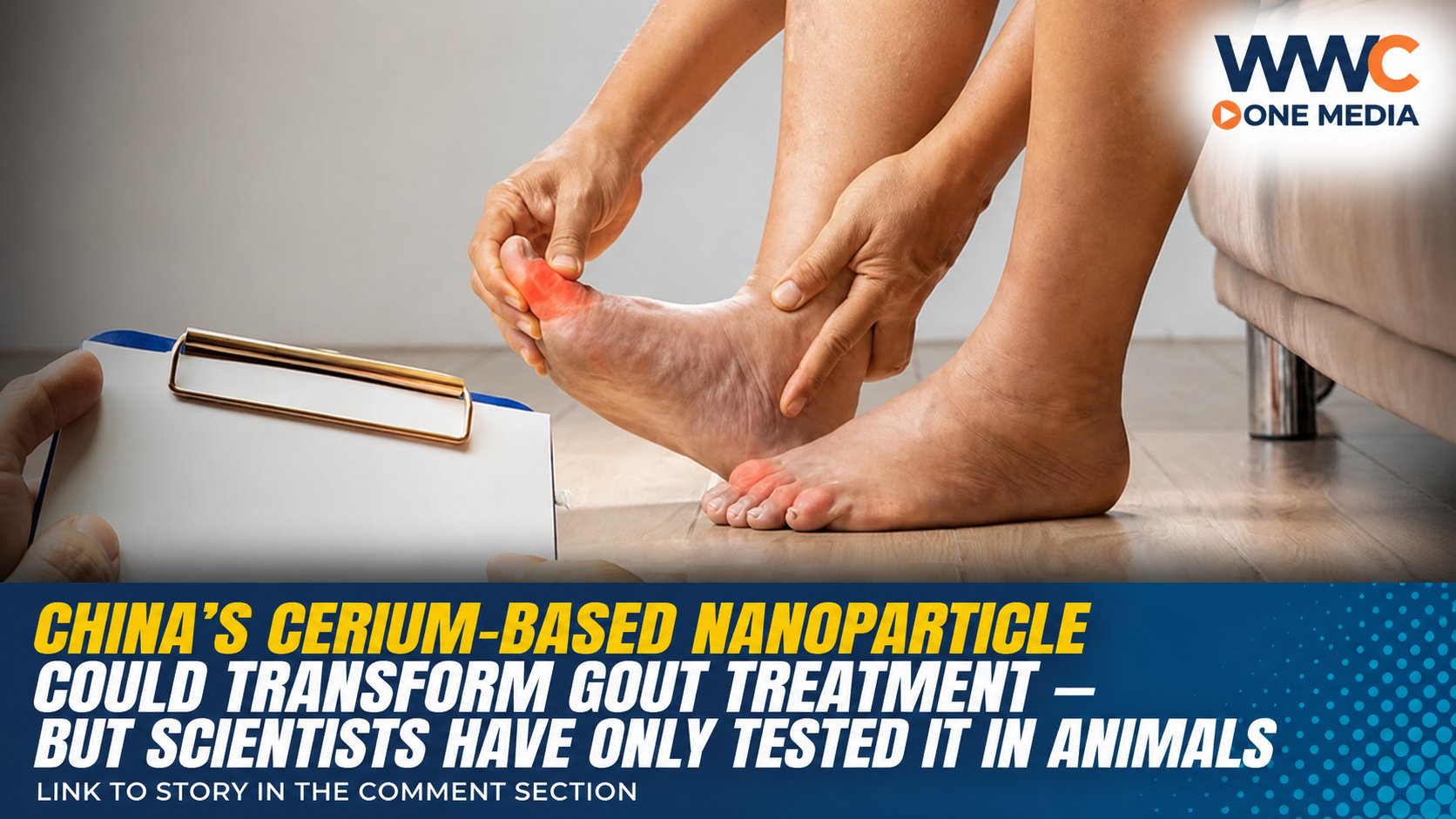
A team of Chinese scientists has developed an experimental cerium-based nanoparticle treatment that targets several underlying processes involved in gout, raising hopes for a new approach to a disease that affects tens of millions worldwide.
But there is an important catch: the treatment has not yet been proven effective or safe in humans. The current evidence comes from laboratory and animal experiments, meaning patients should not view it as an available cure.
Researchers from the School of Pharmaceutical Sciences at Shanghai Jiao Tong University developed a multifunctional nanoparticle system called UCCN, described as an engineered “sweeper” for gouty arthritis. Their findings were published in the journal Biomaterials in August 2026.
Why scientists are excited about the approach
Gout develops when excessive uric acid contributes to the formation of monosodium urate crystals inside joints. Those crystals can trigger intense inflammation and repeated attacks, while long-term crystal accumulation can damage joints and contribute to other complications.
The Shanghai team attempted to tackle several parts of that process at once.
Their nanoparticle combines hollow cerium oxide structures with urate oxidase, while an outer chondroitin-sulfate layer is designed to interfere with crystal formation and inflammatory signaling.
In animal experiments, the researchers reported that the treatment:
- reduced uric acid levels;
- inhibited the formation of urate crystals;
- reduced inflammation;
- limited excessive bone-breaking activity by osteoclasts; and
- improved gout-related symptoms in the experimental models.
That combination is what makes the research particularly interesting. Instead of targeting only uric acid or inflammation, the researchers are attempting a multi-stage treatment strategy.
The “rare-earth” connection
Cerium is a rare-earth element, and the experimental therapy uses cerium oxide at the nanoscale.
That does not mean patients could simply take a conventional cerium supplement or rare-earth product.
The researchers engineered the cerium oxide into a specialized nanostructure and combined it with other components to create the UCCN system. Its behavior in the body—and especially its safety profile—would need to be carefully established before any human treatment could be considered.
Gout remains a growing global problem
The potential significance is considerable.
A major Global Burden of Disease analysis estimated that 55.8 million people worldwide had gout in 2020. Researchers project that figure could reach approximately 95.8 million by 2050, an increase of more than 70%, driven largely by population growth and ageing.
Gout is not simply a temporary pain problem. Persistent urate crystal deposition can contribute to chronic joint damage, while gout is also associated with kidney and cardiovascular problems.
Existing treatments are already effective—but not for everyone
The new research does not mean current gout medicines have stopped working.
The American College of Rheumatology recommends allopurinol as the preferred first-line urate-lowering treatment for patients who require long-term urate-lowering therapy, with treatment adjusted toward a serum urate target below 6 mg/dL. Colchicine, NSAIDs and glucocorticoids remain recommended options for managing acute flares.
Chinese guidelines likewise recommend established urate-lowering therapies, including allopurinol and febuxostat, alongside lifestyle measures.
The experimental nanoparticle therefore represents a potential future treatment strategy—not a replacement for proven therapies today.
Other researchers are also attacking gout from new directions
The Chinese cerium-based study is part of a broader wave of research aimed at treating gout at multiple points in the disease process.
Another 2026 study developed a different cerium-containing nanozyme, Ce-MOF@Pt, designed to dissolve urate deposits while reducing oxidative stress and inflammation. Experiments in mice showed reduced gout-related inflammation and pain, but that research is also still preclinical.
Meanwhile, a separate Phase II human clinical trial in China tested SSGJ-613, an anti-IL-1β antibody, in 90 adults with acute gout. Researchers reported pain reduction comparable with corticosteroid treatment after 72 hours and fewer new flares during the following 12 weeks.
These studies highlight how researchers are increasingly looking beyond simply controlling symptoms.
The biggest question: Will it work in humans?
That remains unanswered.
The Shanghai Jiao Tong University team's results are promising, but animal success does not guarantee human effectiveness or safety.
Before the cerium-based nanoparticle could become a real medicine, researchers would need to establish appropriate dosing, toxicity, long-term safety, pharmacokinetics and effectiveness through progressively larger human clinical trials.
So the accurate headline is not that China has already discovered a permanent cure for gout.
It is that Chinese researchers have developed a promising experimental nanoparticle that simultaneously targets uric acid, crystals, inflammation and bone damage in animal models.
If future human trials reproduce those results, the approach could represent a major change in how gout is treated.
For now, however, the “once and for all” claim remains a possibility—not a medical fact.
WWC ONE MEDIA J.M.D