
Chris Horton Launches Mandarin Edition of ‘Ghost Nation’ in Taiwan as Taiwan’s Global Identity Takes Center Stage

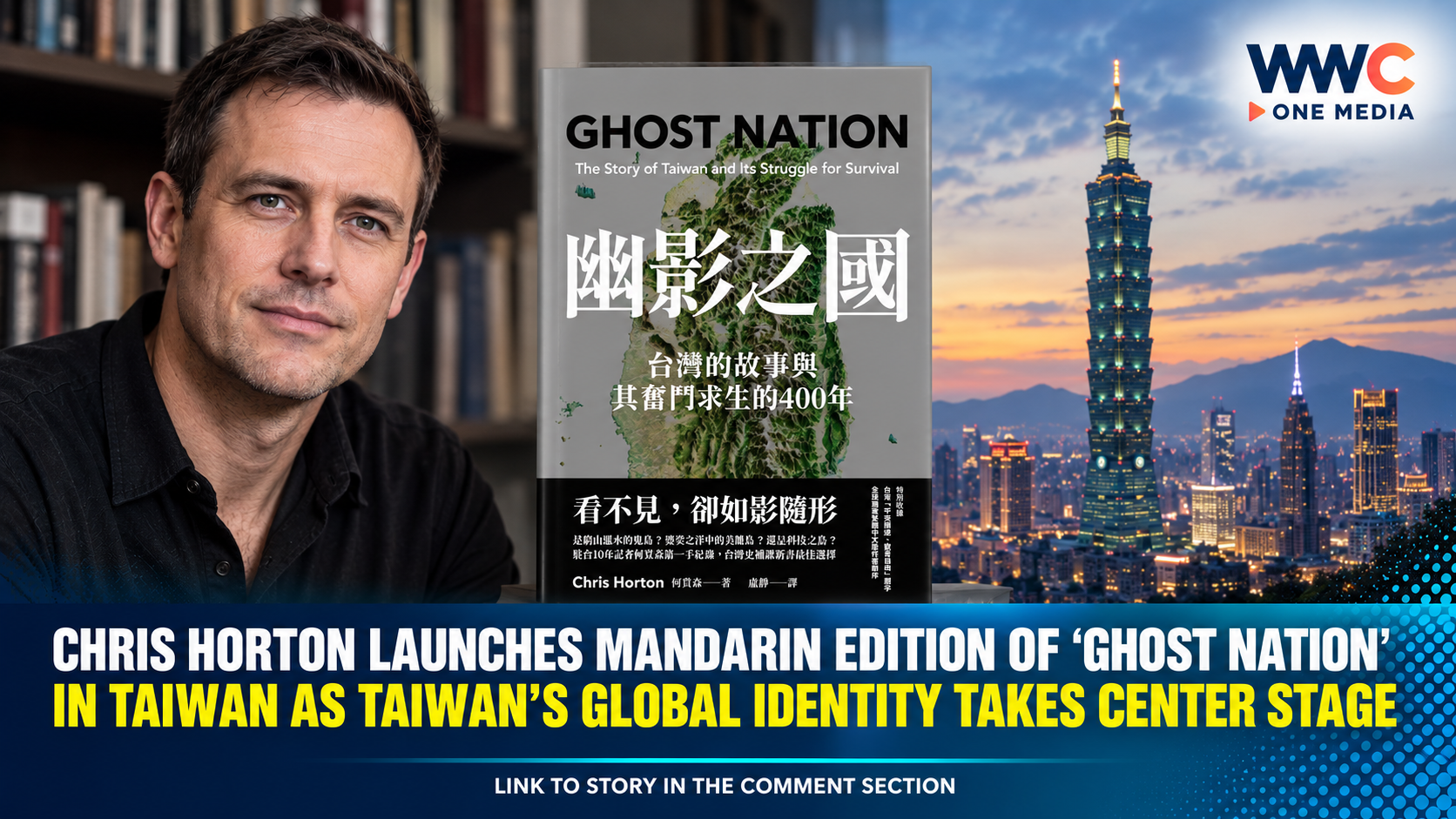
TAIPEI, Taiwan — Journalist and author Chris Horton has brought his acclaimed book Ghost Nation: The Story of Taiwan and Its Struggle for Survival to a new audience with the launch of its Mandarin-language edition, putting Taiwan’s complicated history, international isolation and uncertain future back under the spotlight.
The Mandarin edition was celebrated during a Sept. 5 event at Nowhere Books in Taipei’s Wanhua District, where Horton spoke with readers about the history behind the book and the continuing struggle over how Taiwan is seen—and described—by the outside world.
The book's central argument is striking: Taiwan is globally important, yet it remains politically and diplomatically difficult for much of the world to recognize openly.
Why ‘Ghost Nation’ matters now
Horton, who has lived and worked in Taiwan for more than a decade, uses Ghost Nation to examine roughly four centuries of Taiwan's history, its transformation into a democracy and its precarious position amid tensions between Beijing and Washington.
The English-language edition was first published in July 2025 by Macmillan. Publisher information describes the book as a broad history of Taiwan based on more than a decade of Horton’s reporting and interviews with political leaders, ordinary citizens and other figures.
Horton has said that the book was partly motivated by his own experience. Before moving to Taiwan, he spent 13 years in China and two years in Hong Kong. He has acknowledged that he arrived in Taiwan carrying assumptions about the island that had been shaped by the Chinese Communist Party's narrative.
That perspective became one of the book's defining features: rather than treating Taiwan simply as a flashpoint between China and the United States, Horton attempts to put Taiwanese people and their own history at the center of the story.
From colonial history to modern democracy
Ghost Nation explores the many political powers that have controlled portions of Taiwan over the centuries, including Dutch and Spanish colonial authorities, the Kingdom of Tungning, the Qing Empire and Japan, before the Republic of China government took control of Taiwan in 1945.
Horton also examines Taiwan's postwar political development, including the February 28 Incident of 1947, the decades of authoritarian rule under the Kuomintang and Taiwan's eventual transition toward democracy.
In earlier interviews, Horton said he was surprised by how much of Taiwan's history he had not understood before arriving on the island—including the scale of Japanese influence, the history of 228 and the complicated political circumstances surrounding Taiwan after World War II.
The book therefore isn't simply a contemporary geopolitical analysis. It is also an attempt to explain how Taiwan's modern identity emerged from successive periods of foreign rule, political repression and democratization.
Why Horton calls Taiwan a “ghost”
The title Ghost Nation refers to Taiwan's unusual international position.
Taiwan functions as a self-governing democracy with its own elected government, military, currency and institutions, yet it is excluded from the United Nations and many other international organizations. Its athletes also compete at the Olympics under the name Chinese Taipei.
Horton has described the “ghost” metaphor as reflecting Taiwan's international invisibility despite its enormous importance to the global economy and technology sector.
That contradiction sits at the heart of the book: How can a place be so strategically and economically important while remaining diplomatically marginalized?
Horton warns that Taiwan's visibility is still contested
At the Taipei launch event, Horton argued that Taiwan's international visibility is not determined solely by Taiwan or China but also by other countries that decide how openly they engage with Taipei.
He pointed to what he describes as pressure from Beijing to shape the language used to describe Taiwan and other disputed territories.
“Taiwan isn’t seen even when it is seen,” Horton told the audience, according to Taiwan News. He argued that Beijing's influence over international terminology is part of a broader struggle over how Taiwan is perceived globally.
The issue has become increasingly relevant as Taiwan faces pressure over its diplomatic relationships, international participation and representation in global institutions.
The book arrives amid heightened security concerns
The Mandarin edition also comes at a moment when Taiwan's security has become an increasingly important international issue.
Horton told Taiwan News that he is more concerned about Taiwan's future than when he began writing the book in 2022. He said he does not consider a Chinese attack likely in the immediate future but believes Taiwan's next presidential election could become a major source of tension.
Those are Horton's assessments, not predictions established as fact.
His broader concern is that Taiwan's ability to deter military pressure depends not only on diplomacy but also on its defense capabilities and international support.
A book intended for Taiwanese readers, too
The Mandarin edition represents an important shift in audience.
Horton has said that he hopes the book can help Taiwanese readers explain their country's history to foreign friends, relatives and partners who may have limited understanding of Taiwan's past.
That goal is particularly significant because much international reporting on Taiwan has historically been framed through the lens of China-US relations.
Instead, Horton says his book seeks to give greater weight to Taiwanese voices and experiences.
His reporting has included interviews with major political and historical figures, including former President Lee Teng-hui, political activist Su Beng, former President Tsai Ing-wen and other prominent Taiwanese figures.
More than a history book
Reviews and academic discussions have similarly emphasized the book's attempt to connect Taiwan's history with its current geopolitical predicament.
The University of Washington's Taiwan Studies Program described Horton's book as an examination of how centuries of successive rule shaped Taiwan's people and their pursuit of self-determination, while The Wire China highlighted Horton's effort to center Taiwanese people rather than portraying Taiwan merely as a pawn in US-China competition.
Publisher Macmillan describes Ghost Nation as a panoramic account of Taiwan's past and present, drawing on Horton's more than decade-long reporting career. The book has also received praise from writers and scholars including Rana Mitter, Melissa Chan and Jonathan Sullivan.
The bigger question behind ‘Ghost Nation’
The Mandarin launch ultimately gives Horton another opportunity to raise the question that drives the book:
What happens to a society that is visible to the world economically and strategically, but remains politically difficult for many governments to acknowledge?
For Taiwan, that question is no longer confined to history books.
It touches everything from diplomacy and international organizations to semiconductors, national security and the growing rivalry between China and the United States.
And as Horton argued in Taipei, Taiwan's struggle for international visibility may depend as much on what the rest of the world is willing to say about it as on what Taiwan says about itself.