
DOE Eyes Partial Relief for Visayas, Mindanao Grid Alerts as Power Plants Return This September

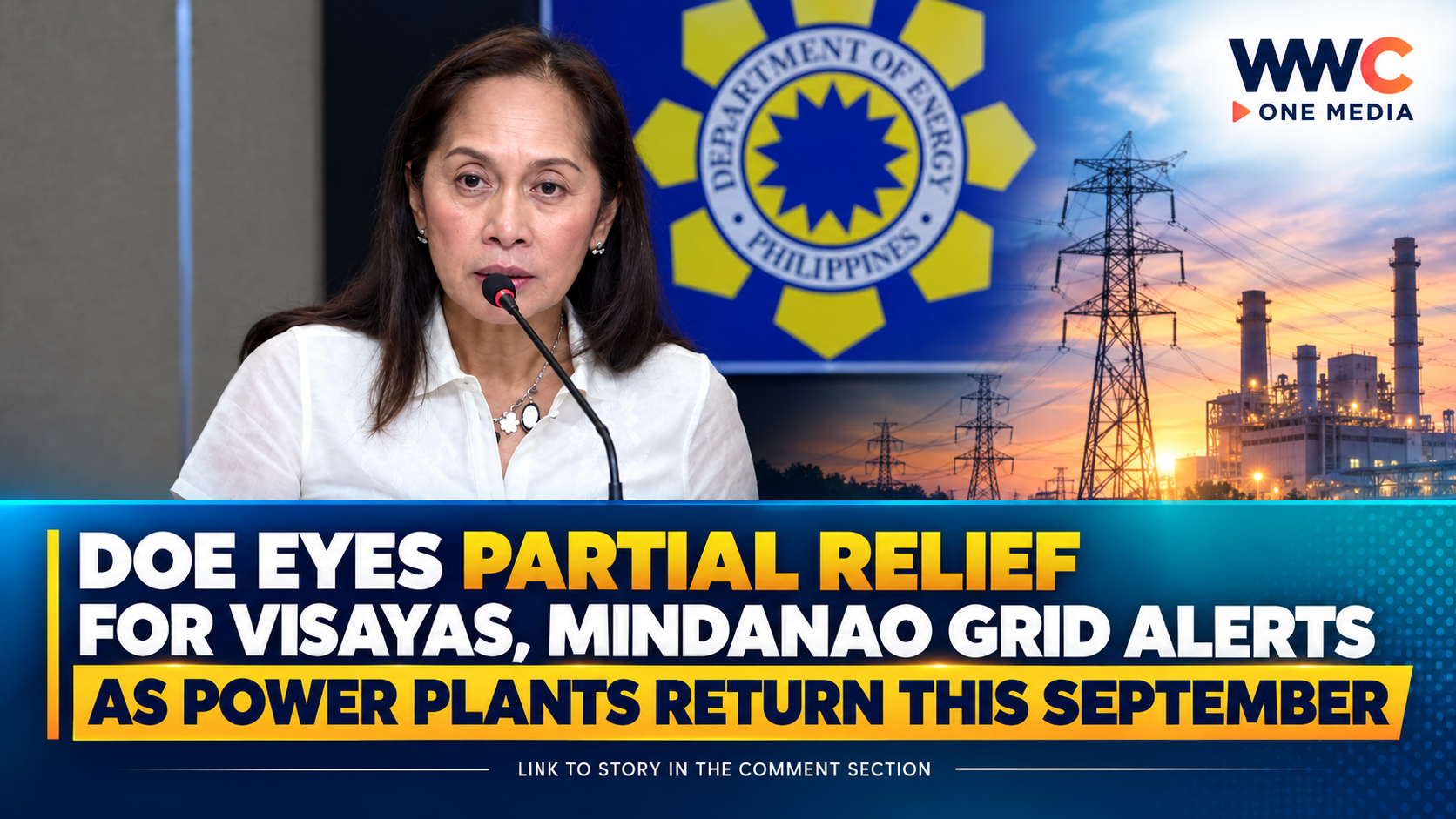
MANILA, Philippines — The Department of Energy (DOE) is racing to stabilize the electricity supply in the Visayas and Mindanao this month, with several major power-generating units scheduled to return to service after prolonged outages triggered repeated yellow and red grid alerts.
Energy Secretary Sharon Garin said Monday that the return of offline generating units, combined with additional battery energy storage and other emergency measures, could provide much-needed relief to consumers facing recurring power interruptions.
But the DOE is not yet declaring the crisis over.
Instead, officials are describing the September measures as a partial solution while the government works on longer-term additions to the country's power supply.
Major power plants set to return
According to DOE data presented during Garin's September 7 briefing, Cebu Energy Development Corp. (CEDC) Unit 1, with an output of about 82 megawatts (MW), returned to service on September 5.
More capacity is expected to follow.
Therma Visayas Inc. (TVI) Unit 1, capable of producing about 169 MW, is scheduled to return on September 15.
In Mindanao, Therma South Inc. Unit 2 was scheduled to return on September 8, followed by Therma South Unit 1 on September 19 and GNPower Kauswagan Unit 2 on September 20.
Another major Visayas unit, Panay Energy Development Corp. Unit 3, is expected to return by October 3.
The scheduled returns are important because the interconnected Visayas and Mindanao grids have been operating with unusually thin reserves, leaving little room to absorb additional plant failures or sudden increases in demand.
Visayas has been hit particularly hard
The scale of the problem is reflected in the number of grid alerts recorded this year.
DOE data cited by the Philippine News Agency showed that, through September 7, the Visayas grid had recorded 96 yellow alerts and 33 red alerts, while Mindanao had logged 12 yellow alerts and three red alerts.
On September 7, the Visayas grid again entered a red-alert period because available generating capacity was insufficient to maintain a comfortable reserve.
GMA News reported that the National Grid Corporation of the Philippines (NGCP) warned of possible brownouts as the Visayas grid faced tight supply conditions.
The situation has already forced rotational outages in parts of the region.
A key problem has been the simultaneous unavailability of several large generating units, compounded by limited electricity imports from Mindanao.
DOE turns to batteries for faster backup
While bringing large power plants back online remains the immediate priority, the DOE is also pushing battery energy storage systems (BESS) as a faster way of providing backup capacity.
Garin said around 253 MW of battery storage capacity is being pursued across Cebu, Panay, Negros and Leyte.
DOE simulations indicate that putting the full 253 MW into service could eliminate more than half of the yellow and red alerts currently experienced by the Visayas grid.
Battery systems can respond far more quickly than conventional power plants, making them useful when the grid suddenly loses generating capacity or demand spikes.
The plan, however, still depends on getting the battery facilities connected and commercially available to the grid.
September may bring relief—but not a permanent fix
DOE officials are hoping that the return of several generating units this month will significantly improve the situation by around September 20 to 21.
DOE Undersecretary Rowena Cristina Guevara said the agency hopes the yellow and red alerts will no longer occur once the affected plants return to service, although the outcome will depend on actual plant performance, demand and other grid conditions.
That distinction is crucial.
The scheduled return of a power plant does not automatically guarantee uninterrupted electricity. Generating units can face technical problems, while transmission constraints can prevent available electricity from reaching areas where it is needed.
Garin has acknowledged that the government must address both generation and transmission problems.
DOE also looking at power barges
Aside from batteries, authorities are examining temporary generation options, including liquid-fuel facilities and power barges, to provide additional capacity while larger projects remain under development.
The government has also been reviewing plant maintenance records and investigating repeated outages.
Garin said the DOE is auditing power plants' compliance with maintenance schedules and requiring corrective measures where necessary. The agency has also issued show-cause orders in cases where violations may have occurred.
The DOE has emphasized that restoring supply is the immediate priority, while accountability for repeated plant failures will follow.
The bigger problem extends beyond September
The current crisis highlights a deeper challenge: the Visayas needs substantially more dependable generation capacity.
The government is pursuing additional baseload and renewable projects, but much of that new capacity will not arrive immediately.
The Daily Guardian reported that 1,060 MW of additional capacity is planned for Panay and Negros between 2028 and 2031, including 690 MW of baseload capacity and 370 MW from renewable-energy projects.
That means batteries, returning plants and temporary generation could provide short-term breathing room—but they are not substitutes for sufficient long-term generation and a stronger transmission network.
Consumers are still being warned to brace for volatility
For households and businesses in the Visayas and Mindanao, the immediate concern remains simple: Will the lights stay on?
The DOE says the government is moving aggressively to restore generation and stabilize the grid.
But recent experience shows how quickly conditions can change.
Even after several plants return, unexpected outages, high demand or transmission restrictions could once again push the system toward a yellow or red alert.
Garin described the current Visayas power situation as unacceptable and said the government is treating the problem with urgency.
For now, the Philippines is counting on a September power comeback.
The real test will be whether the returning megawatts arrive quickly enough—and stay online long enough—to prevent another wave of brownouts.