
Fujitsu’s 64-Qubit Quantum Computer Turns Heads in Taiwan — But the Machine It’s Building Next Could Be the Real Game-Changer

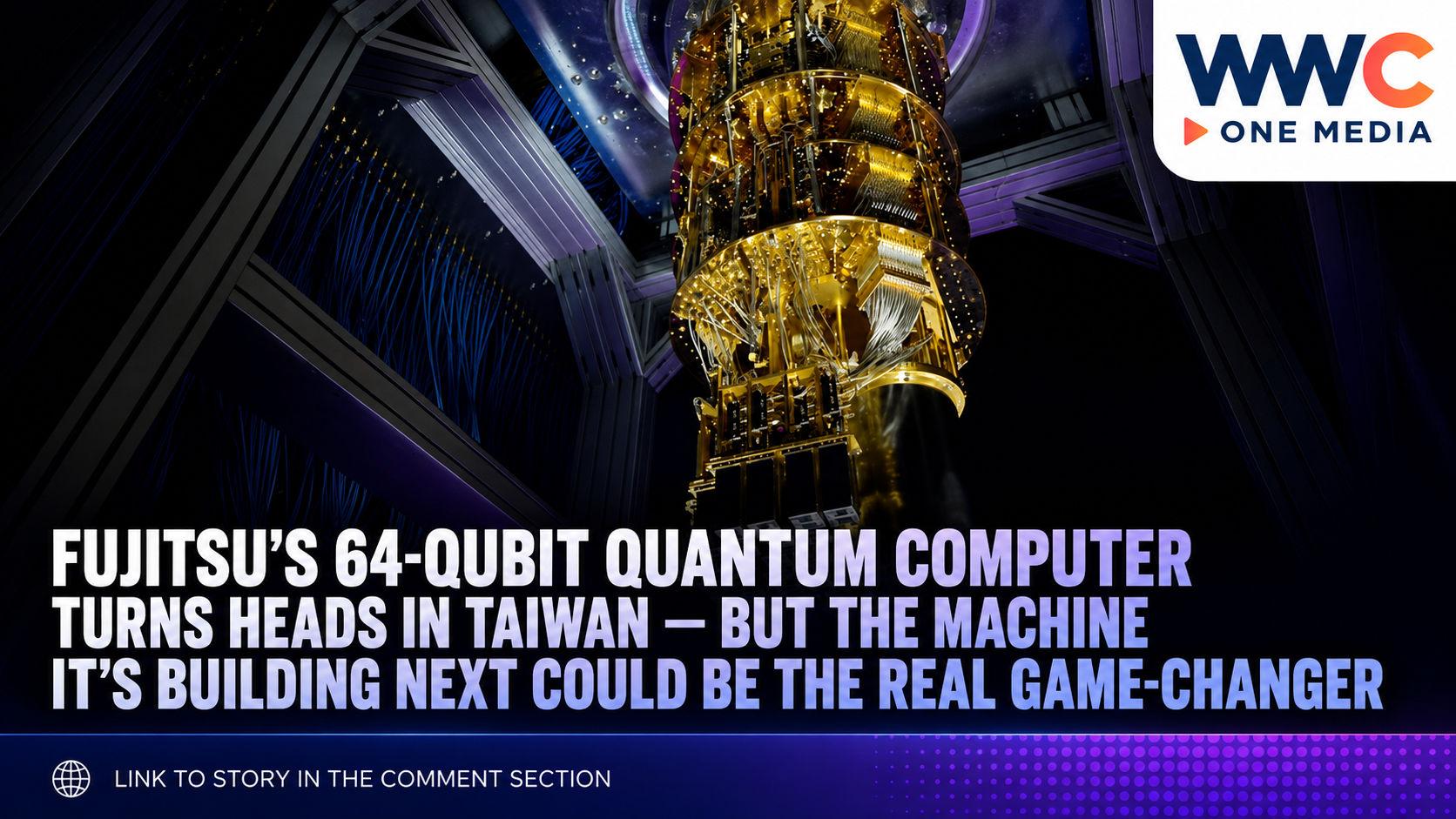
TAIPEI — Amid the towering semiconductor equipment, artificial-intelligence hardware and advanced packaging systems filling SEMICON Taiwan 2026, one machine offered a glimpse at what could come after today’s computing boom: Fujitsu’s 64-qubit superconducting quantum computer.
Visitors gathered around the system at Fujitsu’s booth at the Taipei Nangang Exhibition Center on September 2, an image highlighted by the Taipei Times under the simple headline “The age of quantum.”
But the machine on display tells only part of the story.
The 64-qubit computer is not a new 2026 launch. Fujitsu and Japan’s RIKEN research institute originally announced the system in October 2023 as part of a hybrid quantum-computing platform combining superconducting quantum hardware with Fujitsu’s quantum simulator. It was designed partly to help researchers study quantum chemistry, financial algorithms and methods for reducing errors in early-stage quantum computers.
What makes its appearance in Taipei important is what has happened since.
From 64 Qubits to 256 — and Now Toward 1,024
Fujitsu and RIKEN followed the 64-qubit machine with a 256-qubit superconducting quantum computer in 2025, quadrupling the number of qubits available on their hybrid computing platform.
RIKEN said the larger machine required advances in thermal design and high-density integration — crucial engineering challenges because superconducting quantum processors have to operate at extraordinarily low temperatures while maintaining precise control over increasingly large numbers of qubits.
Now Fujitsu is aiming considerably higher.
At SEMICON Taiwan, Fujitsu Research quantum laboratory head Shintaro Sato outlined the company's path from its 64-qubit machine to the 256-qubit system and toward a 1,024-qubit superconducting quantum computer planned for 2026.
Taiwanese technology outlet TechOrange, reporting from the Quantum Taiwan Forum, said Sato indicated that the facility for the 1,024-qubit system had already been completed and that assembly was nearly finished, with Fujitsu aiming to reach the milestone before the end of the year.
That makes the relatively modest-looking 64-qubit system in Taipei less a showcase of Fujitsu’s latest hardware than a physical marker of how quickly its quantum roadmap is moving.
Why Taiwan Is Paying Attention
The location matters.
SEMICON Taiwan is one of the world's major semiconductor industry gatherings. The 2026 exhibition is bringing together more than 1,300 exhibitors, 4,300 booths and participants from 65 countries, according to organizer SEMI.
And for the first time, the exhibition has introduced a dedicated Quantum Technology Zone, covering superconducting quantum systems, ion traps, silicon-spin qubits, quantum annealing and cryogenic CMOS technologies. Fujitsu is among the companies and research organizations participating in the zone.
That is significant for Taiwan because quantum computing is increasingly becoming intertwined with the same semiconductor ecosystem that already supports advanced AI processors.
Building large quantum computers requires far more than adding qubits. Control electronics, advanced fabrication, specialized materials, packaging, cryogenic systems and semiconductor manufacturing expertise all become increasingly important as systems scale.
Taiwan already sits at the center of many of those supply chains.
The Real Race Is Not Simply About Qubit Count
There is an important catch.
A computer with more qubits is not automatically a more useful quantum computer.
Quantum bits are highly sensitive to noise and errors. As machines grow larger, researchers must maintain qubit quality, connectivity and control while eventually implementing quantum error correction — one of the biggest obstacles separating today's experimental systems from truly fault-tolerant quantum computers.
That is why Fujitsu's strategy extends beyond simply building larger machines.
The company is working with the University of Osaka on fault-tolerant quantum-computing software and its STAR architecture, which is intended to reduce the number of physical qubits and quantum operations required to perform useful calculations. Fujitsu is also researching diamond-spin quantum technologies with Delft University of Technology in the Netherlands.
The goal is ultimately not to win a headline race over who has the biggest qubit number.
It is to build quantum systems reliable enough to solve commercially valuable problems that classical computers cannot handle efficiently.
And that point was echoed at the Quantum Taiwan Forum.
TechOrange reported that speakers from companies including IBM and Fujitsu emphasized hybrid computing, error correction and practical applications rather than raw qubit counts alone. Potential early applications continue to center on areas such as molecular simulation, chemistry, materials development and other computationally difficult problems.
Quantum Computing Is Also Creating a Security Deadline
There is another reason Taiwan's technology sector is taking quantum computing seriously: cybersecurity.
At SEMICON Taiwan 2026, Taiwan's Administration for Digital Industries brought together 15 domestic cybersecurity companies and laboratories to demonstrate technologies including post-quantum cryptography, hardware roots of trust and security-chip verification.
CNA reported that the exhibition specifically highlighted the need for semiconductor companies to prepare for a future in which sufficiently powerful quantum computers could threaten widely used cryptographic systems.
In other words, the quantum race is creating two industries at once.
One is trying to build quantum computers powerful enough to solve previously inaccessible problems.
The other is racing to protect existing digital infrastructure before those computers become powerful enough to threaten today's encryption.
The Bigger Picture
The 64-qubit Fujitsu computer photographed in Taipei may look like the headline.
It isn't.
The more consequential development is the accelerating effort to move quantum computing from specialized research laboratories into an industrial ecosystem — and the growing realization that semiconductor powerhouses such as Taiwan could have an important role in supplying the technologies needed to make that transition possible.
Fujitsu has already moved from 64 qubits to 256. Its next target is a 1,024-qubit-class system, while its longer-term research is focused on scalable, fault-tolerant quantum computing.
Whether those machines ultimately deliver a commercially meaningful advantage remains the question the entire quantum industry still has to answer.
But SEMICON Taiwan 2026 sends a clear signal: quantum computing is no longer being treated merely as a distant physics experiment.
It is becoming part of the semiconductor industry's next strategic race — and Taiwan wants a seat at the table.
WWC ONE MEDIA J.M.D