
Indonesia Cut the Sentences of Soldiers Convicted in an Acid Attack — But the Bigger Question Is Who Else Was Involved

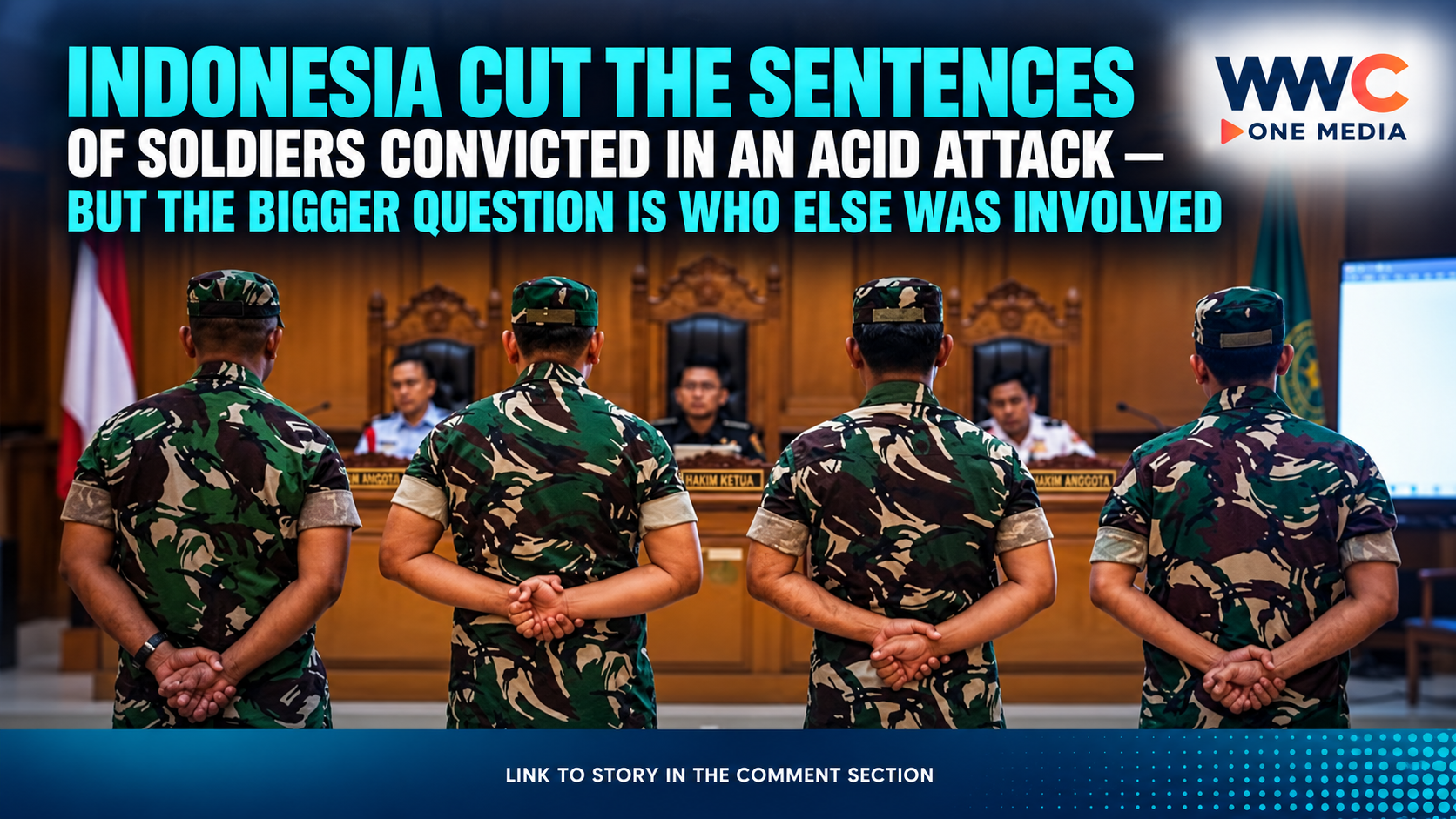
JAKARTA — An Indonesian military appeals court has reduced the prison terms of two soldiers convicted over the acid attack on human rights activist Andrie Yunus and overturned orders dismissing them from the armed forces, triggering a fresh wave of criticism from lawyers and civil society groups who say the ruling raises deeper questions about military accountability.
The decision concerns a March 12 attack on Andrie, deputy coordinator of the Commission for Missing Persons and Victims of Violence, or KontraS, who has publicly opposed the expanding role of Indonesia’s military in civilian affairs. Four members of the military’s Strategic Intelligence Agency, known as BAIS, were convicted in June of serious premeditated assault.
But after two of the defendants appealed, the Jakarta High Military Court reduced their prison sentences by six months each — and, crucially, canceled their dishonorable dismissals from military service. The August 20 appellate ruling did not publicly provide reasons for reducing the penalties, according to Reuters.
The development has transformed a case that was already being closely watched into an even larger debate over whether Indonesia’s military justice system can adequately hold soldiers accountable when civilians are the victims.
Two soldiers get shorter sentences — and keep their military status
Second Sergeant Edi Sudarko, originally sentenced to three years in prison, will now serve two-and-a-half years.
First Lieutenant Budhi Hariyanto Widhi Cahyono, whose original sentence was two-and-a-half years, had his punishment cut to two years.
Both had initially been dishonorably discharged by the lower military court. Those dismissals were overturned on appeal.
The sentences of the other two convicted soldiers were unchanged. Captain Nandala Dwi Prasetya remains sentenced to two years, while First Lieutenant Sami Lakka received one-and-a-half years.
The result means the two servicemen who had been ordered removed from the military can retain their status despite their convictions — one of the most controversial elements of the appellate decision.
Activists say the ruling sends the wrong message
The Advocacy for Democracy Team, or TAUD, a coalition of lawyers and civil society advocates, sharply criticized the decision.
The group said the reduced punishment failed to deliver justice to Andrie and warned that the outcome could strengthen perceptions of impunity and preferential treatment for military personnel.
More than a dozen activist groups also criticized the appeal, according to The Jakarta Post, arguing that the issue goes beyond the length of the prison sentences.
The coalition said the case raises a fundamental question: whether members of the armed forces accused of serious crimes against civilians should be tried inside the military justice system at all. It has asked Indonesia’s Supreme Court and Judicial Commission to examine the appellate ruling.
Indonesia’s military spokesman did not immediately respond to Reuters' request for comment on the coalition’s criticism of the appeal decision.
What happened to Andrie Yunus?
Andrie was attacked while riding a motorcycle in Central Jakarta on March 12, 2026, shortly after taking part in a podcast discussing militarism and legal challenges involving Indonesia’s military law.
CCTV footage showed attackers approaching him on a motorcycle before corrosive liquid was thrown at him. He suffered extensive burns and severe damage to his right eye.
Reuters reported that Andrie has since undergone multiple plastic surgeries as well as skin and eye operations, and that damage to his right eye is so severe he cannot read with it. Earlier reporting put his burns at approximately 24 percent of his face and arms.
The four convicted soldiers were members of BAIS, Indonesia’s military intelligence agency.
The June military court found them guilty of premeditated assault. Prosecutors and the court said the attack followed anger over Andrie’s activism opposing a greater military role in civilian government.
The controversy reaches far beyond four soldiers
One of the biggest unresolved issues is whether the four convicted servicemen were the only people involved.
Civil society investigators have claimed the operation may have involved significantly more individuals.
A TAUD investigation previously alleged that at least 16 people were involved in events surrounding the attack and suggested that additional people may have helped plan, finance or coordinate it. That claim has not resulted in convictions of those additional alleged participants.
Amnesty International has separately cited investigations by Indonesia’s National Human Rights Commission and civil society groups alleging that at least 14 individuals may have played roles in the attack. Amnesty has argued that the military trial did not adequately examine potential involvement beyond the four defendants or determine whether a broader chain of command existed.
Those numbers come from independent or human-rights investigations rather than court findings, an important distinction as authorities continue to face calls for a wider investigation.
A civilian investigation was ordered to continue
The controversy became even more complicated in June when the South Jakarta District Court ordered police to continue investigating the attack, potentially opening a separate avenue for determining whether additional people were responsible.
Andrie’s lawyers had challenged the earlier handling of the case after the police investigation was transferred to military authorities. The district court subsequently ordered Jakarta Police to resume investigating.
Police had initially said they had found no evidence of civilian involvement before the case was handed to military investigators.
That leaves a central question unresolved: Was the attack the work of four soldiers acting independently, or was there a broader operation behind them?
The military court accepted the position that the soldiers were not carrying out orders from higher commanders. Rights organizations, however, have repeatedly challenged whether the investigation went far enough to establish the full chain of responsibility.
Why Andrie’s activism became politically sensitive
Andrie had become a vocal critic of efforts to expand the Indonesian military’s presence in civilian institutions.
A revision to Indonesia’s armed forces law passed in 2025 broadened the number of government ministries and state institutions in which active-duty military personnel could serve from 10 to 14. The change prompted protests and concern among rights groups about the possibility of Indonesia moving back toward a stronger military role in civilian government.
According to evidence presented during the military proceedings, the defendants were angered by Andrie and another activist interrupting a lawmaker’s meeting in 2025 while protesting the military-law changes.
Andrie was attacked months later after participating in a discussion focused on precisely that issue.
The timing and his advocacy have made the case a powerful symbol for activists concerned about freedom of expression and the ability to criticize security institutions without intimidation.
Indonesia’s human rights minister wants the case appealed again
The appellate ruling has also drawn criticism from inside President Prabowo Subianto’s government.
Human Rights Minister Natalius Pigai urged Andrie’s legal team to pursue a cassation appeal, which would bring the case to a higher judicial level, and said further extraordinary legal remedies should be considered if necessary.
Pigai argued that justice should be assessed from the perspective of the victim and said the original decision to dismiss the two soldiers from military service had been appropriate because their conduct damaged the dignity of the military and the state.
That government intervention is significant because the dispute is no longer confined to activists criticizing the military justice system from outside.
A cabinet-level human rights official is now openly calling for the lighter ruling to face another legal challenge.
Military intelligence chief stepped down after attack
The case previously reached the upper ranks of Indonesia’s military establishment.
BAIS chief Yudi Abrimantyo stepped down after the attack, with officials describing his departure as a form of responsibility. However, authorities have not publicly established that he ordered or participated in the assault.
The distinction matters: taking institutional responsibility is not the same as being found legally responsible for the crime.
Four servicemen have been convicted.
But questions raised by activists about who knew about the plan, whether anyone else authorized it and whether other participants remain unidentified have not disappeared.
Why the appeal could become bigger than the acid-attack case
The controversy has become a test of something much larger than the punishment imposed on four officers.
At stake is public confidence in how Indonesia handles alleged crimes committed by military personnel against civilians — especially civilians who openly challenge the military itself.
Amnesty International and other rights organizations have long argued that crimes against civilians should be heard by civilian courts rather than military tribunals. In Andrie’s case, critics say allowing the defendants to remain members of the armed forces after being convicted of a premeditated acid attack risks weakening the deterrent effect of the verdict.
Supporters of the existing process, however, point to the fact that the soldiers were prosecuted, convicted and imprisoned. The military court also concluded that the attack was not ordered through a superior chain of command — a finding critics continue to dispute.
That disagreement is now likely to shape the next phase of the case.
Because although the appeal reduced two sentences, the legal and political fight over who should ultimately be held responsible may be nowhere near finished.
WWC ONE MEDIA M.J.E