
Iran Warns US Energy Assets Across the Gulf Are Exposed — But the Real Pressure Point May Be the Strait of Hormuz

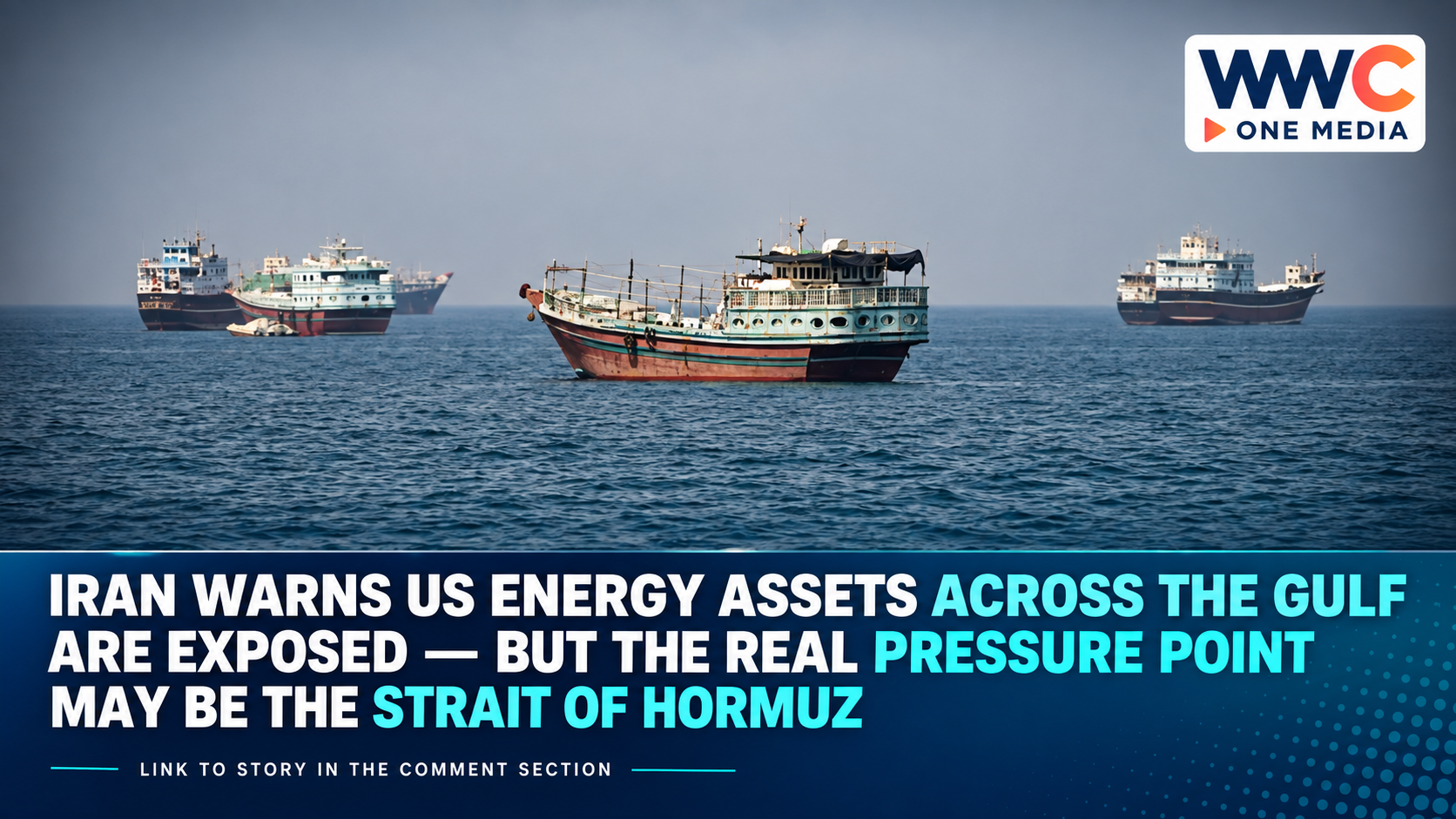
DUBAI — The confrontation between Washington and Tehran is again moving dangerously close to the infrastructure that keeps much of the global energy market running.
Iran has warned that American-linked oil and gas interests across the Persian Gulf could become targets if the United States launches further attacks on Iranian assets, escalating a renewed cycle of military strikes that has already disrupted shipping and driven crude prices toward their highest levels in six weeks.
Iranian Parliament Speaker Mohammad Baqer Qalibaf delivered the warning after US and Iranian forces exchanged attacks involving shipping over the weekend.
His message was unmistakable: Tehran believes Washington cannot attack Iran’s economic lifelines without exposing American and allied energy interests elsewhere in the Gulf to retaliation.
The warning followed comments from US Defense Secretary Pete Hegseth characterizing Iran’s tanker fleet as vulnerable. Qalibaf responded by arguing that oil and gas infrastructure throughout the Gulf is similarly exposed.
But the immediate danger extends far beyond American-owned facilities.
At the center of the confrontation is the Strait of Hormuz, the narrow waterway connecting the Persian Gulf with the Gulf of Oman and one of the world's most strategically important energy corridors.
US Struck Three Iranian Oil Tankers
The latest escalation accelerated Saturday when US forces struck three Iranian oil tankers.
According to US Central Command, the operation followed what Washington described as Iranian ballistic-missile attacks against American warships operating in the region. The US military said an aircraft carrier and a destroyer avoided the attacks and that no American personnel were injured.
US officials said two Iranian tankers were permanently disabled and another empty vessel was destroyed.
Iran subsequently said it retaliated against several tankers and American vessels, although AP noted that parts of Tehran's account could not immediately be independently confirmed.
The strikes represent an especially dangerous development because commercial shipping is increasingly becoming intertwined with the military confrontation.
Risk analysts cited by Reuters described the latest tanker attacks as a major escalation, warning that the previous distinction between military targets and commercial shipping has increasingly eroded.
The Number That Shows How Serious the Disruption Has Become
Shipping traffic through Hormuz has fallen dramatically.
Kpler data cited by Reuters showed that an average of only 10 commodity vessels per day crossed the strait during the preceding 10-day period—the lowest level recorded since May.
On Saturday, only two vessels reportedly passed through the waterway. Six made the journey Sunday.
Those figures matter because Hormuz is not an ordinary shipping lane.
Before the current conflict, the waterway carried roughly one-fifth of global oil and liquefied natural gas shipments, according to Reuters. AP reports that around 9 million barrels of oil per day are currently moving through the strait.
That means every escalation around Hormuz carries consequences well outside the Middle East.
Shipping delays, tanker attacks or tighter restrictions can quickly ripple into crude prices, refinery costs, freight rates and ultimately consumer fuel prices around the world.
Iran Is Preparing Another Move
Tehran is also threatening to change how ships navigate the Gulf.
Mohsen Rezaei, the new head of Iran's Supreme National Security Council, said Iran plans to announce a new restricted—or what AP described as an “exclusion zone”—around parts of the Gulf and near the Strait of Hormuz.
The precise boundaries have not yet been announced.
Rezaei said vessels entering the proposed area in violation of Iranian restrictions could be placed on Tehran's sanctions list. Iran also says it intends to introduce a new shipping corridor through the strait.
Washington and Tehran are therefore confronting each other not only over military targets but over who gets to determine the rules governing one of the world's most valuable waterways.
Iran says unrestricted access will depend on Washington ending attacks and pressure against Tehran.
The United States, meanwhile, maintains that Hormuz is an international waterway and has deployed substantial naval forces as part of its campaign against Iran. AP reported that more than 20 US warships were supporting Washington's blockade operation as of Sunday.
Oil Markets Are Already Reacting
Energy traders did not wait for another attack.
Brent crude rose 1.1% to $97.31 per barrel on Monday, after reaching $98.06 during trading—the highest level since July 24.
US West Texas Intermediate crude climbed to about $92.65, after touching $93.29.
The significance is psychological as well as physical.
Markets are increasingly pricing not simply the amount of oil currently being lost, but the possibility that another escalation could affect production facilities, tankers, ports or export routes elsewhere in the Gulf.
With crude already approaching $100 a barrel, each new confrontation around Hormuz has the potential to amplify fears about supplies.
Gulf Countries Are Looking for Ways Around Hormuz
Iran's neighbors are also preparing for a longer crisis.
The United Arab Emirates says it is expanding alternative infrastructure and trade routes so its exports cannot be effectively trapped by the confrontation.
UAE presidential adviser Anwar Gargash said the country is investing in additional eastern-coast port capacity as well as pipelines, railways and alternative trade corridors.
That response illustrates how dramatically the conflict is reshaping Gulf strategy.
For decades, Hormuz was regarded as a potential geopolitical chokepoint.
Now governments are spending money to reduce how much leverage any one country can exercise over it.
The UAE itself has already been directly affected by the conflict, including Iranian missile attacks and strikes against tankers associated with the country, according to Reuters.
Tehran Is Under Pressure Too
Iran's threat should not be interpreted as evidence that Tehran is operating from a position of economic strength.
Reuters reports that US sanctions and efforts to restrict Iranian oil exports are becoming increasingly difficult for Tehran to withstand.
Iranian officials themselves have acknowledged domestic pressures including inflation, unemployment, currency instability and broader economic disruption.
That creates a dangerous strategic equation.
Washington is attempting to squeeze Iran economically while retaining overwhelming conventional military power.
Tehran, unable to match the US economically or militarily on equal terms, retains something potentially just as consequential: the ability to threaten shipping and energy infrastructure in a region essential to the global economy.
That makes Hormuz one of Iran's strongest remaining pressure points.
Diplomacy Is Going Nowhere
The escalation comes after more than six months of intermittent conflict following US and Israeli strikes against Iran beginning on February 28.
A period of relative calm in August has now given way to renewed military exchanges, while attempts at diplomacy have produced little visible progress.
Rezaei said Iran now wants diplomacy accompanied by guarantees, reflecting Tehran's frustration with earlier mediation efforts involving regional governments.
But there is currently no confirmed new agreement capable of stopping the renewed confrontation.
That distinction is critical.
The existence of diplomatic contacts does not mean a ceasefire is imminent, and neither Washington nor Tehran has publicly abandoned the pressure tactics driving the current escalation.
Why This Warning Is Different
Iran has threatened energy infrastructure before.
What makes the latest warning more consequential is the environment in which it was delivered.
US forces have now directly attacked Iranian tankers.
Iran has attacked or claimed attacks against vessels and US military assets.
Traffic through Hormuz has dropped to its lowest level in months.
Oil is approaching $100.
And Gulf states are accelerating efforts to build routes that reduce their dependence on the strait.
The confrontation is therefore no longer only about what Washington or Tehran might do.
Some of the economic consequences are already visible.
The unanswered question is whether both sides can stop before the next round reaches the energy infrastructure surrounding them.
Because if that happens, the biggest casualty may not be a tanker or military vessel—it could be the fragile system that moves a significant share of the world's energy through the Gulf every day.
WWC ONE MEDIA M.J.E