
MANY DATA CENTRES IN BANGKOK BUILT WITHOUT PERMISSION. SAYS DIGITAL MINISTER

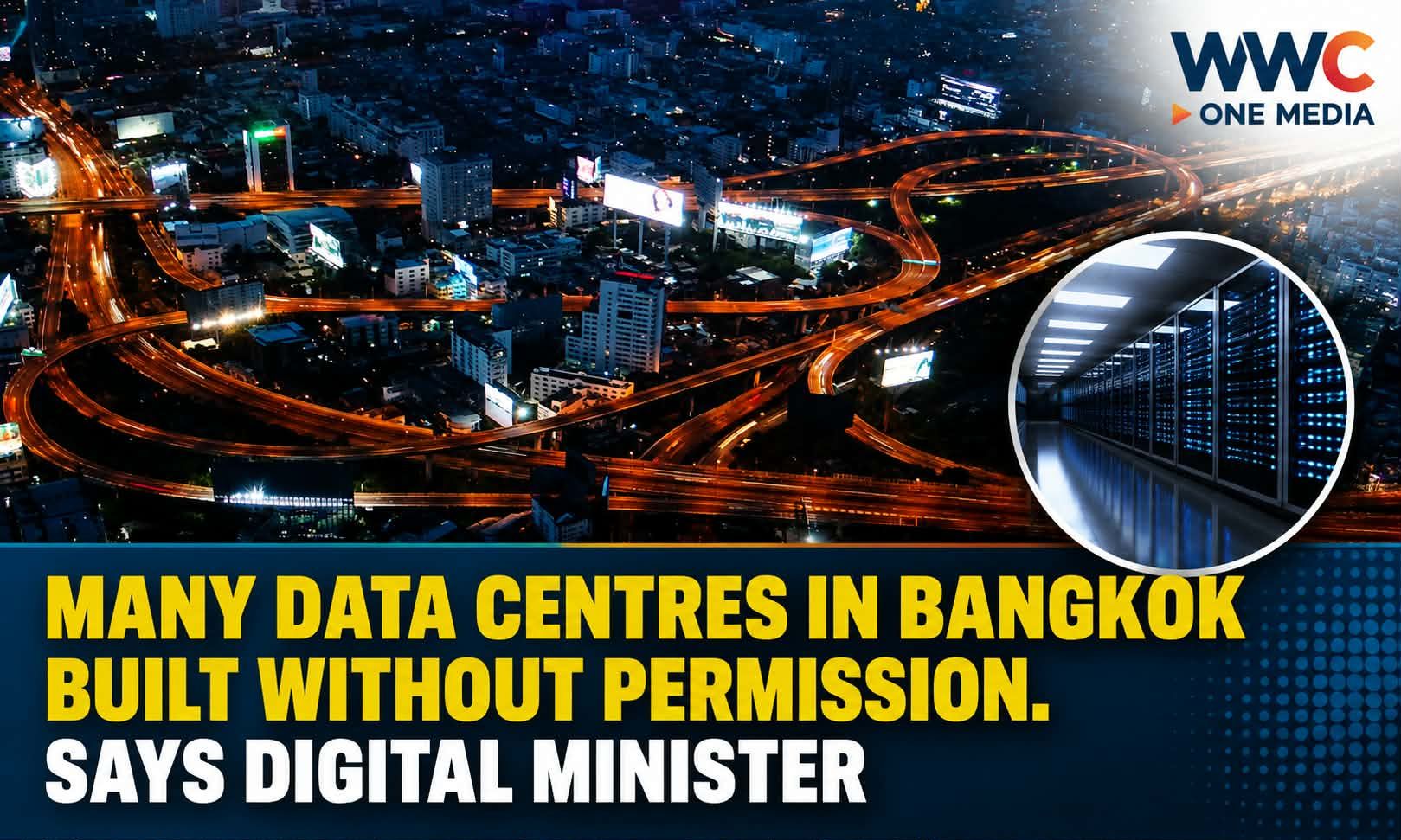
Bangkok’s Data-Centre Boom Faces a New Test as Officials Flag Unpermitted Facilities
Thailand’s race to become Southeast Asia’s digital and AI hub is colliding with a growing regulatory problem: authorities say some data centres in Bangkok have been operating or developing without the required permissions.
Bangkok’s booming data-centre industry is facing tougher scrutiny as Thailand tries to balance billions of dollars in digital investment with electricity security, environmental concerns and regulatory compliance.
Thailand’s Digital Economy and Society Ministry has raised concerns about data-centre facilities in Bangkok that allegedly lack the necessary approvals, prompting authorities to investigate whether operators are complying with requirements governing their construction and operation. The Bangkok Post reported that officials were also examining issues including fuel storage and possible foreign involvement.
The concerns come at a critical moment for Thailand.
The country has been aggressively courting hyperscalers and AI infrastructure companies, with the Board of Investment approving billions of dollars in data-centre projects. Reuters reported that Thailand's investment board approved more than US$3 billion worth of data-centre projects in 2025, while Google has separately announced a US$1 billion investment in a Thai data centre and cloud region.
But the rapid expansion is exposing a fundamental problem: Thailand's regulatory and power infrastructure has struggled to keep pace with the speed of investment.
Bangkok is at the centre of the rush
Data-centre development has accelerated sharply as artificial intelligence, cloud computing, streaming and enterprise digitalisation drive demand for computing capacity.
Industry research cited by Fangda Partners shows that Thailand's BOI approved at least 38 data-centre projects worth about 458 billion baht in 2025, representing roughly 2,066 MW of planned IT load. Seven additional projects worth approximately 96 billion baht were approved in January 2026.
Bangkok remains a crucial part of that infrastructure network, although developers are increasingly looking toward Thailand's Eastern Economic Corridor for very large hyperscale facilities.
CNA previously described Bangkok as a major regional data-centre location, with international operators building facilities to serve cloud providers, technology companies and AI-related demand.
The bigger problem may be electricity
The regulatory controversy arrives as Thailand is simultaneously tightening rules around the enormous amount of electricity that new data centres will require.
Thailand's Board of Investment introduced a new requirement in March 2026: new data-centre projects seeking investment promotion must obtain written confirmation from the Energy Regulatory Commission (ERC) that sufficient electricity will be available for the proposed facility.
That requirement reflects a growing concern that approving a data centre on paper does not necessarily mean Thailand's electricity system can actually support it.
A recent Eco-Business report said Thailand is considering higher electricity tariffs for data centres, upfront grid-access guarantees and stricter investment screening. Proposed rules are also expected to examine electricity consumption, grid stability, water management and the economic contribution of individual projects.
The issue is potentially enormous.
Thailand's Energy Minister has warned that electricity demand associated with data centres and AI could eventually reach 30,000 megawatts, highlighting the scale of infrastructure required if the country's digital ambitions continue accelerating.
Thailand doesn't want households paying for the AI boom
One reason officials are moving toward separate data-centre electricity pricing is to prevent the cost of serving enormous industrial-scale computing facilities from being transferred to ordinary electricity consumers.
Under the proposed structure reported by Eco-Business, data centres could face electricity costs of around 5–6 baht per kWh, compared with a planned household rate of around 3 baht per kWh for the first 200 kWh of monthly consumption.
Authorities are also considering requiring large operators to provide deposits or financial guarantees before receiving transmission capacity, partly to prevent developers from reserving electricity capacity that they ultimately do not use.
Water and environmental pressure are also growing
Electricity isn't the only concern.
Large data centres require substantial cooling infrastructure and can consume significant quantities of water, particularly in hot climates.
A March investigation by Eco-Business, drawing on reporting from Mongabay, highlighted concerns from communities in Thailand's Eastern Economic Corridor about water demand, pollution and the environmental consequences of the data-centre expansion. Some planned facilities could require tens of thousands of cubic metres of water per day when fully operational.
That has turned data-centre development from a purely technology and investment story into a broader energy, water, environmental and urban-planning issue.
Thailand is now moving toward stronger central oversight
The country's state planning agency has also called for a major change in how the sector is governed.
The National Economic and Social Development Council (NESDC) said Thailand needs a central authority to oversee data centres, including their environmental impact. It also called for regulations to be updated to reflect the unique characteristics of data centres and for greater participation by Thai businesses, workers and suppliers.
The NESDC further recommended public participation in data-centre planning and mechanisms to monitor impacts and provide remedies for affected communities. It also urged operators to improve energy and water efficiency and increase their use of renewable electricity.
The message is increasingly clear: Thailand still wants the investment — but officials want tighter control over how, where and at what infrastructure cost these facilities are built.
The regulatory race is now catching up with the investment race
Thailand's data-centre strategy has been remarkably successful at attracting international capital.
Google, Microsoft, Amazon Web Services and other technology companies have committed or announced major investments, while Chinese and Middle Eastern investors are also entering the market. Reuters noted that Thailand's 2025 BOI approvals included projects involving Dubai's DAMAC Digital and China's ZDATA Technologies.
But the government's latest moves suggest that investment approval alone will no longer be enough.
Projects increasingly have to demonstrate access to electricity, comply with environmental requirements and navigate land-use and planning rules.
Legal analysis of Thailand's data-centre sector notes that large facilities can be subject to environmental assessment, while land use remains governed by Thailand's broader town and country planning framework rather than a dedicated data-centre zoning system.
That makes the allegations of unpermitted facilities in Bangkok particularly significant.
If authorities conclude that some operators have bypassed required approvals, the issue could trigger a wider examination of whether Thailand's existing regulatory framework is capable of keeping up with one of the country's fastest-growing investment sectors.
What happens next?
Thailand now faces a delicate balancing act.
On one side: billions of dollars in foreign investment, cloud infrastructure, AI development and ambitions to become a regional digital hub.
On the other: electricity demand, water consumption, environmental impacts, land-use rules and questions over whether every facility is operating with the necessary approvals.
The government appears unlikely to abandon its data-centre strategy. Instead, the direction of policy suggests a shift from “attract as much investment as possible” toward “attract investment that Thailand's infrastructure and regulatory system can actually support.”
WWC ONE MEDIA G.A