
Mindanao Railway Left With Zero Funding in Proposed 2027 Budget as Government Searches for New Investors

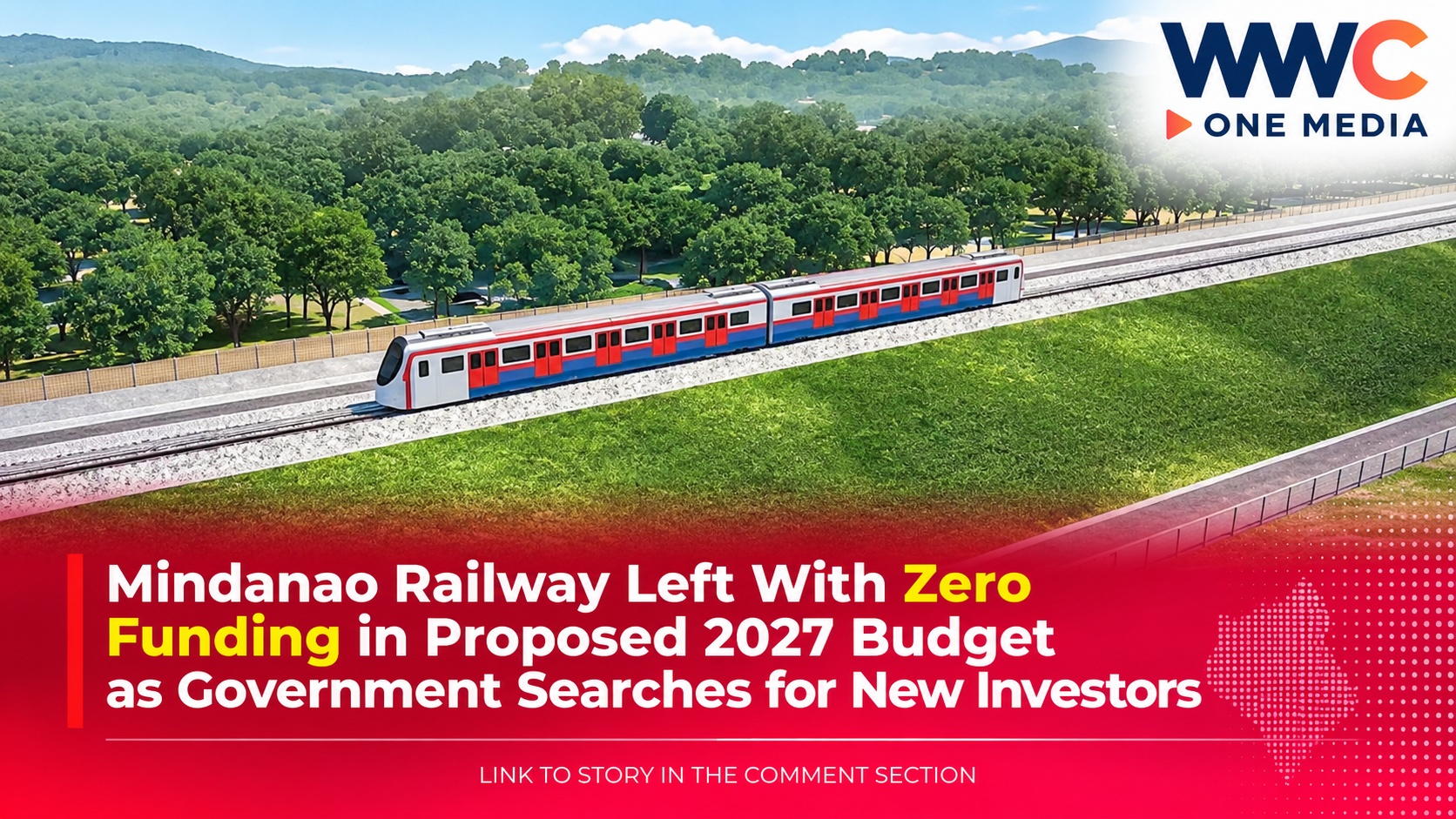
DAVAO, PHILIPPINES — Mindanao's long-awaited railway project has once again hit a major roadblock after being left without funding in the proposed 2027 national budget.
The Mindanao Railway Project (MRP) received zero allocation under the proposed 2027 National Expenditure Program (NEP), despite years of planning, right-of-way activities and promises that the project would transform transportation across the southern Philippines.
The development means one of Mindanao's biggest infrastructure dreams remains in limbo as the government continues searching for a foreign development partner willing to finance the massive railway project.
And the Mindanao Railway was not alone.
The Department of Transportation (DOTr) told lawmakers that only 30 out of its 179 proposed projects were included in the proposed 2027 budget.
That left 149 projects without funding — including the Mindanao Railway, MRT-4 and the Philippine National Railways South Long Haul Project.
Mindanao Railway gets zero allocation again
During a House of Representatives budget briefing on Sept 3, the DOTr revealed that the Mindanao Railway Project was not included among the projects funded under the proposed 2027 NEP.
The department had sought approximately ₱624.48 billion for 179 proposed projects.
But only around ₱237.35 billion for 30 projects was included in the NEP, according to figures presented during the budget hearing.
For the Mindanao Railway, this meant the proposed ₱8.53 billion allocation for 2027 did not make it into the budget.
The funding had been intended for early-stage activities, including:
- Project management
- Detailed engineering work
- Initial civil works preparation
- Technical studies
- Other preparatory requirements
Without an allocation, key activities needed to move the project closer to full construction could face further delays.
'We are still looking for investors'
Acting Transportation Secretary Giovanni Lopez told lawmakers that the government has yet to secure a development partner for the full Mindanao Railway Project.
The government is currently looking at potential funding from partner countries and multilateral development institutions.
The funding problem has become the biggest obstacle standing between Mindanao and its long-promised railway network.
“For the entire Mindanao Rail, we are still looking for potential investors to fund this large project,” Lopez said during the DOTr budget hearing, according to SunStar.
The DOTr has also indicated that project studies are being updated as the government prepares the railway for potential future investors.
What happened to the original Chinese funding?
The Mindanao Railway Project was previously expected to receive financing from China.
However, the Philippine government withdrew from negotiations over Chinese official development assistance for the project in 2023.
Since then, the project has been searching for alternative funding.
The lack of a new financier has now become one of the main reasons the project remains stalled.
The DOTr has been updating and refining project studies as it seeks another country or multilateral institution willing to support the railway's development.
Mindanao has waited years for its first major railway
The Mindanao Railway Project has been discussed for years as a potentially transformative infrastructure project for the country's second-largest island.
Its first phase would cover roughly 100 kilometres, connecting:
Tagum City
⬇️
Davao City
⬇️
Digos City
The planned line is expected to significantly improve connectivity across the Davao Region.
Travel between Tagum and Digos, which can take around three hours by road depending on traffic and conditions, is expected to be reduced to roughly one hour by rail.
For commuters, businesses and investors, the project could have changed how people and goods move across one of Mindanao's most important economic corridors.
But for now, construction remains dependent on securing funding.
Preparatory work has started — but the railway still has no money
One of the most frustrating aspects of the latest development is that work connected to the project has already begun.
According to SunStar, at least 159 families have been relocated to make way for the railway project, indicating that right-of-way acquisition and preparatory activities are continuing in parts of the Davao Region.
That creates a striking situation.
Land preparation is moving forward.
Families have already been relocated.
Plans have been developed.
But the actual railway still has no confirmed funding source.
For many Mindanao residents, the question is becoming increasingly difficult:
How long will they have to wait?
Lawmaker pushes for an additional ₱30 billion
Cagayan de Oro 2nd District Representative Rufus Rodriguez has called for an additional ₱30 billion for the DOTr's proposed 2027 budget.
Rodriguez said the additional money could help cover critical transport projects that were left without funding.
He specifically pushed for part of the proposed additional funding to support the Mindanao Railway Project, including the Philippine government's local counterpart once foreign financing is secured.
The proposal is significant because it could potentially give the DOTr funding for preparatory work even before a full foreign financing package is finalised.
However, the proposed 2027 budget is still being considered by Congress.
That means lawmakers could still introduce amendments before the national budget is finalised.
A bigger DOTr budget — but most projects still lose out
The funding problem comes despite the DOTr receiving a substantially larger proposed budget for 2027.
The agency's proposed budget stands at around ₱300.96 billion.
But the larger headline figure does not mean every transport project received funding.
The DOTr submitted 179 proposed projects requiring approximately ₱624.48 billion.
Only 30 projects made it into the NEP.
The projects that received major allocations include:
- North-South Commuter Railway
- Metro Manila Subway
- LRT-1 Cavite Extension
- MRT-3 Rehabilitation
The Mindanao Railway, however, was left out.
Why the Mindanao Railway matters
For decades, Metro Manila has dominated major railway development in the Philippines.
Mindanao, despite its size, population and economic importance, still has no modern intercity railway network comparable to the major rail projects being developed in Luzon.
The Mindanao Railway Project was supposed to change that.
Supporters have argued that the railway could:
Cut travel times
The Tagum-Davao-Digos corridor could become significantly faster to travel.
Improve logistics
Businesses could move goods more efficiently.
Connect major growth areas
The railway could strengthen links between cities and municipalities.
Attract investment
Major transport infrastructure can support industrial and commercial development.
Improve regional connectivity
A railway network could eventually play a much larger role in connecting Mindanao's key economic centres.
But those potential benefits will remain largely theoretical until financing is secured and construction begins.
This isn't the first time funding has disappeared
The Mindanao Railway has already faced funding problems before.
The project was also left without a direct allocation in the proposed 2026 budget as the DOTr worked to update its feasibility studies and search for alternative financing.
At the time, transportation officials said they wanted updated project studies ready for the next potential funding opportunity.
Now, with the project once again absent from the proposed 2027 NEP, concerns are growing that the railway could face another extended delay.
Could Congress still save the project?
Yes — but there are no guarantees.
The proposed national budget is not yet the final budget.
Congress still has the power to deliberate on the proposal and introduce amendments.
Rodriguez's proposed additional ₱30 billion could provide one possible path for funding some of the DOTr's unfunded projects.
But the Mindanao Railway still faces a much larger challenge.
The project needs a major financing partner.
Government funding for feasibility studies, right-of-way and project management may help keep the project moving.
But full construction of a railway network will require significantly larger investments.
The bigger question: Who will fund Mindanao's railway?
The search for financing is now the central issue.
The government has said it is looking at:
- Partner countries
- Multilateral development institutions
- Other potential international financiers
Possible funding partners will need confidence in the project's:
- Economic viability
- Technical plans
- Passenger demand
- Construction costs
- Long-term sustainability
That is why updated feasibility studies have become increasingly important.
The government needs to present potential investors with a project that is ready for financing.
Mindanao Railway's delay comes as rail spending surges elsewhere
The contrast is becoming increasingly difficult to ignore.
The national government is proposing major rail investments for projects in Luzon.
The proposed 2027 rail transport programme includes significant funding for major projects such as the North-South Commuter Railway and Metro Manila Subway.
Meanwhile, Mindanao's flagship railway project remains unfunded.
For supporters of the MRP, the issue is not simply about trains.
It is about infrastructure equality.
Will Mindanao eventually receive the same level of railway investment as Luzon?
That question is likely to become louder as budget discussions continue.
What happens next?
The Mindanao Railway Project is now facing several critical steps.
1. Congress must finalise the 2027 budget
Lawmakers could still introduce additional funding.
2. The government needs to secure a development partner
A major funding source is needed for full implementation.
3. Project studies must be updated
Potential financiers will need current technical and economic information.
4. Right-of-way activities may continue
Preparatory work could continue even before full construction begins.
5. The DOTr must decide how to keep the project alive
Without a major allocation, the department may need to prioritise essential preparatory work while searching for financing.
The bottom line
The Mindanao Railway Project has been left without funding in the proposed 2027 national budget.
The project was among 149 DOTr proposals that did not receive an allocation under the proposed National Expenditure Program.
The DOTr had proposed funding for 179 projects worth around ₱624.48 billion, but only 30 projects with approximately ₱237.35 billion in funding were included.
The Mindanao Railway's proposed ₱8.53 billion allocation for early works also did not make the cut.
Meanwhile, the government is still searching for a foreign development partner to finance the larger project after the Philippines withdrew from Chinese loan negotiations.
A ₱30 billion budget increase proposed by Rep. Rufus Rodriguez could potentially provide funding for critical unfunded transport projects, including the government's local counterpart for the Mindanao Railway once foreign financing is secured.
For now, Mindanao's railway dream remains alive.
But without funding, a new investor or a major budget breakthrough, the long-awaited trains may remain on the drawing board for even longer.
The tracks have been planned.
The land is being prepared.
Families have already been relocated.
But one thing is still missing:
The money to make Mindanao's railway finally move.
WWC ONE MEDIA J.M.D