Naver Shuts Down Services as South Korea’s Tech Giant Bets Big on AI and Commerce

SEOUL, South Korea — Naver is shutting down several standalone services as South Korea’s internet giant makes a major strategic shift toward artificial intelligence, AI-powered commerce and digital infrastructure.
The latest move will see Naver’s music-streaming platform VIBE shut down on December 31, 2026, while Naver TV will cease operations on September 30. The company has also already retired its standalone AI services Clova X and Cue:, folding their technology into newer AI-powered features.
Rather than simply cutting services, however, Naver appears to be pursuing a broader strategy: fewer standalone products, more AI embedded directly into the company's core ecosystem.
VIBE becomes the latest casualty
VIBE, Naver’s music-streaming service launched in 2018, will officially shut down at the end of this year.
New subscriptions and payments will stop on November 27, ahead of the December 31 closure.
The service struggled to keep pace in an increasingly competitive Korean streaming market.
According to Wiseapp Retail, VIBE had approximately 460,000 monthly active users in June, down sharply from around 1.5 million in 2023. It remains far behind major competitors including Melon, YouTube Music and Spotify.
Naver has increasingly relied on partnerships rather than trying to compete across every digital entertainment category. Its Naver Plus Membership, for example, now includes benefits tied to Spotify Premium.
Naver TV is also disappearing
Naver’s video platform is scheduled to close on September 30.
But creators are not simply being abandoned.
Naver says videos, subscribers, view counts and advertising-related qualifications can be transferred to Clip, its short-form video platform. Creators have until September 30, 2027, to complete transfers or downloads before remaining content is deleted.
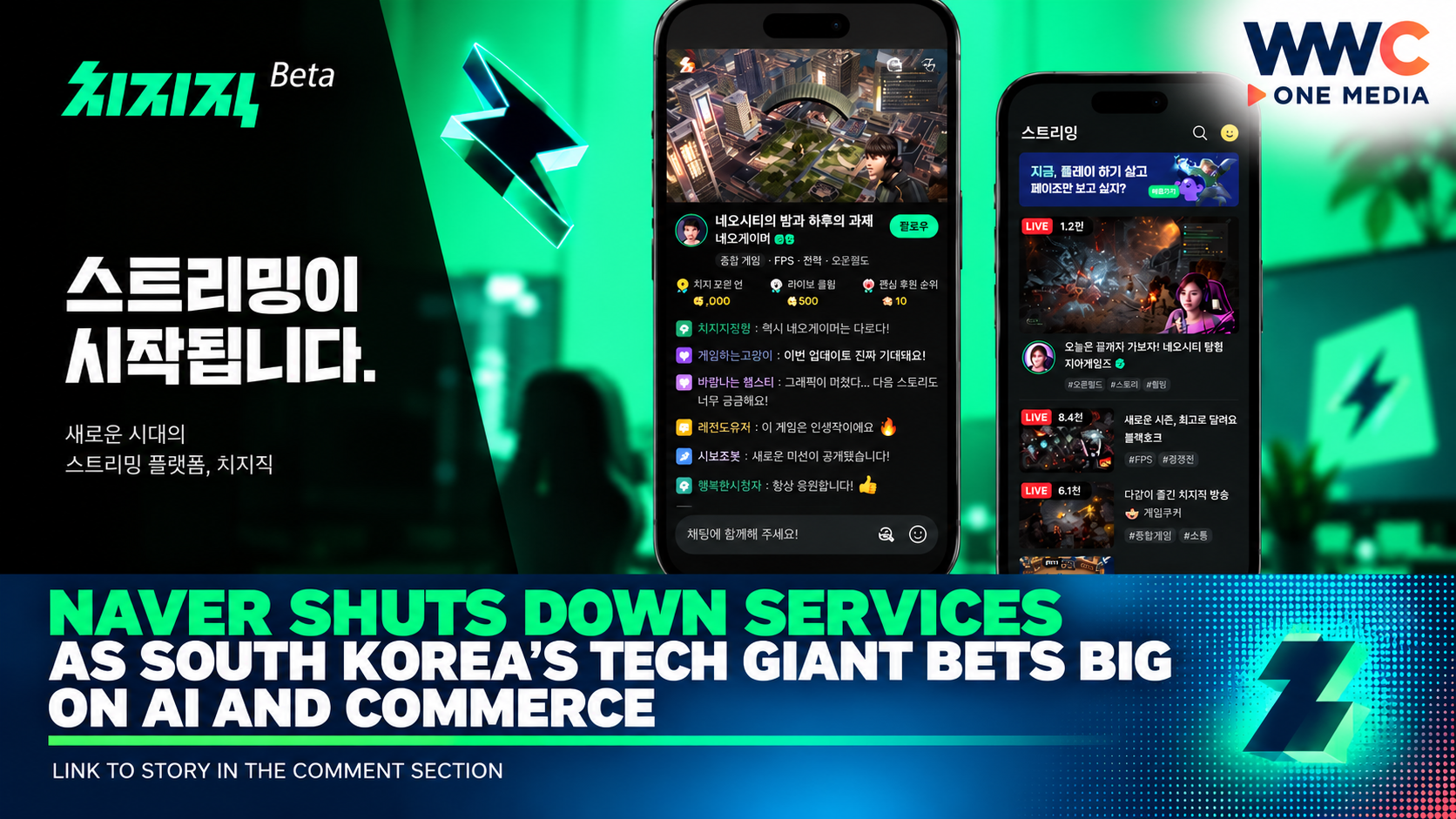
The move effectively consolidates Naver’s video strategy around Clip and Chzzk, rather than maintaining Naver TV as a separate platform.
That distinction matters.
Naver isn't walking away from video—it is concentrating its resources on formats it believes have stronger growth potential.
Even Naver’s AI products are being consolidated
Perhaps the most revealing part of the restructuring is what happened to Naver's own AI services.
In April, Naver closed Clova X, its conversational AI service, and Cue:, its generative AI search service.
Instead of abandoning the technology, Naver integrated lessons and capabilities from those products into newer experiences such as AI Briefing and AI Tab.
The strategy represents a significant change in how Naver approaches AI.
Instead of asking users to open a separate chatbot or AI search product, the company wants AI to become part of the services people are already using.
AI Tab is already attracting millions
That strategy appears to be gaining traction.
Naver CEO Choi Soo-yeon said AI Tab had surpassed 10 million monthly active users by early August.
More importantly for Naver's business model, the company said the click-through rate for shopping and local content on AI Tab exceeded 40 percent.
That figure is particularly significant because it suggests Naver is trying to turn AI from a technological feature into a commercial engine.
Instead of simply answering questions, Naver wants its AI systems to help users discover products, make reservations and ultimately complete transactions.
Naver is betting heavily on AI-powered shopping
The company's broader financial results help explain the strategy.
Naver reported KRW 3.3888 trillion in second-quarter revenue, up 16.2 percent year over year, while operating profit reached KRW 520.3 billion. The company said advertising and commerce benefited from deeper AI integration.
Its commerce ecosystem is becoming increasingly important.
Naver said service revenue rose 31.3 percent year over year, helped by improvements to Naver Plus Store, membership and N Delivery. Naver Pay transaction volume also reached KRW 25.2 trillion during the quarter, up 21 percent from a year earlier.
Earlier this year, Naver announced plans to expand AI agents across shopping, search, local services, finance and health.
Its shopping AI agent is designed to move beyond simple product recommendations and provide a more automated shopping experience.
The bigger bet: an AI factory
Naver's restructuring goes beyond consumer apps.
The company is also pouring resources into the infrastructure needed to power next-generation AI services.
Naver recently secured a $1 billion strategic investment from Nvidia and announced a partnership involving the development of an AI factory.
According to Naver, the initial AI factory is expected to begin generating revenue in the first half of 2027.
The company has also identified Brookfield as its preferred capital partner for raising up to $9 billion for the broader AI-factory project, according to The Korea Times.
The planned facility is expected to begin with 55 megawatts of capacity in the first half of 2027, expand to 200 megawatts by 2028 and ultimately target much greater capacity.
Why Naver is cutting services now
The pattern is becoming increasingly clear.
Naver has discontinued or consolidated services including VIBE, Naver TV, Clova X, Cue:, Naver Post and Modoo, while simultaneously expanding AI across search, commerce and other core services.
That doesn't necessarily mean the company is shrinking.
Instead, Naver appears to be redirecting resources from businesses with weaker growth prospects toward areas where it sees stronger monetization potential.
The company's second-quarter results reinforce that interpretation: revenue continued to grow, while AI integration contributed to advertising and commerce performance.
The real transformation is happening underneath
For users, the most visible part of the strategy will be services disappearing.
But the more consequential change could be less visible.
Naver is attempting to turn AI into an underlying layer across its ecosystem—one that can understand what users want and then help them search, compare, shop, pay, make reservations and complete other tasks.
The company said earlier this year that it planned to introduce AI agents across its services within 2026, with specialized agents for areas including search, shopping, local services, finance and health.
That means the shutdown of individual services may actually be only the surface of a much bigger transformation.
Naver isn't simply closing products. It's betting that the next version of its business will be built around AI doing more of the work—and commerce turning those AI interactions into revenue.
The question now is whether that strategy can deliver enough growth to justify the services Naver is leaving behind.