
Newborn Found Dead in a Garbage Dump — But a Little-Known Philippine Law Could Have Offered Another Way

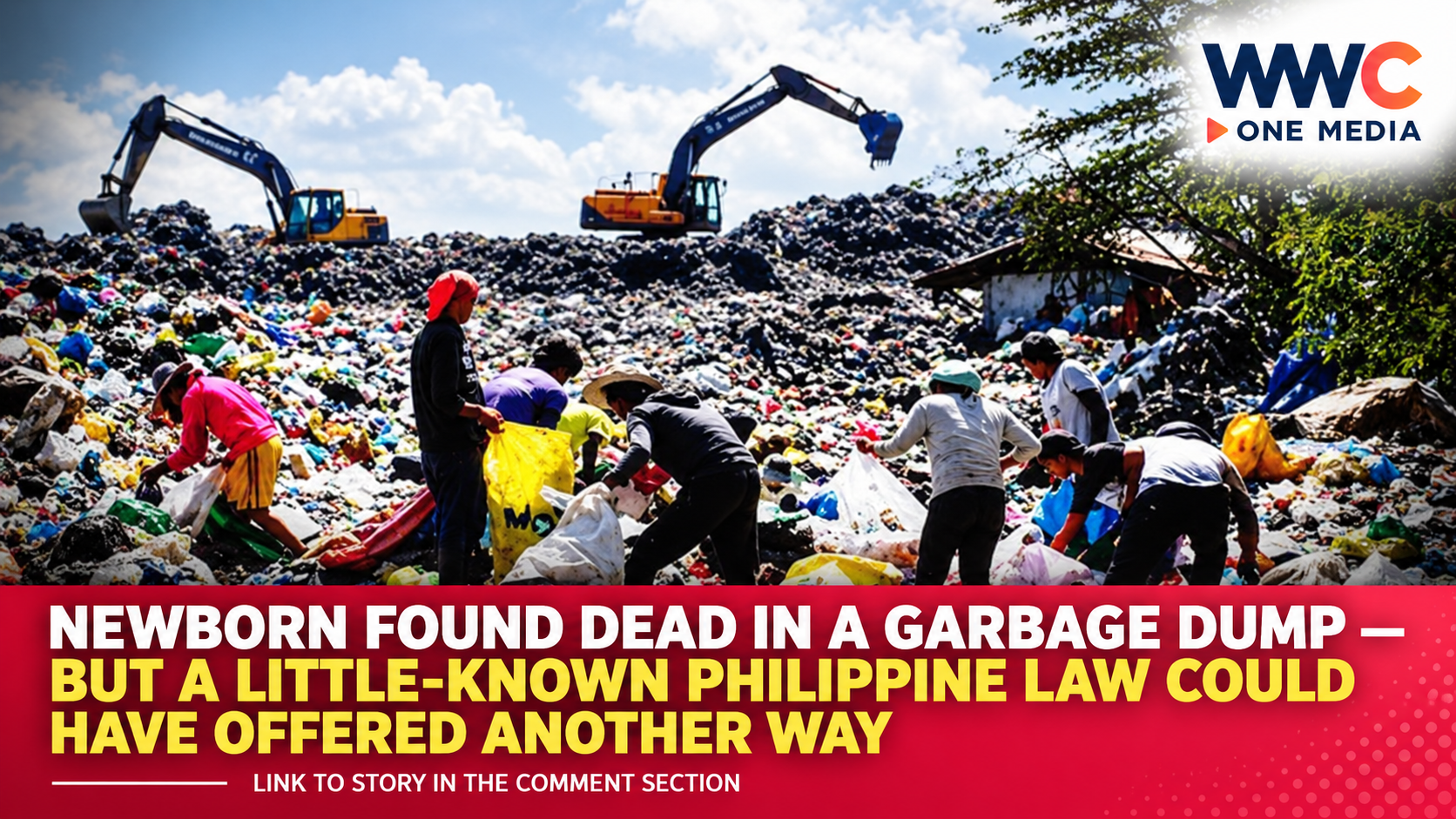
MANILA, Philippines — A newborn baby was found dead in a garbage dump, according to a report carried by GMA News’ Unang Balita on Tuesday, September 8, 2026, prompting fresh concern over infant abandonment and the circumstances that may have led to the child’s death.
The discovery is deeply disturbing, but crucial details surrounding the case have yet to be firmly established in independently accessible reporting.
As of early Tuesday afternoon, publicly indexed reports had not provided enough independently verifiable information to responsibly state the exact location of the discovery, the newborn’s sex, the precise condition in which the body was found, the cause and time of death, or whether investigators have identified any person of interest.
Those questions matter because finding a newborn’s body in a garbage area does not, by itself, establish who left the child there, whether the infant was alive when abandoned, or whether a criminal act directly caused the death.
Until forensic findings and police evidence emerge, speculation should not be presented as fact.
Similar Cases Have Been Reported in Recent Months
While the circumstances of the September 8 discovery remain under investigation, it is not the first time this year that Philippine authorities have dealt with the death of a newborn found amid garbage or in a public area.
On July 30, 2026, ABS-CBN News reported a separate case in which a dead newborn was discovered at a garbage dump in Tondo, Manila. ABS-CBN’s television report said the infant had been discovered by a person searching through garbage.
GMA separately reported on that July 30 Tondo case that the newborn had been wrapped in a black plastic bag. Police were attempting to determine which garbage truck may have transported the waste, while the infant’s body was taken to a funeral home for an autopsy and authorities worked to identify the parents.
Less than two weeks earlier, on July 17, GMA News reported yet another separate incident in Barangay 228, Tondo, where barangay personnel conducting a cleanup found a dead male newborn floating among garbage in an estero. Police said there were no CCTV cameras covering the relevant section of the waterway, complicating efforts to determine where the infant came from. The Abad Santos Police Station’s homicide investigators were handling that case.
Another separate case was reported in Puerto Princesa City on January 14, 2026, when a dead infant was discovered in a garbage disposal area in Barangay Sta. Monica. Authorities were investigating the identity of the mother and the circumstances surrounding the discovery, according to SMNI News.
There is no verified evidence that these incidents are connected. They are significant only as context showing that authorities in different parts of the country have confronted similar cases.
There Is a Legal “Safe Haven” Option in the Philippines
One of the most important pieces of information surrounding cases of infant abandonment is also one that many Filipinos may not know.
Under Republic Act No. 11767, or the Foundling Recognition and Protection Act, Philippine law provides a “Safe Haven” mechanism for parents who cannot care for a newborn.
The law states that a parent who voluntarily relinquishes an infant 30 days old or younger to an authorized safe-haven provider may be exempt from criminal liability associated with abandonment under the circumstances covered by the law.
Those authorized safe-haven providers include licensed child-caring and child-placing agencies, churches, DOH-accredited hospitals and other health facilities, city health offices, birthing homes, rural health units, barangay health stations, Local Social Welfare and Development Offices, and residential care facilities operated by the DSWD or local governments.
There is an important limitation: implementing rules specify that the protection applies where the relinquishment or entrustment did not result in gross negligence or the infant’s death.
In other words, the Safe Haven provision is not immunity for harming a child. It creates a lawful alternative for a parent in crisis to place a newborn in the hands of people and institutions capable of providing protection and care.
That distinction could be crucial in preventing another child from being left in a place where survival is uncertain.
What Criminal Case Could Follow?
Any potential criminal liability in the September 8 case will depend on evidence—not assumptions about the parents or whoever may have left the newborn.
Article 276 of the Revised Penal Code deals with the abandonment of a child under seven years old by someone responsible for the child’s custody, with more serious consequences when death results from the abandonment.
Philippine law also separately defines infanticide under Article 255 as the killing of a child less than three days old. But that offense would require evidence establishing that the newborn was killed; the mere discovery of a newborn’s body is not sufficient to conclude that infanticide occurred.
Investigators would therefore need to establish fundamental facts such as the infant’s age, whether the baby was born alive, the medical cause of death, how long the body had been at the location, who had custody of the child, and how the infant came to be among the garbage.
An autopsy or medico-legal examination could become especially important if authorities need to determine whether the newborn died before or after being left at the site.
Beyond Finding Who Did It
For investigators, the immediate mission is clear: identify the newborn, determine exactly how the child died, trace who was responsible for the infant, and establish whether a crime occurred.
But cases like this carry a broader public-policy question.
If a desperate parent can legally bring a newborn to a hospital, health center, social welfare office, church or other authorized facility instead of leaving a baby somewhere dangerous, how many people actually know that option exists?
RA 11767 provides the mechanism. The harder challenge is ensuring that vulnerable parents know about it before fear, poverty, stigma, isolation or desperation reaches a point from which there is no return.
For the newborn discovered this week, investigators still have to reconstruct what happened before the child ended up among the garbage.
And until those answers come, one question will remain at the center of the case:
Could this death have been prevented?
WWC ONE MEDIA M.J.E