
Northern Thailand’s Food-Security Role Is Bigger Than You Think — and the World Is Starting to Take Notice

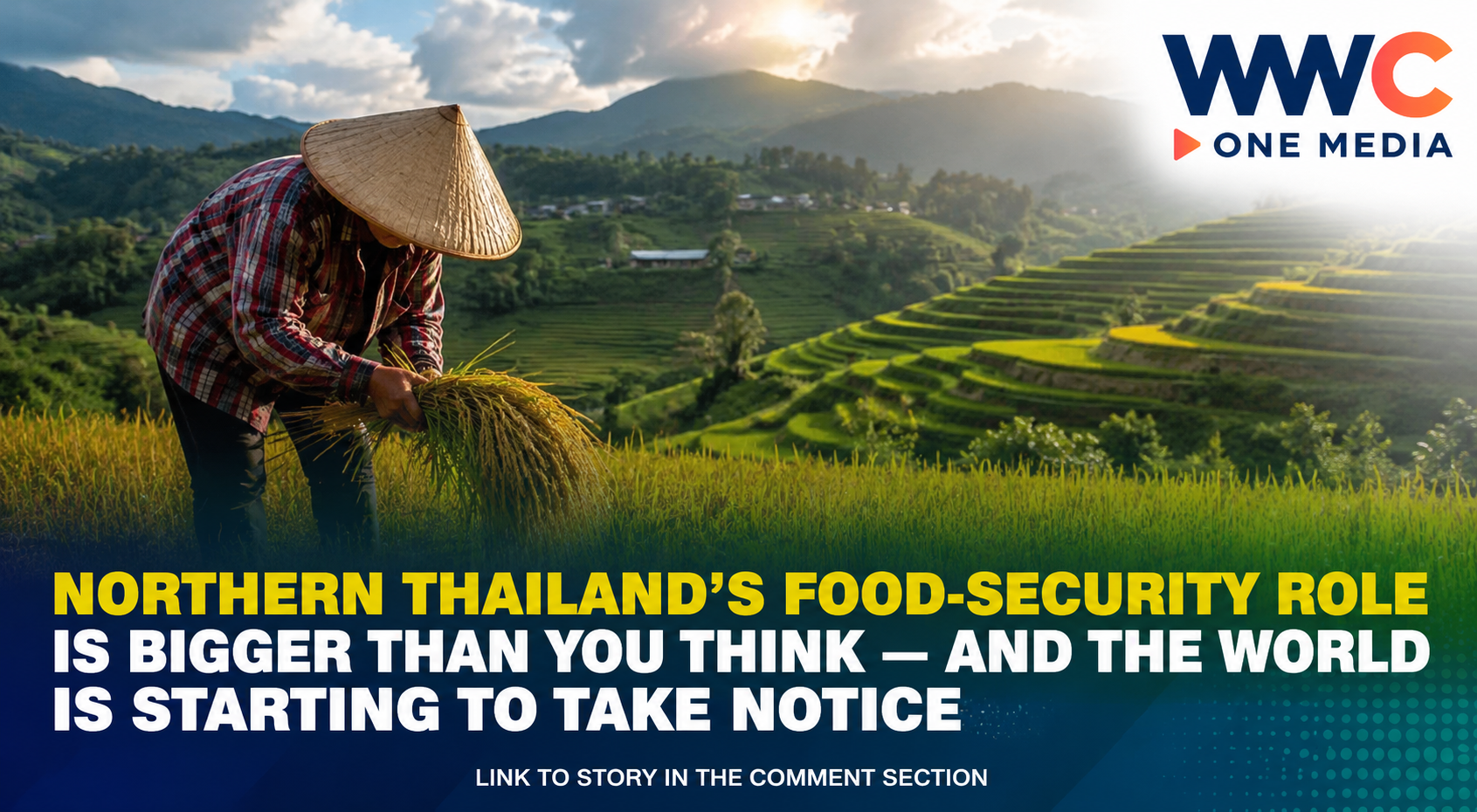
Northern Thailand is emerging as an increasingly important part of the country’s agricultural and food-security system, but the region’s future role comes with a difficult trade-off: how to produce more food and support rural livelihoods without worsening deforestation, soil degradation and seasonal air pollution.
A recent report by Thai PBS World highlighted Northern Thailand’s potential as a pillar of global food security. That argument is reinforced by new research published in Frontiers in Sustainable Food Systems, which describes the region’s highlands as an important agricultural landscape with lessons that could extend well beyond Thailand.
Why Northern Thailand Matters to Global Food Security
Northern Thailand’s highlands are not simply remote farming areas. They form part of an important watershed system that supplies water for households, irrigation and industry, while supporting biodiversity and other ecosystem services. The highlands are also home to roughly 1.4 million people and a diverse group of farming communities.
Agriculture in the region has changed dramatically over recent decades.
Traditional subsistence farming has increasingly been connected to Thailand’s national economy and global markets. Maize, rubber, coffee, tea, vegetables and other commercial crops have expanded, while technological improvements such as hybrid seeds, fertilizers and improved farming techniques have increased productivity.
The scale of maize production is particularly significant.
Research published in January 2026 found that Thailand’s northern highland provinces, together with Tak, account for nearly 40% of the country’s maize production. The region's maize is largely linked to the livestock-feed and industrial sectors, connecting northern farmers to wider domestic and international supply chains.
But maize is only part of the story.
Rice Remains the Hidden Food-Security Backbone
Despite the growing importance of commercial crops, rice remains critical to food security for many highland communities.
Researchers found that upland rice continues to play a major role in household food security even though it produces lower yields than wetland rice and maize. Wetland rice represents only about 20% of the annual highland rice area and roughly 30% of highland paddy production.
Northern Thailand also contains valuable rice genetic diversity.
A survey by Chiang Mai University researchers identified nearly 300 named rice landraces in highland communities in Chiang Mai, Chiang Rai and Mae Hong Son. These locally adapted varieties represent an important genetic resource at a time when climate change is increasing pressure on agricultural systems.
That makes the region's importance bigger than its production figures alone.
Its farmers are also maintaining agricultural knowledge, crop diversity and genetic resources that could prove increasingly valuable as farming conditions change.
A Global Food System Under Growing Climate Pressure
The timing is significant.
The global agricultural system is entering another period of heightened climate uncertainty. Reuters reported in June that hot and dry conditions associated with a developing strong El Niño pattern were already affecting crops across Asia, including Thailand, while concerns were growing over higher production costs and tighter supplies.
By August, Reuters reported that the global food system had become more resilient because of improved crop varieties, irrigation, precision agriculture, forecasting technology and large grain inventories. But the agency also warned that climate and geopolitical risks remain significant, particularly because disruptions involving fuel and fertilizer can quickly affect agricultural production.
That puts agricultural regions such as Northern Thailand under an important spotlight.
The question is no longer simply whether farmers can produce more.
It is whether they can continue producing reliably while protecting the natural systems that make production possible.
The Northern Thailand Food-Security Paradox
The region faces a complicated contradiction.
Commercial agriculture has brought higher productivity, income opportunities and stronger connections to markets. Contract farming has also provided some farmers with technical assistance, inputs and greater market certainty for crops such as processing potatoes, green soybeans, ginger and hybrid maize seed.
Yet agricultural expansion has also created environmental pressures.
In Nan province, for example, forest cover fell substantially between 1977 and 2016 amid the expansion of crops including maize and rubber, although forest cover across the northern highland provinces collectively has remained above 60% during the 21st century, according to the 2026 review.
Land-tenure issues also complicate the picture, with significant areas of agricultural land in northern highland provinces lacking formal land-rights documentation.
And then there is the smoke problem.
The Burning Problem Behind the Food Supply
The burning of maize residues has long been associated with seasonal haze and PM2.5 pollution in northern Thailand.
The 2026 research review says residue burning is an urgent problem requiring practical solutions. Researchers point to alternatives such as retaining crop residues, composting, producing biochar, using agricultural waste as animal feed or mushroom-growing material, and adopting conservation farming techniques.
The Thai government has also been increasing efforts to reduce agricultural burning.
In June 2026, Thailand's Agriculture Ministry said it had identified more than 2.59 million rai across 56 provinces as target areas for measures aimed at reducing agricultural burning. The strategy includes managing agricultural residues without burning, producing organic fertilizer, creating markets for environmentally friendly agricultural products and using technology to reduce emissions.
The challenge is enormous because farmers need economically realistic alternatives—not simply restrictions.
Why This Could Matter Beyond Thailand
Thailand is already a major agricultural producer and exporter.
FAO's January 2026 country brief reported generally favourable prospects for Thailand's 2025/26 main rice crop, with aggregate paddy production forecast at about 33.5 million tonnes. However, the agency also noted that Thailand's rice exports fell to an estimated 7.7 million tonnes in 2025 from 9.9 million tonnes in 2024 amid increased competition.
At the same time, a recent ISEAS analysis argues that Southeast Asian food systems are facing mounting pressure from climate change, soil degradation, biodiversity loss, water pollution and greenhouse-gas emissions. It identifies regenerative agriculture—including crop diversification, agroforestry, conservation tillage, biofertilizers and precision agriculture—as a potential pathway toward greater resilience.
Northern Thailand therefore offers a case study with global relevance.
Its experience shows that food security is not only about increasing yields. It also depends on preserving water systems, maintaining soil health, protecting biodiversity, supporting farmers and keeping locally adapted crop varieties alive.
The Bigger Question
Northern Thailand may have the agricultural capacity to contribute significantly to food security—but its future will depend on whether economic development and environmental protection can advance together.
The region's experience demonstrates both sides of modern agriculture: technology and commercial markets can dramatically raise productivity, while poorly managed expansion can create environmental costs that ultimately threaten the very food system farmers depend on.
For the rest of Southeast Asia—and potentially other mountain farming regions around the world—the lesson may be clear:
The future of food security could depend not only on producing more food, but on protecting the landscapes that make that production possible.