
Patagonia Could Become AI’s Next Powerhouse — But There’s One Massive Problem

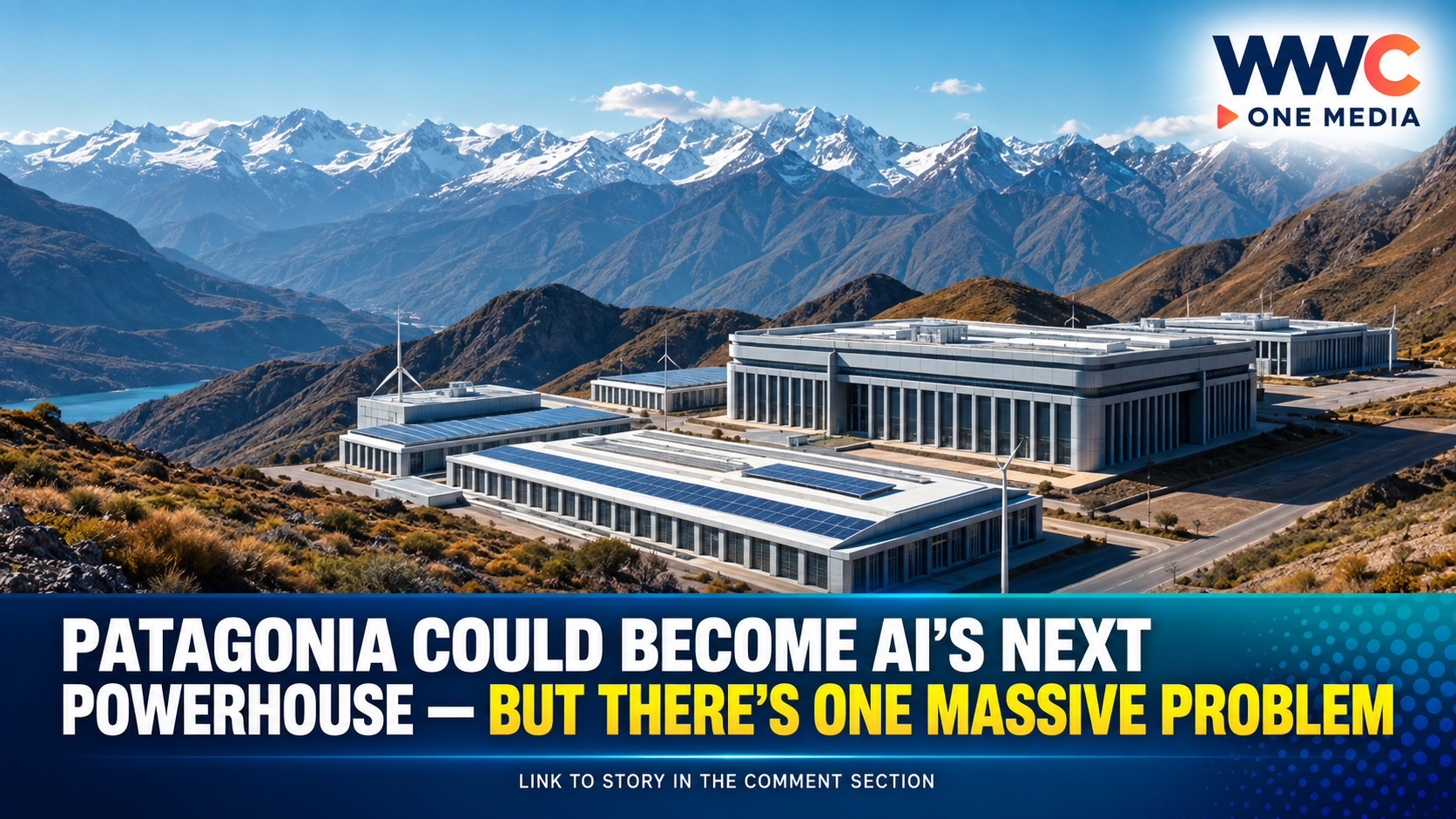
Argentina’s remote Patagonia region is emerging as an unexpected contender in the global race to build massive artificial intelligence data centers, attracting developers with its cool climate, abundant energy resources and vast areas of available land.
But while billions of dollars in proposed investments are putting Patagonia on the technology map, major infrastructure and connectivity challenges could determine whether the ambitious plans actually become reality.
According to Reuters, investors and technology companies are examining locations across Argentina’s southern provinces as demand for AI computing capacity accelerates worldwide. Patagonia offers several advantages that are increasingly valuable to data-center developers: relatively cool temperatures that can reduce cooling requirements, renewable energy potential, access to natural gas and large areas suitable for industrial-scale facilities.
One of the projects being explored is backed by Argentine energy company Pampa Energía. The company is seeking investors for a potential data center near its Loma de la Lata thermal power plant in Neuquén. The facility could eventually consume as much as 500 megawatts of electricity, with infrastructure required to support that scale estimated at nearly $900 million.
Neuquén has another major advantage: proximity to Vaca Muerta, one of the world's largest shale-gas formations. The region also has access to hydroelectric resources, giving developers multiple potential sources of electricity for energy-intensive computing operations.
The interest is not limited to Pampa Energía.
U.S.-based FlexDomes is seeking investors for a proposed Neuquén facility whose first phase could involve 120 MW of IT capacity and about $1.4 billion in investment. In neighboring Chubut, Poland's Green Capital has proposed a project starting at around 300 MW and $3 billion, with the possibility of eventually expanding to as much as 3 gigawatts.
The biggest proposal currently associated with Argentina is an initiative involving OpenAI and Sur Energy. Announced in 2025, the proposed project could involve up to $25 billion in investment and 500 MW of capacity, with plans centered on clean energy.
However, the project should not be treated as a completed investment. Reuters reported that a definitive agreement had still not been signed, while Sur Energy has been working with Neuquén officials on identifying a potential site.
That distinction is important because Patagonia's biggest advantage — abundant energy and open land — also exposes one of its biggest weaknesses.
The power has to reach the computers.
Developers still face significant hurdles involving electrical infrastructure, transmission capacity and high-speed connectivity. Argentina currently has a relatively small data-center market concentrated largely around Buenos Aires, meaning that building giant AI campuses in Patagonia would require substantial investment in supporting infrastructure as well as the server facilities themselves.
Argentina is also trying to improve international connectivity. In July, the country's communications authorities announced plans for a second fiber-optic cable landing station intended to make Patagonia more attractive to data-center developers.
The country's improving investment climate is another factor drawing attention. President Javier Milei's administration has promoted investment incentives, including the RIGI regime, while seeking to attract major international technology and energy companies. Investors are also watching Argentina's political and economic outlook ahead of the 2027 presidential election.
Still, industry experts caution against confusing announcements and proposals with actual construction.
A project can have land, potential electricity and an eye-catching investment figure yet still require financing, permits, transmission upgrades, fiber connections and a final investment decision before construction can begin.
That makes Patagonia less of a confirmed AI data-center hub — for now — and more of a high-potential frontier in the global search for power and computing capacity.
If even a portion of the proposed projects moves forward, however, the consequences could be significant. Patagonia could evolve from one of the world's most remote regions into a major destination for the infrastructure powering the next generation of artificial intelligence.
The question now is not whether the world has noticed Patagonia.
It is whether Argentina can build the infrastructure fast enough to turn that attention into reality.
WWC ONE MEDIA M.J.E