
Sara Duterte’s Impeachment Still Needs 16 Votes—But Four Missing Senator-Judges Have Forced a Constitutional Showdown

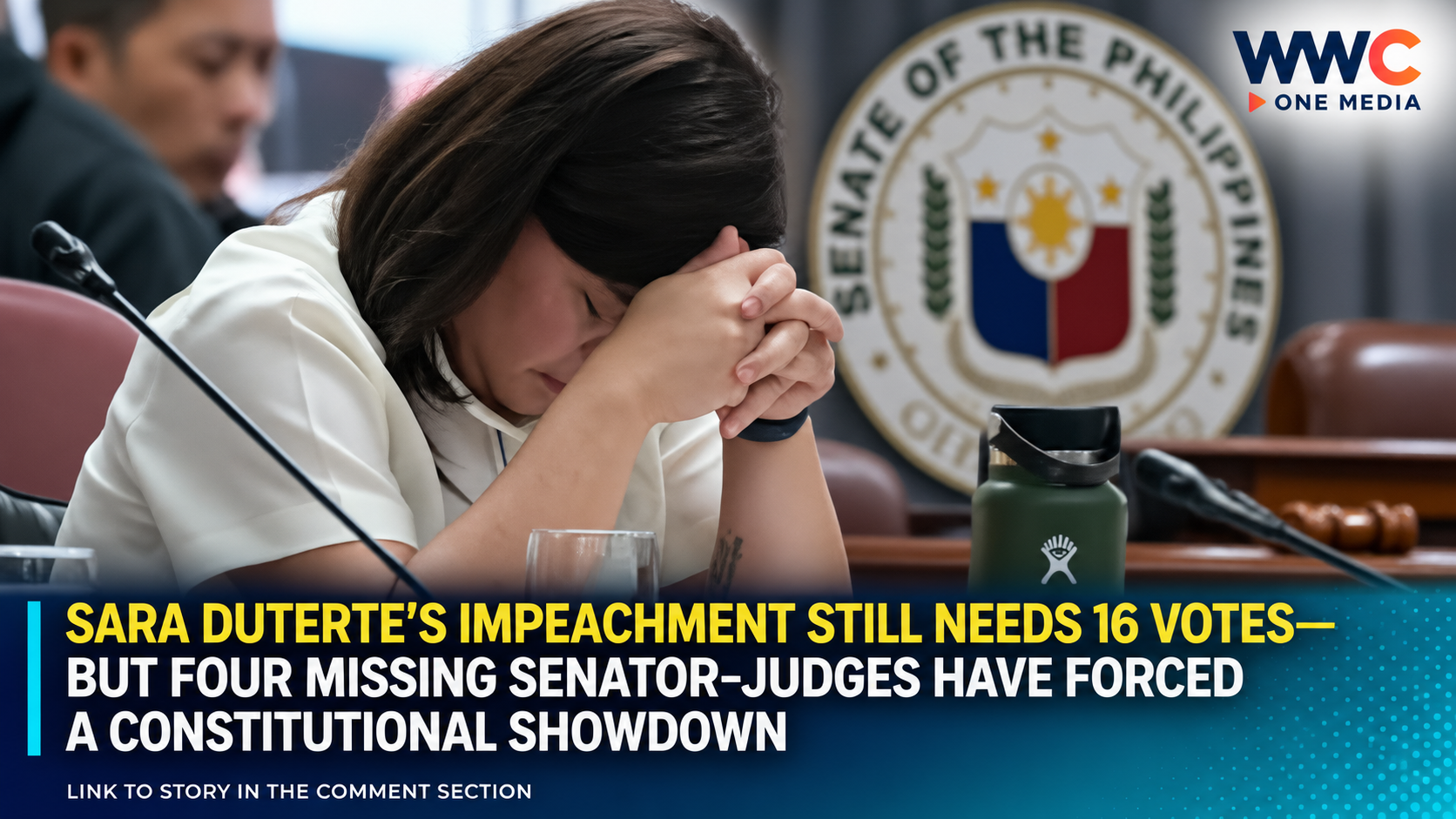
MANILA, Philippines — A constitutional question that could ultimately determine the fate of Vice President Sara Duterte's impeachment trial is heading for a major showdown on September 23, 2026, when prosecutors and defense lawyers argue over how many senator-judges are actually needed to convict her.
The Senate, sitting as an impeachment court, agreed Tuesday to formally revisit the 16-vote conviction threshold after Senator-Judge Erwin Tulfo raised concerns over the absence of four members who may not be able to participate if the court eventually reaches a verdict.
Presiding officer Senator Francis “Chiz” Escudero said the impeachment court will first hear legal views from amici curiae, or friends of the court, on September 16, before the prosecution and defense deliver oral arguments on September 23. Each side will receive 15 minutes to present its case, after which senator-judges are expected to vote on the threshold issue.
The dispute sounds mathematical.
Politically and constitutionally, however, it could become one of the most important decisions of the entire impeachment proceeding.
Why the Number 16 Matters
Article XI, Section 3 of the 1987 Constitution requires the concurrence of two-thirds of all members of the Senate to convict an impeached official.
With the Senate constitutionally composed of 24 members, the traditional calculation produces a threshold of 16 votes.
The Senate's own impeachment rules similarly require two-thirds of all Senate members to sustain an article of impeachment. If no article secures the required support, the respondent is acquitted.
When Duterte's trial formally opened in July, Escudero ruled that the Constitution should be read literally and that at least 16 senator-judges must vote guilty for a conviction.
He cited the Supreme Court's Bayan v. Zamora decision, which involved Senate concurrence in the Visiting Forces Agreement. In that case, the Supreme Court said that because the Constitution provides for a 24-member Senate, at least 16 affirmative votes satisfied the constitutional two-thirds requirement—even though only 23 senators were actually incumbent at the time.
There is an important distinction, however: Bayan v. Zamora dealt with treaty concurrence, not an impeachment conviction.
That difference is now at the heart of the debate.
Four Senator-Judges Complicate the Equation
Tulfo's manifestation came as four senators remain unavailable or unable to regularly participate in the impeachment proceedings.
Senators Jinggoy Estrada and Rodante Marcoleta are detained while facing separate plunder cases, while Senator Ronald “Bato” dela Rosa has remained away from the Senate amid an International Criminal Court arrest warrant. Senator Loren Legarda, meanwhile, has been abroad while on medical leave.
Their circumstances raise a potentially decisive question:
Should senators who cannot actually participate still count toward the denominator used to calculate the two-thirds requirement?
If the answer is yes, the conviction threshold remains 16.
That could become especially significant if the number of senator-judges legally able to cast votes continues to fall. Philstar noted that if fewer than 16 senator-judges were ultimately able to participate, reaching the existing threshold could become mathematically impossible even if every available senator voted for conviction.
But lowering the denominator could dramatically change the arithmetic—and potentially the outcome.
The Other Side of the Legal Argument
House prosecutors have previously raised another Supreme Court precedent: Avelino v. Cuenco.
That 1949 case involved the determination of a Senate quorum. Supreme Court decisions discussing Avelino have explained that a senator who was abroad and beyond the chamber's coercive power was not treated in the same way when determining whether a quorum existed.
House lead prosecutor Rep. Gerville Luistro has argued that the principle deserves examination in the Duterte trial, particularly when senators are detained, outside the country or otherwise beyond the Senate's effective reach.
But the legal leap would be substantial.
Avelino concerned a quorum—not the constitutional number of votes necessary to convict an impeached official.
That is why the September hearings matter: the impeachment court must determine whether such quorum jurisprudence has any application to the much stricter constitutional language governing conviction.
Why This Could Become Bigger Than Sara Duterte
Whatever rule the impeachment court adopts may extend far beyond the current Vice President.
Changing how “all members” is interpreted could influence future impeachment trials whenever senators are suspended, detained, incapacitated, abroad, absent or otherwise unable to vote.
Maintaining an absolute 16-vote requirement protects against conviction by a smaller group of senator-judges—but critics of that interpretation could argue that it creates another danger: enough unavailable senators could make conviction mathematically impossible regardless of the evidence presented.
That tension explains why the Senate is seeking outside legal opinions before making its decision.
The stakes are therefore not simply whether the number is 16, 15 or something lower.
The deeper question is what the Constitution means by “all the Members of the Senate” when some senators remain members on paper but cannot actually exercise their functions inside the impeachment court.
Trial Continues as Voting Battle Develops
The threshold dispute comes while Duterte's impeachment trial continues on several fronts.
Philstar reported Tuesday that House prosecutors had completed much of their presentation involving the article concerning the alleged misuse and irregular liquidation of ₱612.5 million in confidential funds, while indicating that they eventually want Duterte herself to testify.
The impeachment court, however, has kept that article technically open while deciding whether additional witnesses should be called.
The Senate has also adjusted its September and October calendar to accommodate both the impeachment proceedings and deliberations on the proposed 2027 national budget. Trial dates include September 21 to 23, placing the crucial voting-threshold arguments directly inside another scheduled trial week.
September 23 Could Reshape the Endgame
For now, 16 remains the existing threshold.
Nothing in Tuesday's proceedings automatically lowered it, and the scheduled oral arguments should not be interpreted as a finding either for Duterte or against her.
But September 23 could determine the rules governing the trial's most consequential moment: the final vote.
If the impeachment court keeps the fixed 16-vote requirement, prosecutors will have to secure that number regardless of how many senator-judges ultimately participate.
If the court adopts a different interpretation, the arithmetic of conviction—and potentially acquittal—could change dramatically.
And because the dispute involves constitutional language with implications beyond a single impeachment proceeding, the Senate's eventual decision could itself face further legal scrutiny.
For Sara Duterte, prosecutors and senator-judges, the evidence presented inside the impeachment court remains critical.
But before anyone reaches the final verdict, the Senate now has another question to answer first:
Exactly how many votes will it take to make that verdict count?
WWC ONE MEDIA M.J.E