
Philippines’ Dollar Reserves Jump to $104.8 Billion — But One Detail Behind the Surge Changes the Story

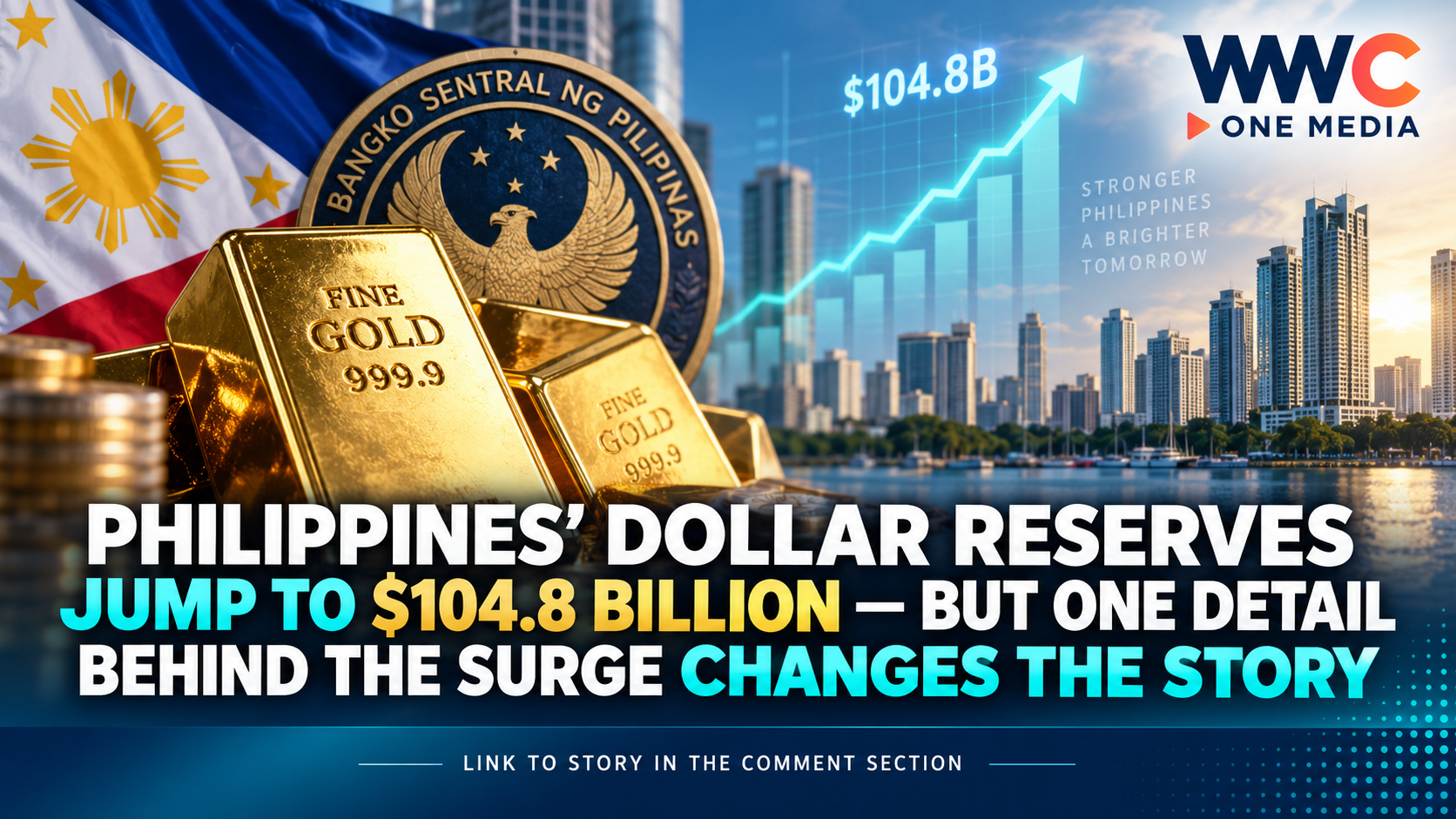
MANILA — The Philippines entered September with a stronger financial shield against external shocks after its gross international reserves jumped to $104.81 billion at the end of August 2026, according to preliminary data from the Bangko Sentral ng Pilipinas.
That was up from $103.32 billion in July, an increase of roughly $1.5 billion in just one month, and marked the country’s strongest reserve position since March. Official BSP data confirm the August figure at $104.813 billion.
But there is an important catch.
Despite the monthly rebound, reserves were still about 2.1% lower than the $107.1 billion recorded in August 2025, according to Philippine Star calculations based on BSP data.
That means the recovery is meaningful — but it does not yet signal that all of the Philippines’ external-sector pressures have disappeared.
Gold Did Much of the Heavy Lifting
The biggest reason reserves improved was not a sudden flood of foreign capital.
It was gold.
The value of the BSP’s gold holdings climbed 9.3% month on month to $19.11 billion in August, from $17.49 billion in July, as international gold prices increased. Compared with a year earlier, the central bank’s gold reserves were up a much larger 31.6%.
UnionBank chief economist Ruben Carlo Asuncion said the improvement reflected valuation gains on the BSP’s gold holdings as well as income earned from investments abroad.
That distinction matters.
When gold prices rise, the dollar value of a central bank’s bullion holdings rises even if no additional physical gold is purchased. In other words, part of August’s reserve increase came from asset revaluation, rather than entirely from fresh foreign currency entering the economy.
The BSP itself said higher gold valuations and investment income were the key drivers of the increase.
Government Debt Payments Pulled in the Opposite Direction
The increase would have been larger if not for government foreign-debt payments.
According to the BSP, the national government withdrew foreign currency deposits held with the central bank to meet external debt obligations, partially offsetting the gains from gold and investment earnings.
This is a normal function of foreign reserves.
The country maintains these assets partly so dollars and other foreign currencies are available when government agencies and the broader economy need to meet international obligations.
But it also illustrates why the reserve level can move sharply from month to month.
Gold prices, debt repayments, BSP market operations, foreign borrowing, investment income and capital flows can all change the number.
Why $104.8 Billion Matters to Ordinary Filipinos
Gross international reserves are often described as the country’s financial “war chest.”
The reserves include foreign-currency securities and deposits, gold, Special Drawing Rights and other reserve assets controlled by the BSP.
They matter because they help the Philippines:
- pay for imports such as fuel, food, machinery and medicine;
- service foreign-currency debt;
- provide foreign-exchange liquidity during periods of market stress; and
- give the BSP greater ability to manage extreme volatility in the peso.
At the August level, the reserves were sufficient to cover about 6.8 months of imports of goods and payments for services and primary income, according to the BSP.
That remains comfortably above the traditional rule of thumb that around three months of import cover is considered an important minimum buffer.
The reserves were also equivalent to roughly 3.7 times the Philippines’ short-term external debt based on residual maturity, another widely watched measure of external financial resilience.
In practical terms, the Philippines still has a substantial cushion against a sudden shortage of foreign currency.
The Bigger Question: Why Were Reserves Falling Before August?
August’s rebound followed a weaker stretch.
Philippine reserves had fallen to about $103.38 billion in July, their lowest level in around 18 months, after BSP foreign-exchange operations and government withdrawals outweighed gains from gold valuations.
That decline had raised questions about the broader balance of payments, or BOP — essentially the record of money flowing into and out of the Philippines through trade, investments, remittances, borrowing and other transactions.
Economist and former BSP deputy governor Diwa Guinigundo recently warned that persistent BOP deficits and falling reserves could increase the economy’s vulnerability to external shocks and create additional pressure on the peso, although he stressed that the Philippines was not facing an external payments crisis.
That context makes August's rebound particularly important.
It restores some of the buffer lost earlier in the year.
But one strong month does not necessarily reverse the underlying trend.
BSP Had Already Cut Its 2026 Reserve Forecast
There is another number investors will be watching closely.
Earlier this year, the BSP reduced its forecast for gross international reserves at the end of 2026 to about $104 billion, down from an earlier projection of $111 billion.
For 2027, it lowered the reserve projection to around $105 billion from $112 billion.
That means the August reserve level of $104.81 billion is already slightly above the BSP’s current year-end projection.
That does not mean reserves are guaranteed to finish 2026 above forecast.
The level could still rise or fall significantly before December depending on gold prices, foreign investment flows, government borrowing and repayments, BSP foreign-exchange operations and global financial conditions.
The central bank has also projected a more challenging balance-of-payments environment, citing weaker trade conditions, slower growth in some foreign-exchange earning sectors and tighter global liquidity.
Gold Is Helping — But It Can Work Both Ways
August provides a useful reminder that gold is becoming an increasingly important part of the Philippines’ reserve story.
The BSP's gold holdings rose by more than $1.6 billion in value from July to August alone.
If international gold prices keep climbing, that can further strengthen the reported dollar value of the country's reserves.
But valuation gains can also reverse.
If gold prices fall sharply, the dollar value of those holdings can decline even without the BSP selling a single ounce.
That is why economists generally look beyond the headline GIR number and examine the underlying sources of reserve accumulation.
Sustained inflows from exports, business-process outsourcing, overseas Filipino remittances, foreign direct investment and other external earnings can provide a more durable source of foreign exchange than asset-price gains alone.
Peso Protection — But Not a Guarantee
A large reserve pile can also help reduce the risk of disorderly movements in the peso.
The BSP can use foreign-currency assets to provide liquidity when markets become severely stressed.
But reserves should not be interpreted as a fixed defense line for any specific peso-dollar exchange rate.
Central banks typically allow currencies to respond to market forces while intervening mainly when movements become excessively volatile or disorderly.
And using reserves aggressively to defend a particular exchange rate can rapidly reduce the country's buffer.
For the Philippines, the healthier long-term scenario is therefore not simply a larger reserve number.
It is a stronger and more sustainable flow of foreign currency into the economy.
The Five-Month High Is Good News — With an Asterisk
There is little doubt that August's $104.8-billion reserve level represents an improvement.
The country now holds enough reserves to cover nearly seven months of imports and several times its short-term foreign debt obligations, providing an important layer of financial protection.
But the composition of that rebound matters.
Much of the increase came from higher gold prices.
Government debt payments continued to drain foreign currency.
And the overall reserve level remains below where it stood one year ago.
So the real test will not be whether the Philippines can record another headline increase next month.
It will be whether trade, remittances, investments and other sustainable dollar inflows become strong enough to rebuild the country's external buffer without relying heavily on rising gold valuations.
That is the number behind the number — and the reason the $104.8-billion milestone deserves both optimism and caution.
WWC ONE MEDIA M.J.E