
Singapore Is Still Clean—but This New Survey Reveals Where Standards Are Starting to Slip

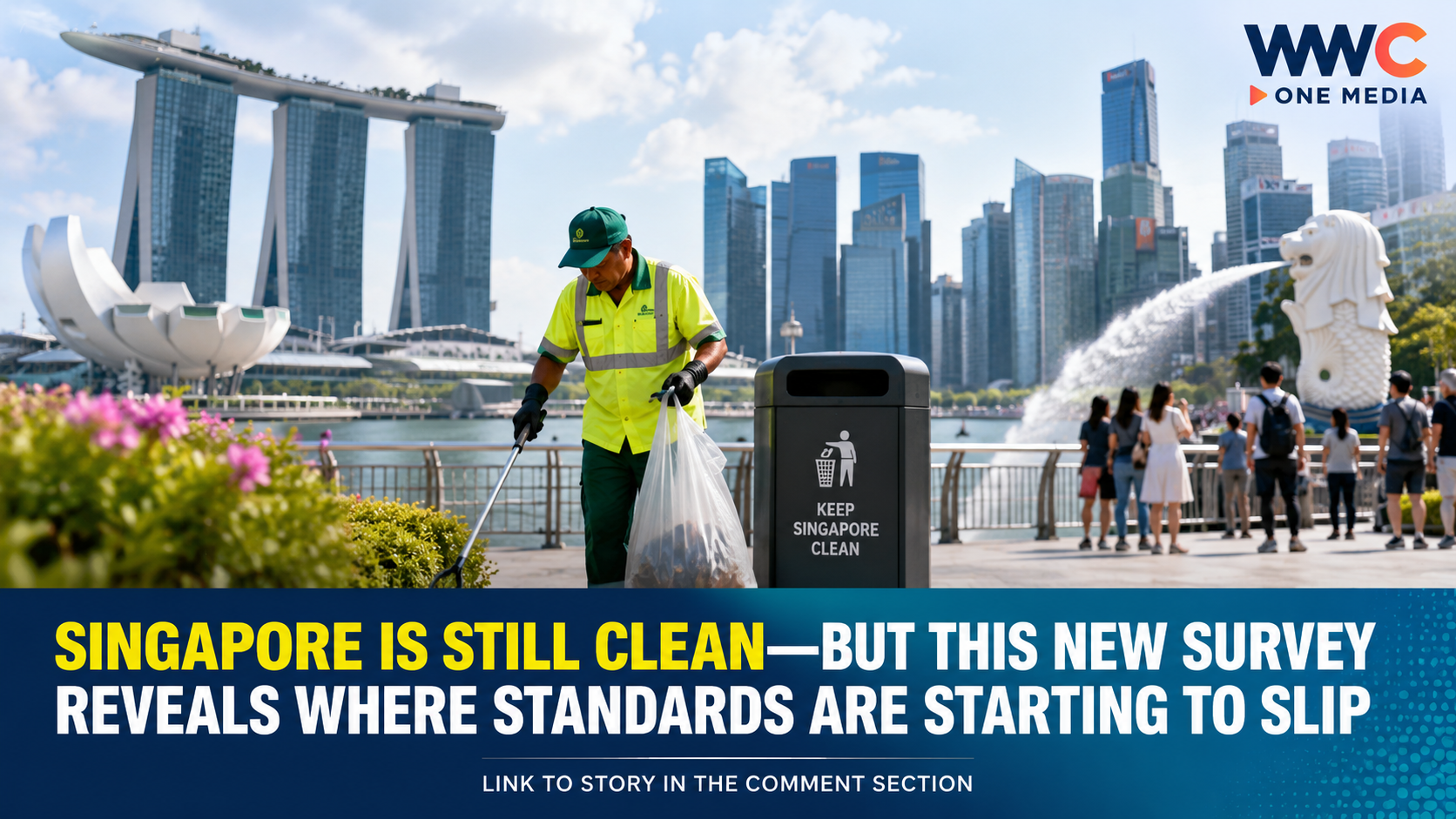
SINGAPORE — Singapore remains widely regarded as one of the world’s cleanest cities, but a new survey shows that public satisfaction with cleanliness has slipped—and some of the sharpest declines are being seen in everyday neighbourhood spaces and public toilets.
The 2025 Public Cleanliness Satisfaction Survey, conducted by the Singapore Management University (SMU), found that 91% of respondents were satisfied with the cleanliness of public spaces they had recently visited, down from 94% in 2023.
While the figure remains high—and is still well above the 82% recorded in 2017, when the survey was first conducted—the latest results point to growing pressure on Singapore’s cleanliness standards as residents' expectations continue to rise.
The seventh edition of the survey involved 2,007 Singapore citizens and permanent residents aged 21 and above, with responses collected between December 2025 and April 2026.
Neighbourhood areas see the biggest drop
Among the six major categories studied, neighbourhood spaces recorded the steepest decline, with satisfaction falling from 93.3% in 2023 to 87.4% in 2025.
The most noticeable drop was in void decks, corridors and lift lobbies, where satisfaction fell by 8.8 percentage points to 80.9%—the lowest level recorded for these spaces since 2018.
Researchers said several factors could be contributing to the decline, including higher expectations for cleanliness, increased waste associated with deliveries and whether cleaning services have kept pace with rising manpower costs.
Food outlets also remain a weak point.
Overall satisfaction with food outlets fell to 82.4%, while satisfaction at hawker centres dropped to 76.4% and at coffeeshops to 76.8%.
That continues a longer-term pattern in which food-related public spaces tend to receive lower cleanliness ratings than transportation and leisure facilities.
Public toilets emerge as another major concern
Perhaps one of the most striking findings involved public toilets.
Only 75.5% of respondents said they were satisfied with public toilet cleanliness, an 8.2-percentage-point decline from 83.7% in 2023.
The gap becomes even more pronounced at coffeeshops, where satisfaction with toilet cleanliness fell to just 48.3%.
Hawker-centre toilets also scored relatively poorly, at 60%, while toilets in downtown and central business district shopping malls recorded a much higher satisfaction rate of 93.6%.
The findings come as Singapore authorities continue efforts to improve public toilet standards.
The government established the Public Toilets Taskforce in 2024, and in 2025 endorsed recommendations that included financial support for coffeeshop toilet upgrades and deep cleaning. NEA has since introduced dedicated grant schemes aimed at improving toilet infrastructure and addressing persistent stains and odours.
But Singaporeans are taking more responsibility
Despite the decline in satisfaction, the survey also contains an encouraging finding: 98.6% of respondents agreed that keeping Singapore clean is the responsibility of every individual.
Among people who said they disposed of rubbish properly, 71.3% cited personal responsibility as a reason, up from 65.2% in 2023.
Tray-return behaviour also remained extremely high, with 95.5% saying they always return their trays and crockery, compared with 95% in 2023.
The researchers said these behaviours increasingly appear to be driven by social norms and personal responsibility rather than simply fear of enforcement.
Fewer people want to pay more for cleanliness
There is, however, a striking contradiction.
While 96.7% supported residents helping maintain neighbourhood cleanliness and 96.5% agreed that residents and cleaners should work together, fewer people were prepared to participate in organised community efforts.
Only 49.6% said they would volunteer with a neighbourhood cleanliness group, down from 63.5% in 2023.
Willingness to pay more for cleaning services also fell sharply. The percentage supporting additional spending on cleaning services dropped from 74.8% to 58.1%, while those willing to pay more through higher service and conservancy charges fell from 45.5% to 32%.
The message from researchers is therefore becoming harder to ignore: residents expect high cleanliness standards, but many are reluctant to accept higher costs or commit more time to maintaining those standards.
Authorities say targeted efforts are making a difference
The latest survey comes alongside fresh figures from NEA showing that enforcement and targeted interventions are producing improvements at some cleanliness hotspots.
Between January and June 2026, NEA conducted more than 110 enforcement blitzes at cleanliness hotspots and issued over 260 Corrective Work Orders. About 5,300 fines for ground-littering offences were issued islandwide during the same period.
NEA also reported a 54% reduction in litter at a former hotspot at 628 Ang Mo Kio Avenue 4, measured between July 2025 and June 2026, allowing the location to be removed from the hotspot list.
The agency has also been working with Town Councils and using surveillance technology to tackle high-rise littering.
These efforts suggest that the decline in satisfaction does not necessarily mean Singapore's public spaces are becoming dramatically dirtier. Instead, the SMU researchers believe rising expectations may be playing an important role.
The bigger question: Who is responsible?
The latest findings expose an increasingly important question for Singapore: how much of the country's famous cleanliness can continue to depend on professional cleaning services—and how much responsibility should fall on the public?
The survey found that only 71.8% of respondents knew how to provide feedback about cleaning services, down considerably from 81.5% in 2023.
Researchers said improving feedback mechanisms could help residents feel more empowered to take action.
They also highlighted a more difficult step: encouraging people not merely to avoid littering, but to pick up litter left by someone else.
That may ultimately be the next test of Singapore's cleanliness culture.
The country's challenge is no longer simply keeping streets, stations and neighbourhoods clean. It is creating a culture where residents feel they personally own the cleanliness of the spaces they share.
And with satisfaction still at 91%, Singapore has plenty to protect—but the latest numbers suggest that maintaining its reputation as a clean city will require more than simply sending in more cleaners.