
Singapore’s Growth Outlook Surges to 5% — But Economists Warn the Biggest Risks Are Still Ahead

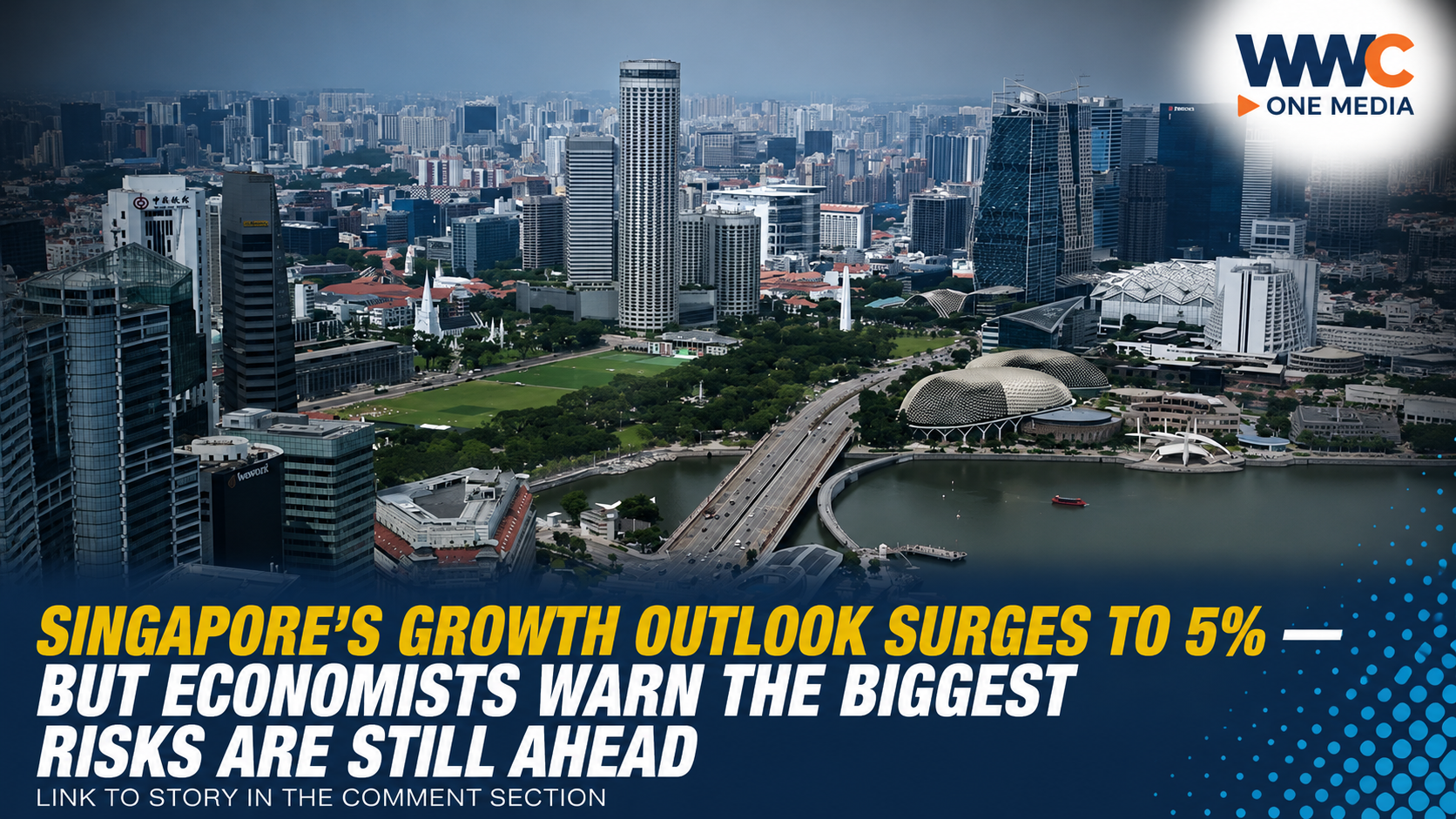
Singapore’s economic outlook has taken a sharp turn for the better, with private-sector economists raising their 2026 growth forecast to 5%, up significantly from 3.5% just three months earlier.
The upgrade reflects a stronger-than-expected first half of the year, particularly in manufacturing, exports and technology-related activity linked to the global artificial intelligence boom. But economists are also warning that Singapore’s rapid growth is not without vulnerabilities.
The latest Monetary Authority of Singapore (MAS) Survey of Professional Forecasters, released on September 2, gathered views from 21 economists and analysts. Their median forecast of 5% is now comfortably within the government’s revised 4.5% to 5.5% GDP growth range for 2026.
Singapore’s economy is outperforming expectations
The upgrade comes after Singapore posted surprisingly strong growth during the first half of 2026.
The economy expanded 6.3% year-on-year in the first quarter and another 5.9% in the second quarter, bringing first-half growth to around 6.1%. The second-quarter result was particularly notable because economists in the previous MAS survey had expected growth of only 4.3%.
That momentum has been heavily influenced by Singapore’s role in the global technology supply chain.
Manufacturing has benefited from strong demand for semiconductors and equipment connected to AI infrastructure. Singapore’s manufacturing sector grew 12.2% year-on-year in the second quarter, with electronics and precision engineering among the key drivers.
The strength was significant enough for the Ministry of Trade and Industry to upgrade its full-year 2026 GDP forecast in August from 2%-4% to 4.5%-5.5%.
AI is becoming Singapore’s economic engine
The latest forecasts underline how important the AI boom has become to Singapore.
All economists surveyed by MAS identified a sustained AI-driven technology upturn as a major potential support for economic growth. The surge in demand for semiconductors, data-centre infrastructure and related technology is helping Singapore benefit from a global investment cycle that stretches far beyond the city-state.
The Straits Times reported that economists lifted their 2026 manufacturing growth forecast to 8.4%, reflecting expectations for continued strength in AI-related electronics demand.
This creates a powerful opportunity for Singapore.
But it also creates a vulnerability.
The AI boom could become Singapore’s biggest risk
The same technology cycle helping Singapore accelerate could eventually become a source of weakness.
Economists identified a potential bursting of the AI investment bubble as one of the most frequently cited downside risks to the country's outlook. A sharp correction in global technology investment could hit Singapore through its highly trade-dependent manufacturing and electronics sectors.
The International Monetary Fund has similarly warned that a potential bust in the global AI boom could negatively affect Singapore because of its export-oriented economy.
That creates an unusual situation: the technology boom is simultaneously one of Singapore’s greatest growth opportunities and one of its biggest potential vulnerabilities.
The Middle East conflict remains another threat
Geopolitical tensions are another major concern.
Economists cited a prolonged or escalating conflict in the Middle East as a key downside risk. Singapore is highly dependent on international trade and imported energy, meaning disruptions to global supply chains or energy markets can quickly feed into costs and inflation.
Recent oil-market analysis has also highlighted continuing supply risks linked to the conflict and disruptions around major Middle Eastern shipping routes.
For Singapore, the danger is not necessarily direct exposure to the conflict itself. The bigger issue is what happens to oil prices, shipping costs, inflation and global demand if the crisis continues.
Inflation outlook has actually improved
There is some good news on the price front.
Economists have lowered their median forecast for Singapore’s 2026 headline inflation to 2.1%, from 2.3% previously.
Core inflation is now expected at 1.9%, compared with the previous forecast of 2%.
Actual inflation in the second quarter was even lower than economists had expected, with headline inflation at 1.8% and core inflation at 1.5%.
That gives policymakers some breathing room — although renewed energy or geopolitical shocks could quickly change the picture.
Could MAS tighten monetary policy?
The stronger growth outlook is also shifting expectations for Singapore’s monetary policy.
In the latest survey, 45% of economists expect MAS to tighten policy in October by increasing the slope of the Singapore dollar nominal effective exchange-rate policy band.
That compares with just 30% in the previous survey. Still, a majority do not currently expect an immediate policy change.
For 2027, economists expect Singapore’s economy to grow at a considerably slower 3.1%, suggesting that the extraordinary pace of expansion expected in 2026 may not last.
The forecast is stronger — but the risks have not disappeared
The latest numbers paint a fascinating picture of Singapore’s economy.
On one side, growth is accelerating far faster than economists expected only months ago. Manufacturing is booming, AI-related demand is supporting exports, and inflation remains relatively contained.
On the other, Singapore remains one of the world's most open and trade-dependent economies.
A global technology correction, renewed geopolitical tensions, weaker global growth or a major disruption to energy supplies could quickly change the outlook.
The IMF has likewise described Singapore as navigating elevated global uncertainty from a position of strength, while warning that geopolitical tensions, global trade friction and a potential AI downturn remain significant risks.
The bigger picture
Singapore has gone from worrying about whether growth might slow to asking how long the current boom can last.
The 5% economist forecast is a major upgrade — but it is also heavily tied to a global AI investment cycle that economists themselves acknowledge could reverse.
For now, Singapore is riding the wave.
The real question is whether the AI boom can keep powering the economy — or whether the same technology surge that lifted Singapore’s growth forecast could eventually become its biggest risk.
WWC ONE MEDIA J.M.D