
Singapore’s Haze Is Back as PSI Hits Unhealthy Levels — But Officials Are Watching What Happens Next

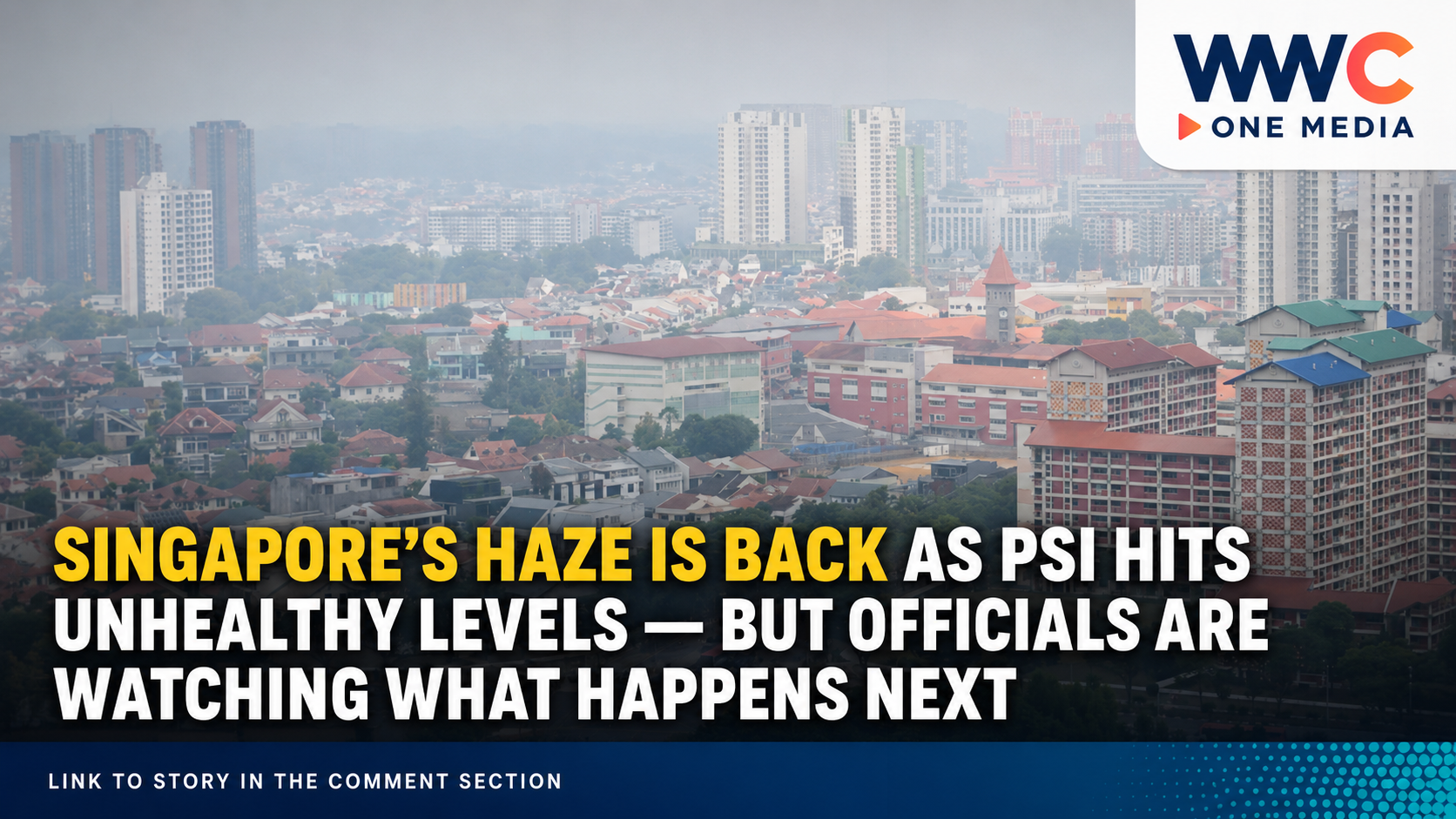
SINGAPORE — Singapore has crossed a threshold it had avoided for nearly three years.
The 24-hour Pollutant Standards Index in central Singapore reached 101 at 7am on Friday, September 4, pushing air quality into the Unhealthy range and triggering a new phase in the government’s haze response.
It was the first time Singapore’s PSI had entered the Unhealthy range because of haze since October 8, 2023, according to the National Environment Agency.
And the bigger concern may be what happens next.
The reading climbed further during the morning, reaching 105 at 10am before easing to 104 at 11am, according to The Straits Times, as smoke from fires across Indonesia continued to affect parts of Southeast Asia.
NEA Is Starting Daily Haze Advisories
The worsening air quality prompted NEA to announce that it will begin issuing daily haze advisories from Friday evening.
Those advisories will include a forecast of the 24-hour PSI, allowing residents, businesses and event organisers to make decisions about outdoor activities for the following 24 hours.
Singapore's government has also activated response measures through its 28-agency Haze Task Force.
Authorities said the effects of haze depend not only on the PSI reading but also on a person's health, how long they remain outdoors and how strenuous their activity is.
People are being encouraged to reduce unnecessary outdoor exertion when conditions deteriorate, stay hydrated and closely monitor official air-quality updates.
Older people, pregnant women, children and people with chronic heart or lung conditions are considered particularly vulnerable.
What Does a PSI of 101 Actually Mean?
Singapore classifies a 24-hour PSI reading of:
0–50 as Good, 51–100 as Moderate, 101–200 as Unhealthy, 201–300 as Very Unhealthy, and above 300 as Hazardous.
The PSI is calculated using six major pollutants, including fine particulate matter known as PM2.5, which becomes especially important during haze episodes.
While the 24-hour PSI is designed to guide planning over a longer period, NEA also publishes one-hour PM2.5 readings.
That distinction matters.
Someone deciding whether to exercise outdoors immediately should pay attention to the one-hour PM2.5 reading, while the 24-hour PSI forecast is more useful for planning activities over the coming day.
PM2.5 particles are extremely small and can travel deep into the lungs, making them one of the main health concerns during severe smoke haze.
The Smoke Is Coming From a Much Bigger Regional Fire Crisis
Singapore's deteriorating air quality is part of a wider escalation across Southeast Asia.
NEA said dense smoke haze has been observed over southern and central Sumatra and parts of Kalimantan since around August 21, while dry conditions are expected to continue across much of the surrounding region during the first half of September.
Prevailing southeasterly and southwesterly winds can determine whether smoke from those fires is transported towards Singapore.
That means air quality can change considerably depending on both fire intensity and wind direction.
The ASEAN Specialised Meteorological Centre had already raised the alert status for the southern ASEAN region to Level 2, its second-highest alert level, amid increasing hotspot activity and persistent smoke haze.
Indonesia Has Already Lost More Than 200,000 Hectares to Fire
The numbers emerging from Indonesia show why authorities across the region are concerned.
According to Indonesia's Forestry Ministry, about 202,000 hectares of land were burned between January and the end of July 2026 — an area almost three times the size of Singapore.
Nearly 94,539 hectares burned in July alone.
Indonesia's dry season traditionally raises fire risks, but this year's conditions have been intensified by El Niño, which brings hotter and drier weather to the region.
Indonesia's meteorological agency has forecast the dry season to peak around August and September.
Reuters reported that Indonesian authorities are inspecting 19 companies connected with fires across Sumatra and Kalimantan, while authorities have deployed tens of thousands of personnel as well as aircraft for water bombing and other firefighting operations.
Indonesia's forestry minister has warned that controlling the fires could remain especially difficult during September as El Niño conditions reach their peak.
Parts of Malaysia Are Already Experiencing Far Worse Conditions
Singapore's PSI has only just entered the Unhealthy range, but some neighbouring areas have experienced significantly worse air pollution.
In Malaysia's Sarawak state, Serian recorded an Air Pollutant Index reading of 408 on September 3, according to The Straits Times, placing conditions there in the very hazardous category.
Haze from Indonesia's fires has also spread across Malaysia, Brunei and parts of the Philippines, demonstrating just how far smoke can travel when weather patterns align.
That regional spread is one reason Singapore authorities are treating the latest PSI breach as more than an isolated morning of poor air quality.
What Singapore Is Preparing for If Conditions Get Worse
Government agencies have already activated haze-related plans.
Public healthcare institutions have prepared measures including air purifiers, fans and portable air coolers where appropriate.
Employers have been advised to reduce prolonged or strenuous outdoor work when PSI levels are unhealthy, particularly for vulnerable employees and people with chronic heart or lung conditions.
If Singapore's PSI exceeds 200 and reaches the Very Unhealthy range, air-conditioned rooms at all community centres and selected Residents' Committee or Residents' Network centres will be placed on standby for members of the public seeking relief from the haze.
Authorities have also stressed that N95 masks are not generally necessary for brief exposure, such as commuting between home and work or school.
For most healthy people, official guidance becomes more restrictive as pollution reaches the Very Unhealthy or Hazardous ranges, especially when prolonged outdoor exposure is unavoidable.
Why the Next Few Weeks Matter
Singapore's current haze episode is nowhere near the severity of the historic 2015 regional crisis, when roughly 2.6 million hectares burned across Indonesia.
But authorities and researchers are watching the trajectory closely.
Indonesia's forestry minister has described September as a critical period, while experts cited by CNA warned that the region may not yet have reached the peak of the current fire season.
For Singapore, that means Friday's PSI reading of 101 could prove to be either a temporary breach — or an early warning of a more difficult September.
Much will depend on three things: how quickly Indonesia can contain its fires, whether meaningful rain returns, and which direction the winds blow.
For now, Singapore residents are being advised to monitor the NEA website, haze.gov.sg and the myENV app, particularly before prolonged outdoor exercise or events.
Because after nearly three years without haze pushing Singapore's PSI into the Unhealthy range, the question is no longer whether the smoke has returned.
It is how long it will stay — and how much worse the regional fire season could become before the rains finally arrive.