
Singapore’s Littering Fines Are Falling and Rat Burrows Are Down — But NEA’s New Camera Data Reveals the Bigger Shift

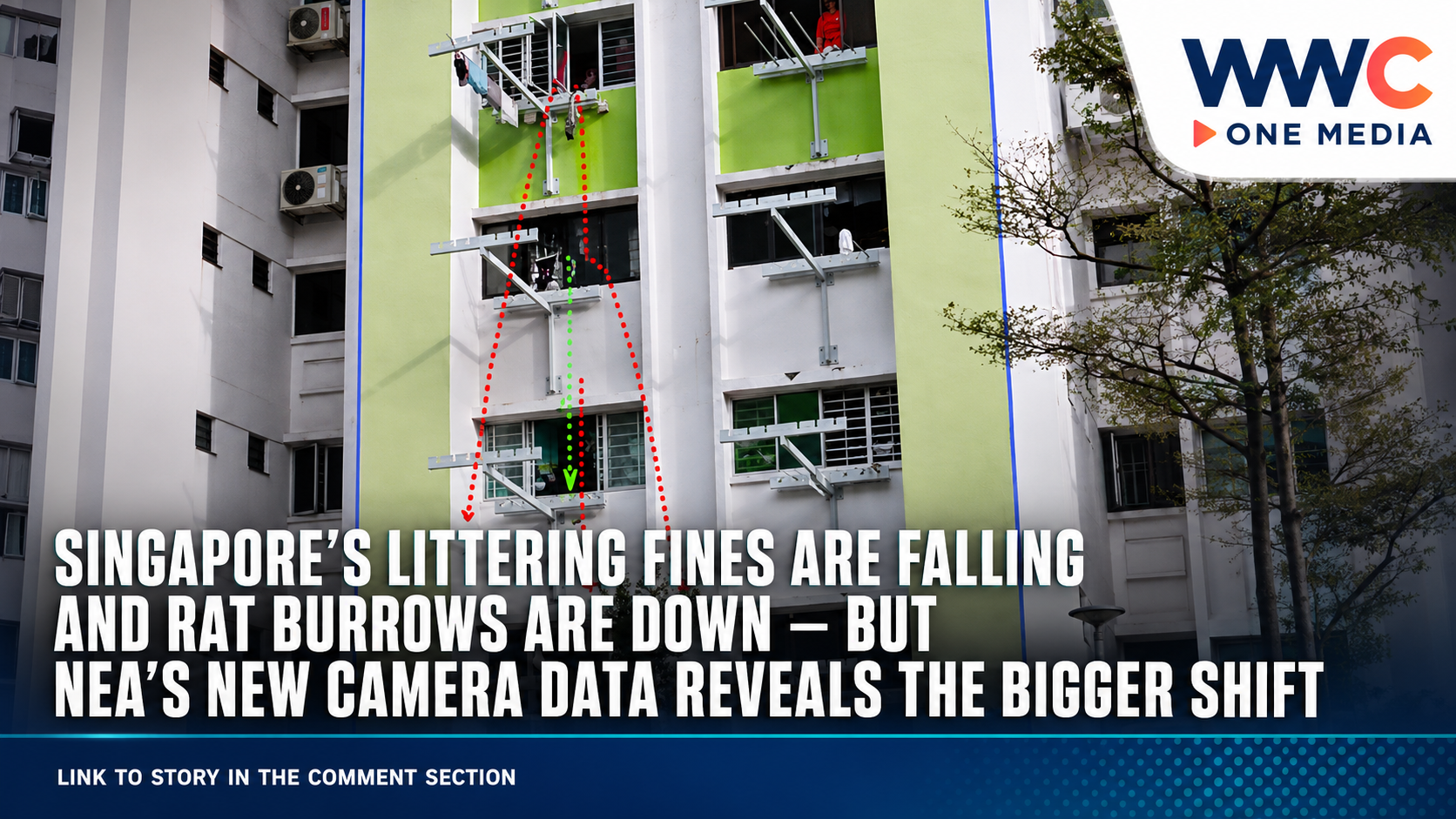
SINGAPORE — Singapore’s battle against litterbugs and rats is increasingly becoming a battle fought with cameras, data and highly targeted enforcement — and the latest numbers suggest the strategy may be gaining ground.
The National Environment Agency (NEA) issued about 5,300 fines for ground littering offences in the first half of 2026, down from roughly 7,000 during the same period a year earlier.
That represents a drop of about 24 per cent.
Corrective Work Orders also declined. NEA issued 267 such orders in the first six months of 2026, compared with 373 during the corresponding period of 2025.
But the most revealing development may not be the falling number of fines.
It is where — and how — Singapore is catching offenders.
One Ang Mo Kio hotspot saw litter fall 54%
NEA says the area around Block 628 Ang Mo Kio Avenue 4 is no longer classified as a cleanliness hotspot after the amount of litter recorded there fell 54 per cent between July 2025 and June 2026.
There are currently 12 designated cleanliness hotspots across Singapore.
The locations are identified using a combination of physical litter counts, public complaints and observations on the ground. Authorities can then concentrate patrols, surveillance cameras and public engagement in places where the problem is persistent rather than spreading enforcement resources evenly across the island.
That approach builds on NEA's Cleaner Neighbourhood initiative, launched in 2025.
An earlier NEA assessment found that targeted measures at identified hotspots had produced an overall 40 per cent reduction in litter counts over a six-month period. The agency said roughly 300 enforcement blitzes were carried out at hotspots in 2025, more than double the number a year earlier.
The latest figures therefore suggest Singapore's cleanliness campaign is moving beyond simply issuing more tickets.
Increasingly, the strategy is about identifying where bad behaviour repeatedly occurs and concentrating technology and enforcement there.
Cameras can now trace litter falling from high-rise flats
High-rise littering remains one of the hardest problems to police because investigators must determine exactly which flat an object came from.
NEA has been using trajectory analytics since July 2025, allowing surveillance systems to trace the path of falling objects back towards the unit from which they were apparently thrown.
The following month, the agency expanded surveillance periods from 14 days to as long as 28 days.
It then took the strategy further.
In October 2025, NEA began a six-month pilot with Singapore's 19 town councils. Each council could nominate locations based on complaints and observations by residents, conservancy workers and council staff.
Between October 2025 and April 2026, 73 camera deployments were conducted under the programme.
Their reported catch rate was 34 per cent, compared with 26 per cent across roughly 1,300 other NEA camera deployments during the same period.
That is an eight-percentage-point improvement — or roughly a 31 per cent increase in detection rate relative to the wider deployment figure.
The improvement also appears to build on earlier results.
The Straits Times reported in March that an earlier stage of the town council pilot had produced a 30 per cent catch rate, compared with 21 per cent for NEA's broader high-rise surveillance programme in 2025.
One recent operation at Tampines Street 45 shows how the system is supposed to work.
NEA and Tampines Town Council combined local intelligence with camera surveillance at a site where high-rise littering was suspected. The deployment captured an incident, allowing authorities to conduct follow-up investigations.
The problem, however, has not disappeared
Despite better technology, complaints involving high-rise littering remain substantial.
NEA says it has received an average of around 28,600 high-rise littering feedback cases annually since 2023.
Singapore has also strengthened the legal framework around such offences.
Since July 1, 2023, when litter is proven to have been thrown from a residential flat into a public place, the registered owner — or the tenant if the entire flat is rented — may be presumed to have committed the offence.
That presumption can be rebutted, including where the owner or tenant can establish that they were not present, could not have been responsible, or can identify the person reasonably believed to have committed the offence.
A person convicted of littering can face a court fine of up to S$2,000 for a first conviction, S$4,000 for a second and S$10,000 for a third or subsequent conviction. Courts can also impose up to 12 hours of corrective work.
Earlier this year, a 43-year-old repeat offender was fined S$2,500 and ordered to perform 12 hours of corrective work after being convicted for throwing a cigarette butt in public. It was his 13th littering conviction since 2000.
Singapore's rat numbers are moving in the same direction
The latest cleanliness update also contained another striking figure.
The average number of rat burrows detected during each two-month surveillance cycle fell from about 5,400 in the first half of 2025 to around 3,400 in the first half of 2026.
That is a decline of approximately 37 per cent.
It continues a trend detected earlier in the year.
In June, NEA said approximately 2,900 burrows were being recorded per surveillance cycle during the January-February and March-April periods, compared with about 4,900 during 2025. The Straits Times separately reported the decline, noting that most burrows were found in public housing estates, followed by roadside grass verges and industrial estates.
AsiaOne also reported that authorities had been targeting the conditions that allow rodents to thrive rather than relying exclusively on extermination.
At Serangoon Avenue 2 and 3, for example, refuse-management lapses fell 52 per cent following measures that included asking businesses to provide additional bins and clear bulky items that could provide shelter for rats.
Yishun records another major improvement
A similar strategy has been deployed around Yishun Avenue 11, one of four areas receiving enhanced intervention because of poor refuse-management practices.
Between March and July 2026, refuse-management lapses there fell by more than 60 per cent, according to NEA.
Authorities engaged businesses, worked more closely with the town council and deployed surveillance cameras. Five enforcement actions were taken for improper refuse disposal.
The focus on rubbish is deliberate.
Rats multiply when food and shelter are readily available, meaning poisoned bait and trapping alone may produce only temporary results if overflowing bins, exposed food waste and clutter remain.
NEA advises businesses to maintain covered bins, prevent overflowing rubbish, remove potential nesting material and close structural gaps that rats can use as entry points.
The agency also warns that rats can contaminate food, water and the surrounding environment and can transmit illnesses including leptospirosis, murine typhus and hantavirus infection.
Fewer fines do not automatically mean fewer offences
There is an important caveat in interpreting the latest numbers.
A reduction in the number of fines cannot, by itself, prove that littering has fallen by the same amount. Enforcement figures can also be influenced by where officers are deployed, how surveillance is conducted and how offences are detected.
The more persuasive indicators are the physical litter counts at targeted hotspots and the reductions recorded in specific locations such as Ang Mo Kio.
Those measurements suggest the authorities are seeing improvements on the ground, not merely writing fewer tickets.
And that may be the bigger story behind Singapore's latest cleanliness figures.
The country's next phase of enforcement is increasingly less about having officers everywhere and more about knowing precisely where the next problem is likely to appear.
Trajectory-tracking cameras are helping investigators trace rubbish falling from apartment blocks. Passive infrared systems are being used to detect rodents. Video analytics can identify overflowing bins and littered locations, while autonomous pavement sweepers are also being trialled in parks.
For a country that has spent decades building a reputation for clean public spaces, the latest campaign signals a change in tactics.
The litterbug — and increasingly the rat — is now being pursued not simply with manpower, but with data.