
Sondhi Returns to Thailand's Political Streets With New 'Take Our Thailand Back' Campaign

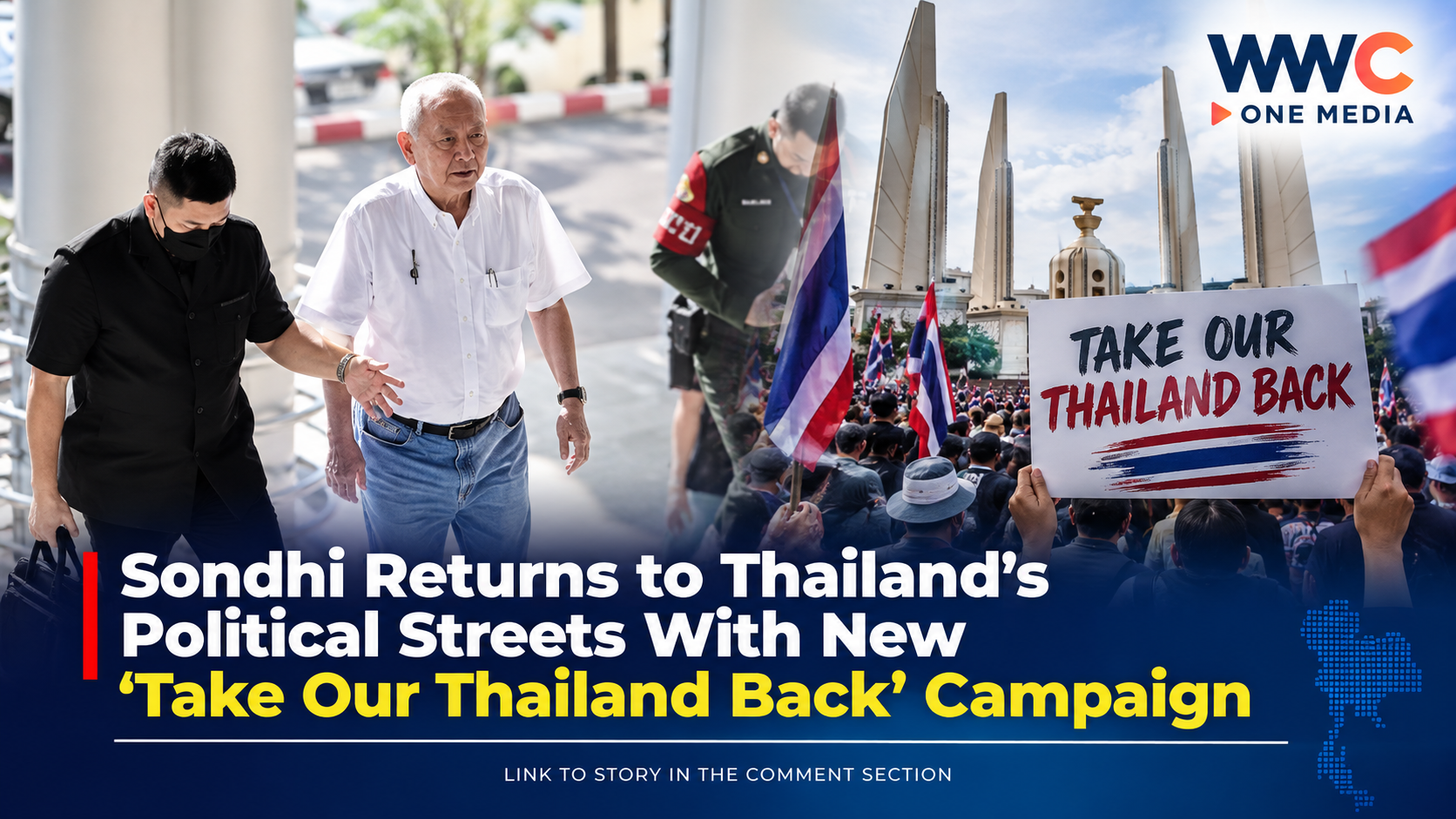
BANGKOK — One of Thailand's most recognisable protest leaders is stepping back into the political spotlight, raising the prospect of fresh street demonstrations at a time of growing pressure on Prime Minister Anutin Charnvirakul's government.
Veteran activist and media mogul Sondhi Limthongkul, a central figure in some of Thailand's most consequential political protests, has unveiled a new campaign under the banner:
“Take Our Thailand Back”
The announcement marks Sondhi's latest return to political mobilisation — and has immediately drawn attention because of his long and influential history in Thailand's street politics.
But this time, Sondhi insists his movement is not initially seeking to bring down the government.
Instead, he says the campaign aims to pressure the Anutin administration to address what he describes as serious problems affecting Thailand, including alleged illegal business networks and other issues his movement believes require urgent action.
A familiar name returns to Thailand's political stage
For many Thais, the name Sondhi Limthongkul immediately brings back memories of the massive political demonstrations that reshaped Thailand's modern political history.
The former media mogul was one of the leading figures behind the People's Alliance for Democracy, or PAD, whose supporters became widely known as the Yellow Shirts.
Sondhi played a major role in anti-government protests during the political turmoil of the mid-2000s.
Now, two decades later, he is once again talking about taking political pressure to the streets.
That has raised an obvious question:
Could Thailand be heading towards another major protest movement?
For now, Sondhi has announced a campaign rather than an immediate mass march, but recent reporting indicates that wider mobilisation remains part of the movement's plans.
'Take Our Thailand Back'
Sondhi formally announced the new campaign on Sept 7, 2026.
The movement's name — “Take Our Thailand Back” — signals a strongly nationalist message aimed at mobilising public concern over issues the group says are damaging the country.
The announcement took place at Baan Phra Athit, where Sondhi and other movement leaders outlined the campaign's direction.
Unlike the massive demonstrations associated with his earlier political career, the initial announcement did not involve a street march.
Instead, the event was used to explain why the group was mobilising and what it intended to pressure the government to address.
According to recent reports, Sondhi said the campaign was not, at this stage, designed to demand the government's resignation.
The government is under pressure — but Sondhi says this is not about overthrowing it
That distinction is important.
Thailand has a long history of political protests escalating into much larger movements.
When a figure such as Sondhi returns to public mobilisation, comparisons with the country's previous political crises are almost unavoidable.
But Sondhi has said his current campaign is focused on applying pressure to the government rather than immediately seeking its removal.
The movement wants authorities to respond to issues it considers serious threats to Thailand.
That approach could allow the campaign to broaden its support beyond traditional political divisions.
Instead of focusing on one party or political leader, the movement is attempting to frame its message around national concerns.
The big question is whether that strategy will attract enough public support to produce the large crowds that once defined Sondhi's political influence.
Street protests remain on the table
While no major street march accompanied the campaign's launch, the possibility of future demonstrations remains very much alive.
Sondhi and other leaders have continued discussing wider mobilisation, while another nationalist group led by Sondhi and former protest figures has also threatened street action over MoU 44 if its demands are not met.
That means Thailand's political atmosphere could become increasingly tense in the coming weeks.
For the Anutin government, the situation presents a difficult challenge.
Ignoring the movement could allow public frustration to grow.
Responding too aggressively could also generate more attention and sympathy for the protesters.
And if demonstrations expand, the government could face pressure from multiple directions at once.
Why Sondhi's return matters
Sondhi is not an ordinary political activist.
His previous movements helped demonstrate the enormous influence that organised street protests can have in Thailand.
During the political crisis of 2005 and 2006, protests involving Sondhi and allied groups became a major force in national politics.
His public rallies and political campaigns helped transform public dissatisfaction into large-scale street mobilisation.
That history is why his latest announcement is receiving such close attention.
A small protest organised by an unknown activist might disappear after a few days.
A campaign launched by Sondhi carries historical weight.
He has mobilised crowds before.
And Thailand knows what can happen when political protests grow beyond their original demands.
What issues is the new movement targeting?
According to recent reports, Sondhi's campaign is focusing on concerns including alleged illegal business networks, sometimes described in Thailand's political debate as "grey capital".
The campaign is also linked to broader nationalist concerns and disputes involving national interests.
The movement's leaders argue that the government needs to take stronger action.
However, the exact scope of future demands — and whether they will expand — could determine how large the campaign eventually becomes.
Political movements often begin with a limited list of demands before attracting supporters with broader frustrations.
That is one of the reasons observers will be watching Sondhi's campaign closely.
Israel protest letter also part of early mobilisation
Sondhi had earlier indicated that one of the campaign's first actions would involve submitting a protest letter to the Israeli embassy in Bangkok.
However, recent reporting said the letter had not yet been delivered by the time the campaign's formal announcement was made.
The issue reflects the movement's attempt to connect domestic political mobilisation with wider international and nationalist concerns.
It also demonstrates that the campaign is not being limited to traditional party politics.
Instead, organisers appear to be building a broader narrative around what they describe as Thailand's national interests and sovereignty.
PM Anutin faces a new political challenge
Prime Minister Anutin Charnvirakul now faces the possibility of a renewed street movement led by one of Thailand's most experienced political campaigners.
The government is already dealing with a range of political and public concerns.
A growing protest movement could add another layer of pressure.
However, Sondhi's current position — that he is not seeking the government's immediate removal — may provide the administration with room to negotiate or respond to individual demands before demonstrations escalate.
The key question will be whether the government can address the issues raised by the movement before they become a larger national campaign.
Thailand's protest history casts a long shadow
Thailand's political history makes any discussion of renewed street demonstrations particularly significant.
Previous protest movements have changed governments, paralysed parts of Bangkok and contributed to periods of intense political instability.
Sondhi himself was one of the most prominent figures during the Yellow Shirt era.
That does not mean the new movement will automatically reach the same scale.
Thailand's political environment has changed.
The government has changed.
Public attitudes have changed.
And social media has transformed how political movements organise.
But the basic power of street mobilisation remains.
A campaign can begin with a press conference.
A protest letter.
A few hundred people.
And then grow rapidly if it connects with wider public frustration.
Is Thailand heading for another political showdown?
It is too early to say.
For now, Sondhi's campaign remains in its early stages.
There has been no major street march accompanying the formal launch.
And Sondhi has publicly said he is not currently seeking to topple the Anutin government.
But the announcement itself has put Thailand's political establishment on notice.
The veteran protest leader is back.
A new campaign has been launched.
And street mobilisation remains an option.
That alone is enough to make political observers pay attention.
What happens next?
The coming days and weeks could determine whether “Take Our Thailand Back” becomes a small pressure campaign or the beginning of a much larger movement.
Several factors will be crucial:
- Whether Sondhi announces major rally dates
- How the Anutin government responds
- Whether the campaign gains support beyond its traditional base
- Whether nationalist issues bring new groups into the movement
- Whether protests remain peaceful and limited
- Whether public frustration over other political issues adds momentum
For now, Sondhi's message is clear:
He is returning to political mobilisation.
And while he says his movement is not yet trying to remove the government, Thailand's long history of street politics means few observers will dismiss the campaign.
Because in Thailand, a protest movement does not always end where it begins.
And when Sondhi Limthongkul starts talking about taking politics back to the streets, the entire country pays attention.
WWC ONE MEDIA J.M.D