
Southern Thailand Rail Line Reopens After Bombing — But Security Fears Remain After 51 Coordinated Attacks

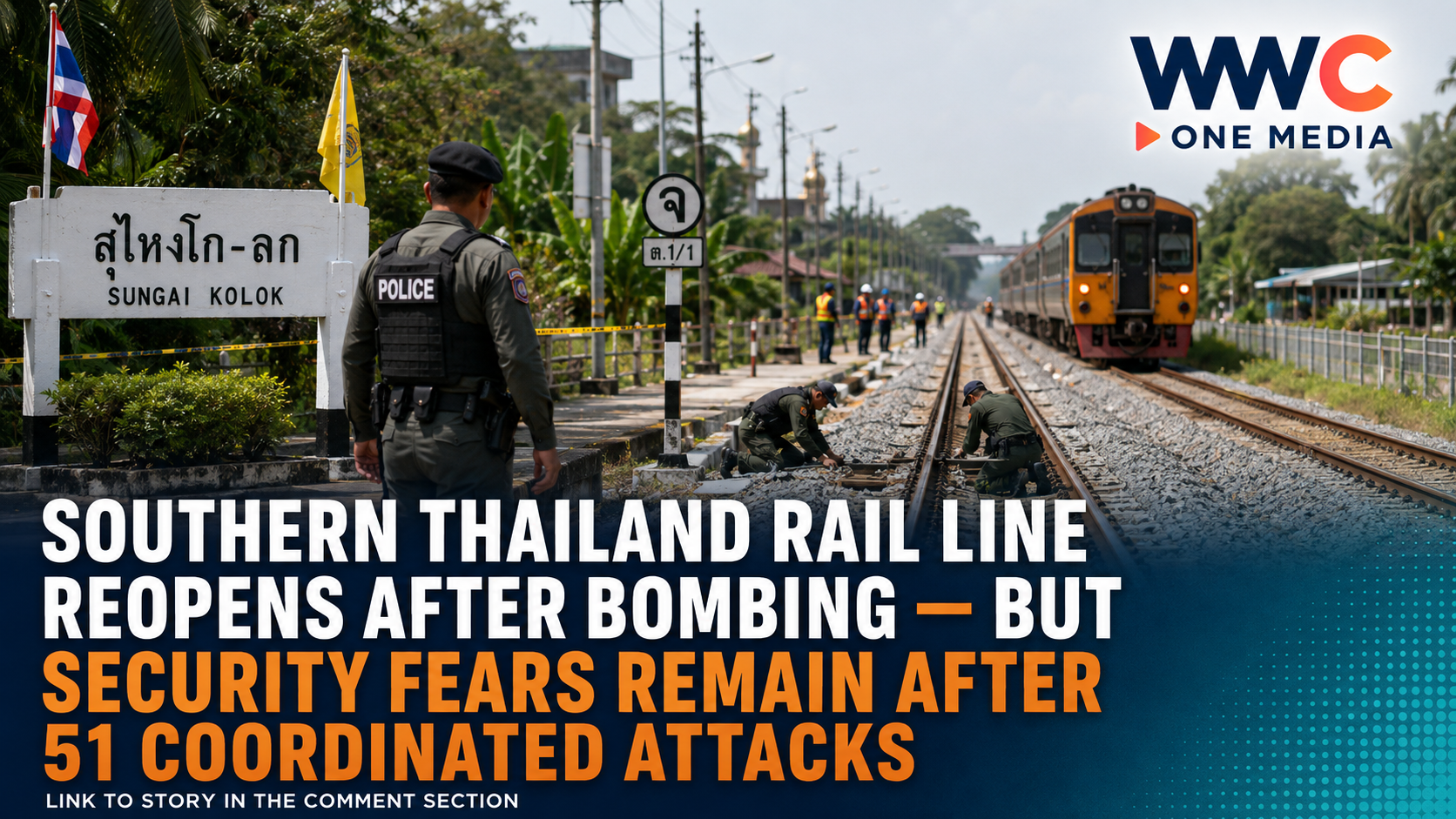
NARATHIWAT, Thailand — Train services have returned to normal on a key stretch of Thailand’s southern railway after a bomb damaged the tracks in Narathiwat province, but the reopening comes amid heightened security following a sweeping wave of coordinated attacks across the country’s troubled Deep South.
The State Railway of Thailand restored services between Maruebo and Tanyong Mat stations at 6:30 p.m. on Monday, August 24, after explosive-ordnance teams cleared the area and railway engineers completed repairs and safety inspections.
The blast damaged railway infrastructure near kilometre marker 1,090 in Maruebo Tok subdistrict of Ra-ngae district, forcing authorities to suspend services and alter several long-distance and local train routes.
Investigators said one explosive device damaged two concrete sleepers and the track itself, making the railway temporarily impassable. Security personnel later inspected the site with bomb-disposal specialists, forensic officers and sniffer dogs before repair crews were allowed to begin work.
Railway bombing was part of a much wider night of violence
The attack on the railway was not an isolated incident.
Thailand’s Internal Security Operations Command reported 51 incidents across Narathiwat, Pattani and Yala on the night of Saturday, August 22, involving bombings, arson attacks, gunfire and damage to government and civilian property.
Narathiwat recorded 22 incidents, Pattani 11 and Yala 18, according to the authorities’ midnight tally. The violence unfolded across numerous districts in what officials described as a coordinated series of disturbances.
Associated Press reported that Thai Prime Minister Anutin Charnvirakul called an urgent meeting with senior security officials following the attacks. At least three civilians were reported wounded in the wider unrest, while much of the damage involved small bombs, fires and attacks on property and infrastructure.
No organisation immediately publicly claimed responsibility for the wave of attacks.
Rail passengers faced major disruption
The railway bombing forced the State Railway of Thailand to suspend services through the affected section and modify several routes serving the far South.
Some Bangkok–Su-ngai Kolok services were forced to terminate early or return from stations such as Yala and Maruebo, while regional services were similarly adjusted until repairs could be completed.
The disruption was particularly significant because Su-ngai Kolok, near the Malaysian border, is the southernmost major railway terminus on the Thai network and an important transport link for residents of the border provinces.
Following repairs, authorities said the line met operational safety standards and could reopen.
A southern security authority also confirmed that regular service from Su-ngai Kolok was expected to resume on Tuesday, August 25, with Train 452 to Nakhon Si Thammarat among the first scheduled services. Passengers affected by the suspension on August 23 and 24 were eligible to seek ticket refunds.
Security remains elevated despite reopening
Although the railway is moving again, the broader security situation remains tense.
Thailand’s Department of Provincial Administration raised security measures to its highest response level in Pattani, Yala, Narathiwat and four districts of Songkhla following the weekend violence. Authorities were instructed to strengthen security around government offices, communities and other potentially vulnerable locations.
The incidents come against the backdrop of Thailand’s long-running southern insurgency.
Narathiwat, Pattani and Yala are predominantly Malay-Muslim provinces bordering Malaysia and have been at the centre of a separatist conflict for more than two decades.
More than 7,800 people have been killed since the insurgency intensified in 2004, according to figures cited by Reuters and Associated Press. The Barisan Revolusi Nasional, or BRN, is regarded as the most powerful separatist organisation operating in the region.
Just days before the latest attacks, Reuters reported that Bangkok was exploring a new approach to peace negotiations, including greater discussion of political grievances, decentralisation and possible governance arrangements for the southern provinces.
That timing is significant.
The railway may have been repaired within days, but the coordinated attacks have again demonstrated how militants can disrupt transportation, communications, businesses and government facilities across multiple provinces almost simultaneously.
Authorities face questions over warnings before attacks
The attacks have also triggered scrutiny of Thailand’s security preparations.
Fourth Army Area commander Lt Gen Norathip Poinok acknowledged that authorities had received intelligence warnings for nearly two months suggesting possible attacks against locations including government buildings, power infrastructure, convenience stores and commercial areas.
However, officials did not have sufficiently precise information to identify every intended target before the coordinated violence erupted.
That disclosure is likely to intensify questions about whether security agencies can prevent another large-scale operation rather than simply respond after attacks occur.
For railway passengers, the immediate crisis has eased: trains are once again travelling through the damaged section of Narathiwat.
But for southern Thailand, the bigger issue remains unresolved.
The tracks have been repaired. The security threat behind the bombing has not.