
Taiwan and Europe Push Deeper Tech Alliance as Semiconductor Supply Chains Shift

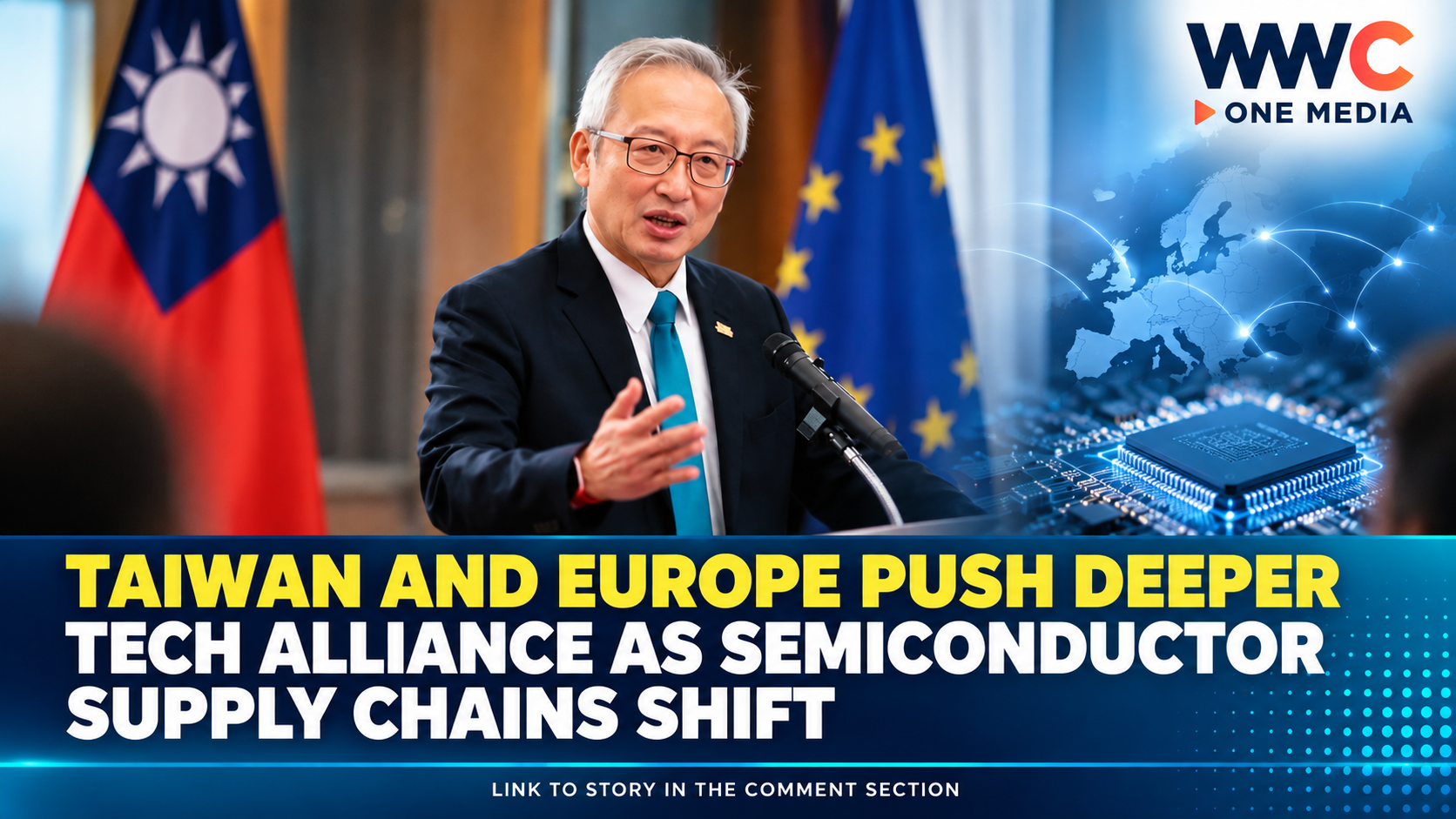
TAIPEI — Taiwan is stepping up efforts to deepen its technology and semiconductor partnership with Europe as governments on both sides look for more secure, diversified and resilient supply chains in an increasingly competitive global technology landscape.
Taiwan Deputy Foreign Minister Francois Wu called for stronger cooperation with European partners during a welcome reception for officials participating in the European Values Important Partnership (EVIP) program, emphasizing the growing links between Taiwan's technology industry and Europe.
The message comes at a pivotal moment for the global semiconductor industry, with Taiwan seeking to expand international partnerships while Europe works to strengthen its own chip ecosystem and reduce vulnerabilities in critical technology supply chains.
Taiwan sees Europe as a strategic technology partner
Wu highlighted Taiwan's long-standing relationships with the Netherlands, Germany, France and Belgium, identifying the four countries as important partners in Taiwan's industrial development.
He also pointed to the growing presence of Taiwanese companies in Europe, including major technology firms such as TSMC and Foxconn, while noting semiconductor talent exchanges between Taiwan and the United Kingdom.
The goal, according to Wu, is not simply to increase trade.
Taiwan and Europe are seeking deeper cooperation that can make their technology and industrial networks more resilient and secure while reinforcing shared democratic values.
That makes semiconductors particularly important.
Modern economies increasingly depend on advanced chips for artificial intelligence, telecommunications, automobiles, data centers, defense systems and consumer electronics. Any major disruption to the global chip supply chain could therefore have consequences far beyond the technology sector.
Europe is also looking to Taiwan
The European Union has been pursuing closer semiconductor cooperation with Taiwan.
On August 31, the European Commission and the European Economic and Trade Office in Taiwan held the second EU-Taiwan Semiconductor Industry Dialogue in Taipei alongside SEMICON Taiwan 2026.
European and Taiwanese semiconductor companies, research organizations and technology institutes discussed cooperation in semiconductors and artificial intelligence, including opportunities created by Europe's proposed Chips Act 2.0.
The discussions are significant because Europe is trying to strengthen its domestic semiconductor capabilities while Taiwan remains one of the world's most important centers for advanced chip manufacturing.
Rather than attempting to duplicate Taiwan's entire semiconductor ecosystem, European officials and companies are exploring ways to combine their own strengths in areas such as research, chip design, equipment and advanced materials with Taiwan's manufacturing, packaging and supply-chain expertise.
Taiwan wants a more resilient global chip network
Taiwan President Lai Ching-te has separately called for a strategic semiconductor partnership with Europe.
Speaking at the 2026 EU Investment Forum in Taipei, Lai said Taiwan and Europe should combine their respective strengths to create a safer, more diverse and resilient global semiconductor ecosystem.
According to Taiwan's Presidential Office, Taiwan-EU trade reached nearly US$75 billion last year, making the EU Taiwan's fifth-largest trading partner. Taiwanese investment in EU countries has also grown sharply over the past decade.
Lai has also urged progress on agreements covering double taxation and investment protection, arguing that such arrangements could encourage additional investment and industrial cooperation between Taiwan and Europe.
That would potentially give companies greater certainty when expanding operations across borders.
TSMC's European expansion gives the partnership real weight
The Taiwan-Europe relationship is not merely diplomatic.
Taiwan's semiconductor industry is already expanding its physical presence in Europe.
Reuters reported that TSMC is investing €3.5 billion in a semiconductor facility in Germany, illustrating how Taiwan's chip industry is becoming increasingly integrated with European manufacturing ambitions.
The expansion comes as governments and companies around the world attempt to reduce the risks associated with highly concentrated semiconductor supply chains.
TSMC remains the world's leading contract chip manufacturer, making Taiwan a critical component of the global technology ecosystem.
At the same time, Taiwan's companies are expanding in other major markets. Reuters reported this week that Taiwanese companies plan an additional US$20 billion in investment in the United States, driven largely by demand for artificial intelligence technologies.
The pattern is becoming increasingly clear: Taiwan's technology industry is expanding its international footprint while governments seek to make critical supply chains more geographically diverse.
AI is pushing the partnership beyond traditional semiconductors
The latest Taiwan-Europe discussions are not limited to conventional chip manufacturing.
Delegation leader Stefan Gara said European and Taiwanese strengths could be combined across semiconductors, artificial intelligence and drones, with Taiwan's industrial ecosystems complementing Europe's research capabilities.
That broader agenda reflects how quickly AI is changing the technology industry.
Advanced AI systems require enormous computing power, which in turn depends on sophisticated semiconductors, advanced packaging, high-bandwidth communications and massive data-center infrastructure.
The European Commission's semiconductor dialogue specifically examined Taiwan's potential role in helping develop Europe's AI ecosystem, including cooperation in chip design, foundry services, packaging and system integration.
France offers a glimpse of the emerging model
Recent reporting from Focus Taiwan illustrates how this relationship is already developing at the company and research level.
French semiconductor startup SiPearl, for example, has developed processors in France while using TSMC's manufacturing capabilities in Taiwan.
The model demonstrates a potentially important future for Taiwan-Europe technology cooperation: research, design, manufacturing and applications can be distributed among trusted partners rather than concentrated entirely within one country.
France is not alone.
At SEMICON Taiwan 2026, European countries including France, the United Kingdom, the Netherlands, Sweden and Finland showcased their semiconductor capabilities.
The Netherlands alone brought 19 companies and organizations representing areas ranging from AI and chip design to advanced packaging, semiconductor equipment and precision engineering.
A partnership that is getting more practical
The growing relationship is also moving beyond conferences and diplomatic statements.
Taiwan and European institutions are preparing additional technology and innovation exchanges.
The Taiwan-Europe Chip Innovation Forum, for example, is scheduled to bring together government, industry, research and university leaders in Antwerp, Belgium, to discuss cooperation spanning semiconductor strategy, research, manufacturing, applications and talent.
Taiwan is also preparing a technology matchmaking event with Belgian companies and research organizations covering AI, deep technology, smart manufacturing, semiconductors and advanced materials.
Meanwhile, the current EVIP delegation includes officials from Austria, the Czech Republic, France, Lithuania, the Netherlands, Poland, Romania and the United Kingdom, showing that the Taiwan-Europe dialogue extends well beyond a handful of traditional partners.
Why this matters for the global chip race
The significance of Taiwan's latest outreach goes beyond Taipei and Brussels.
The semiconductor industry has become deeply intertwined with economic security and geopolitical strategy.
The United States, Europe, Japan, South Korea and China are all seeking greater control or resilience across portions of the semiconductor value chain.
Taiwan, meanwhile, remains indispensable because of its manufacturing expertise and highly integrated technology ecosystem.
The emerging Taiwan-Europe model therefore offers a different approach: instead of every side trying to build an entirely independent semiconductor industry, trusted partners can specialize in different parts of the chain while reducing the risks of excessive dependence on any single location.
That is particularly important as AI accelerates demand for advanced chips and data-center capacity. The European Commission says the rise of AI and Europe's growing demand for data-center infrastructure are already reshaping EU-Taiwan industrial cooperation.
The bigger question is what comes next
Taiwan's latest push toward Europe is still developing.
There is no indication that a comprehensive Taiwan-EU political or economic alliance has suddenly been created.
Instead, what is emerging is a growing network of investment, semiconductor cooperation, research exchanges, technology partnerships and supply-chain initiatives.
For Taiwan, the strategy could provide greater international integration and additional markets for its technology companies.
For Europe, closer ties with Taiwan could provide access to one of the world's most sophisticated semiconductor ecosystems while strengthening the continent's ability to build a more resilient technology supply chain.
And for the global technology industry, the stakes are enormous.
As AI demand continues to surge, the countries and companies capable of securing reliable access to advanced chips will have a major advantage.
Taiwan and Europe appear determined to make sure they are on the same side of that equation.
The partnership is no longer just about buying and selling chips. It is increasingly about deciding who builds, protects and controls the technology infrastructure of the AI era.